

AI Summary
Local search behavior has shifted toward zero click map pack results, implicit local intent, and research that happens inside the Google Business Profile. Winning local now means owning the profile and the local pack, not only the classic organic listing.
- The local 3 pack and Business Profile answer many queries with no website click.
- Near me intent is often implicit: the engine infers location from the query.
- Reviews, categories, hours and photos inside the profile drive most conversions.
- Mobile and voice push more discovery into Maps and spoken local answers.
Understanding Local SEO
Local SEO represents a significant aspect of SEO strategy that practitioners need to understand thoroughly. As search algorithms evolve and user behavior changes, staying current with best practices in this area becomes increasingly important. This guide provides comprehensive coverage of the key concepts and actionable recommendations.
Strategic Importance
The role of local seo in overall SEO success cannot be understated. It influences multiple ranking factors and affects user experience. Sites that excel in this area typically see better organic performance across key metrics. Understanding the strategic implications helps prioritize efforts and allocate resources effectively.
Implementation Approach
Effective implementation requires a systematic approach. Begin with thorough assessment of your current state. Identify gaps and opportunities through analysis. Develop an action plan with clear priorities. Execute methodically while monitoring for issues. Iterate based on results and industry changes.
Best Practices
Industry best practices have evolved through collective experience and testing. Following established guidelines helps avoid common pitfalls and accelerates results. However, best practices should be adapted to your specific situation rather than applied blindly. Test and measure to confirm what works for your site.
Future Considerations
The landscape continues to evolve with new technologies and algorithm updates. Stay informed about developments that may affect your strategy. Build flexibility into your approach to accommodate changes. Focus on fundamentals that provide long-term value rather than short-term tactics that may become obsolete.
Where local discovery happens now
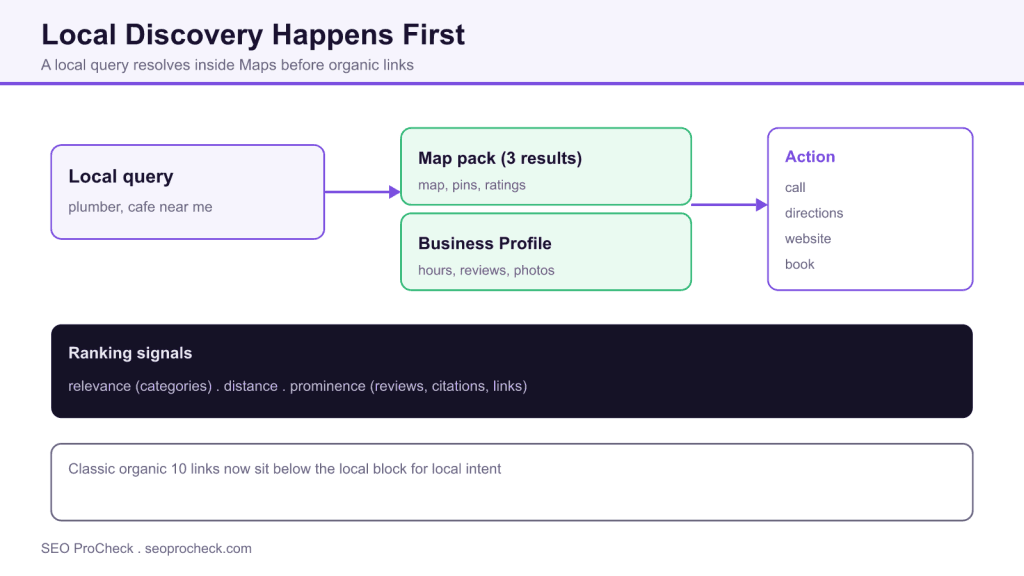
For queries with local intent the Business Profile, Maps and the local 3 pack appear above the traditional organic listings. Many searches end inside that block: a call, a direction request or a booking, with no click to the website at all. Treat the profile as a primary landing surface, not an afterthought.
| Query type | Where the answer appears | What to optimize |
|---|---|---|
| cafe near me | Map pack plus Business Profile | Primary category, hours, photos |
| is store x open now | Profile knowledge panel | Regular and special hours |
| best dentist in city | Local pack ranked by prominence | Reviews volume, rating, citations |
| service in city | Local pack plus local landing page | LocalBusiness schema, localized content |
Signals that move the local pack
Google weighs three broad factors: relevance, distance and prominence. Relevance comes from an accurate primary category, a truthful business name and on page content that matches the service. Distance is proximity to the searcher, which you cannot change but can influence with correctly set service areas. Prominence comes from review volume and velocity, average rating, consistent citations (name, address, phone) across directories, and links. Set one precise primary category and add secondary categories only where they genuinely apply.
A local optimization checklist
Work through this list per location:
- Claim and verify the Business Profile.
- Set an exact primary category and complete regular plus special hours.
- Upload real, geotagged photos and keep them current.
- Run an always on review generation and response process.
- Keep name, address and phone identical across every citation.
- Build a localized landing page with an embedded map and LocalBusiness structured data.
Tracking local performance
Use the Business Profile performance view for calls, direction requests, and the split between discovery and direct searches. Layer in local pack rank tracking on a geo grid so you see rankings as they vary by neighborhood, and monitor the review rating trend. Together these show whether behavior changes are helping or hurting your visibility.
Frequently asked questions
What is the map pack?
The map pack, or local 3 pack, is the block of three business listings shown with a map for queries with local intent. It appears above the organic results and often satisfies the search without a website click.
Do I still need a website for local SEO?
Yes. The Business Profile drives discovery, but a fast localized website with LocalBusiness schema supports relevance, hosts conversion content, and backs up the profile with citations and links.
How important are reviews for local ranking?
Reviews are a major prominence signal. Volume, recency, average rating and your responses all contribute, and they strongly influence whether a searcher chooses you from the pack.
What does near me actually target?
Near me is a signal of local intent rather than a keyword to place on the page. Google resolves it using the searcher location, so the priority is accurate location data and service areas, not the literal phrase.
Why must my NAP be consistent?
Inconsistent name, address or phone across directories creates conflicting signals that weaken prominence and can confuse both engines and customers. Consistent citations reinforce trust.
How do I measure local visibility?
Combine Business Profile performance metrics, geo grid local rank tracking, and review trends. These reveal both raw visibility and the actions searchers take from your listing.
Related reading: LocalBusiness schema returns, voice search, and indexation controls.
Take this with you
The assistant links open with a question about this page already written. Nothing is sent until you press enter.
Claude Vincent is a technical SEO consultant focused on crawlability, rendering, and AI-search visibility. He writes the field guides and case studies at SEO ProCheck, with a bias toward the durable, unglamorous work that decides whether search engines and AI answer engines can actually read and cite a site.
About SEO ProCheck
Technical SEO consulting and GEO strategy with 20 years of enterprise experience. Case studies, resources, and tools for search and AI visibility.
Work With Me
Technical SEO audits, GEO strategy, site migrations, and international SEO. Hourly consulting for teams who need hands-on support, not just reports.
Subscribe to our newsletter!







Recent Posts
- Finding a Competitor's Sitemap, and Turning It Into a Change Log September 15, 2026
- AI Crawler User Agents: The Current Names, and Which Ones Sites Actually Block September 9, 2026
- Can AI Crawlers Actually Read Your Site? I Measured 400 of the Biggest September 5, 2026