AI Summary
Nonprofit SEO means ranking for three very different audiences, donors, volunteers, and the people your organization serves, each of whom searches with different intent and needs a different landing page. Nonprofits also have advantages no business gets, including the Google Ad Grant of up to 10,000 USD per month in free Search ads, Nonprofit schema, and Google for Nonprofits.
- Map content to three audiences: donors, volunteers, and service seekers, with a dedicated page for each intent.
- Apply for the Google Ad Grant, up to 10,000 USD per month in free Search ads, to complement organic SEO.
- Add Nonprofit schema (NGO or NonprofitType) with nonprofitStatus to clarify your entity.
- Win donor trust with transparency pages: financials, impact, and clear registration details.
Nonprofits run SEO on tight budgets, yet they have advantages a commercial site can only envy: free advertising through the Google Ad Grant, a mission that naturally earns links, and audiences actively searching to help. The catch is that a nonprofit serves several audiences at once, and treating them as one blurs the whole site. This guide starts with that audience split, then works through the nonprofit specific tools and the local and content fundamentals that turn a mission into rankings.
The local pieces below build on general local SEO. If your organization operates from a physical location or serves a defined area, pair this with our complete local SEO guide and the local ranking factors before layering on the nonprofit tactics.
Rank for three audiences, not one
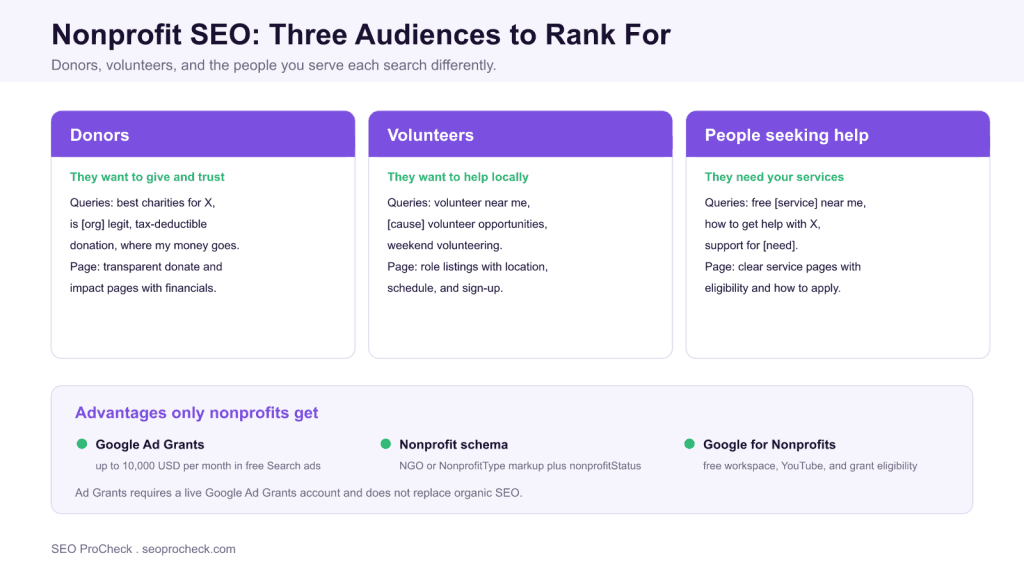
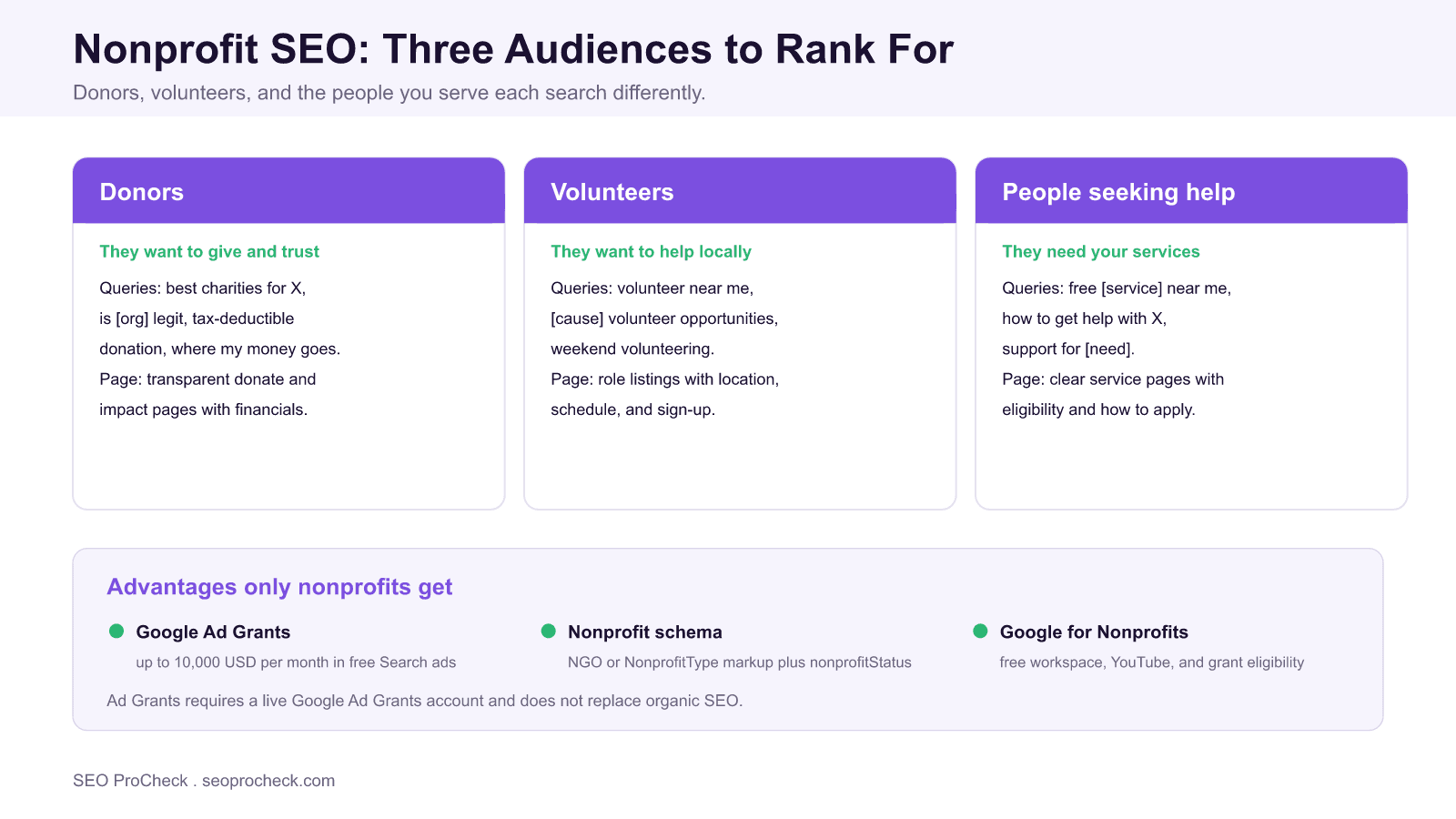
The single biggest strategic decision in nonprofit SEO is recognizing that your visitors arrive with three very different goals. Each needs its own keywords, its own page, and its own call to action:
- Donors search to give and to verify trust: "best charities for [cause]," "is [org] legitimate," "tax-deductible donation." They land best on transparent donate and impact pages that show where the money goes.
- Volunteers search to help locally: "volunteer near me," "[cause] volunteer opportunities." They need role listings with location, schedule, and a simple sign-up.
- People seeking help search for your services: "free [service] near me," "how to get help with [need]." They need clear, reassuring service pages with eligibility and how to apply.
A common failure is a homepage and a donate button, and nothing built for volunteers or service seekers. Build a real page for each intent and the site starts ranking for all three audiences instead of competing with itself.
| Audience | Example query | Target page | Primary goal |
|---|---|---|---|
| Donors | is [org] a legitimate charity | Transparency and impact page | Donation |
| Volunteers | volunteer opportunities near me | Volunteer roles page | Sign-up |
| Service seekers | free food assistance near me | Service and eligibility page | Contact or apply |
| Researchers and press | [cause] statistics and reports | Data and research content | Links and authority |
Claim the Google Ad Grant
Registered nonprofits can qualify for the Google Ad Grant, up to 10,000 USD per month in free Search advertising. It is one of the largest advantages in the sector, but it comes with rules: a live Google for Nonprofits account, a functioning website, ads that maintain a minimum click-through rate, and account structure requirements. Ad Grants and SEO work together rather than as substitutes. Paid ads capture demand today while your organic rankings build; and the keyword data from Ad Grants campaigns tells you exactly which queries to target with content. Do not treat the grant as a reason to skip SEO, because grant ads stop the moment the account lapses, while organic rankings compound.
Add Nonprofit schema
Structured data helps search engines and AI systems classify your organization correctly. Use Organization markup with the NGO type, or the newer NonprofitType and nonprofitStatus properties, to state clearly that you are a nonprofit, along with your legal name, registration or tax identifier where appropriate, logo, and contact details. If you operate from a physical location, layer LocalBusiness style properties on top. Our LocalBusiness schema guide covers the address, geo, and hours properties that apply to nonprofits with a public location.
Build local presence and a Google Business Profile
Most nonprofits serve a specific community, which makes local SEO central. Claim and optimize a Google Business Profile with the correct nonprofit category, real photos, hours, and posts. Encourage reviews from volunteers and the people you have helped, since reviews build the trust that both donors and service seekers look for. Keep your name, address, and phone consistent across every directory and citation.
Earn trust and authority through content
Donor decisions and many service topics are trust sensitive, so E-E-A-T matters. Publish transparent financials, real impact stories, named leadership with credentials, and clear registration details. Cause related content, original data, community guides, and impact reports, naturally attracts links from local press, partner organizations, and universities, which is exactly the authority smaller sites struggle to build otherwise. Our guide to E-E-A-T signals for small sites shows how to establish trust without a big brand budget, and for more tactics see our nonprofit organization SEO tips.
Key takeaways
Nonprofit SEO succeeds when you build for three audiences instead of one: donors, volunteers, and the people you serve, each with a dedicated page and call to action. Layer on the sector's unique advantages, the Google Ad Grant, Nonprofit schema, and a strong local presence, and back it all with transparent, trust building content that earns links. Done together, these turn a limited budget into durable visibility across every group your mission depends on.
It is a program that gives eligible registered nonprofits up to 10,000 USD per month in free Google Search advertising. It requires a Google for Nonprofits account and following account rules such as a minimum click-through rate. It complements SEO rather than replacing it, since ads stop if the account lapses while organic rankings persist.
Because they search with different intent. Donors want proof of trust and impact, volunteers want local opportunities, and service seekers want help. A single generic page ranks for none of them well, while a dedicated page for each intent captures its own keywords and conversions.
Use Organization markup with the NGO type, or the NonprofitType and nonprofitStatus properties, plus your legal name, logo, and contact details. If you have a public physical location, add LocalBusiness style properties for address, geo, and opening hours.
Yes. The Ad Grant captures demand today, but the ads disappear if the account is suspended or the program changes. Organic rankings keep working around the clock, cost nothing per click, and often earn more trust than an ad label. Use both together.
Publish original cause data, impact reports, and community guides that local press, partner organizations, and universities want to cite. Transparent financials, named leadership, and real impact stories build the E-E-A-T that donors and search engines both reward, without a large brand budget.
For most, yes. Nonprofits usually serve a defined community, so a claimed and optimized Google Business Profile, consistent citations, and reviews from volunteers and beneficiaries drive both the map pack visibility and the trust that donors and service seekers rely on.
Is your nonprofit ranking for all three of its audiences?
Most nonprofit sites serve donors and forget volunteers and service seekers entirely. An audit finds the missing pages and the untapped Ad Grant keywords.
Claude Vincent is a technical SEO consultant focused on crawlability, rendering, and AI-search visibility. He writes the field guides and case studies at SEO ProCheck, with a bias toward the durable, unglamorous work that decides whether search engines and AI answer engines can actually read and cite a site.
About SEO ProCheck
Technical SEO consulting and GEO strategy with 20 years of enterprise experience. Case studies, resources, and tools for search and AI visibility.
Work With Me
Technical SEO audits, GEO strategy, site migrations, and international SEO. Hourly consulting for teams who need hands-on support, not just reports.
Subscribe to our newsletter!