

Does adding a list of offered amenities to store location pages improve SEO?
- February 23, 2023
- Content
AI Summary
Adding a clear, crawlable list of offered amenities to store location pages tends to help SEO because it turns near duplicate template pages into pages with unique, useful content and structured data. The lift is strongest when the amenities are specific to each location and marked up with LocalBusiness schema rather than buried in an image or a generic paragraph.
- Amenity lists add unique on-page text that differentiates otherwise templated location pages.
- They map directly to real searcher questions like parking, EV charging or wheelchair access.
- Marking amenities up with LocalBusiness and amenityFeature reinforces the signal for search and assistants.
- Validate the change with an A/B split test across your location page template.
Multi location brands often publish one store or branch page per location from a single template. That is efficient, but it produces pages that are almost identical apart from a name, address and map. This case study asks whether adding a genuine list of the amenities each location offers can move those thin pages up the results and capture more organic and local traffic.
Why amenities are more than decoration
People search for amenities constantly: "supermarket with parking near me", "pharmacy open late", "cafe with wifi", "store with wheelchair access", "gym with a pool". When a location page states plainly which amenities it offers, it becomes eligible for a much wider set of long-tail queries than a page that only lists an address and opening hours. Just as importantly, the amenity list is content that legitimately differs from location to location, which breaks the near duplicate pattern that holds templated pages back.
The change that was tested
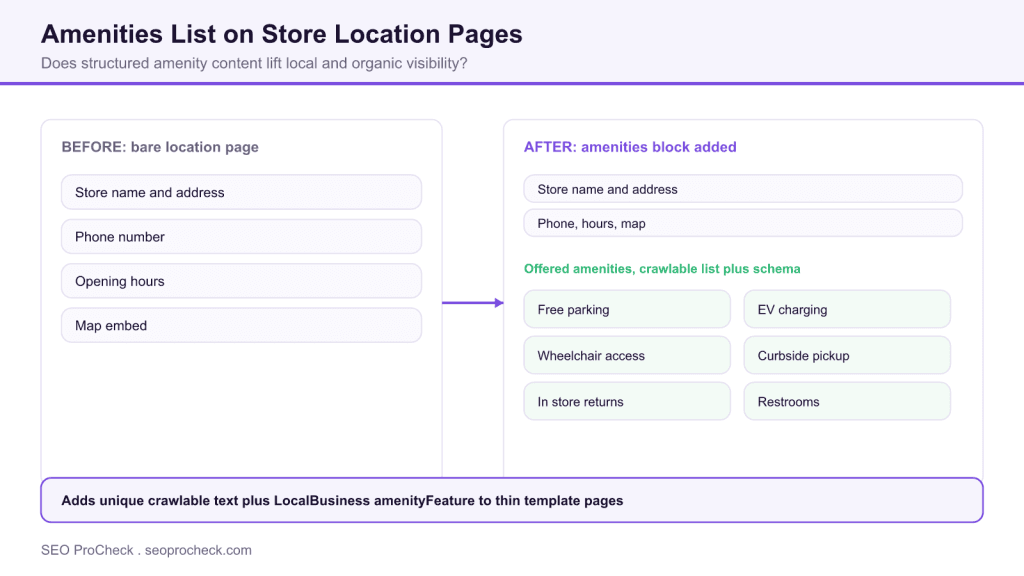
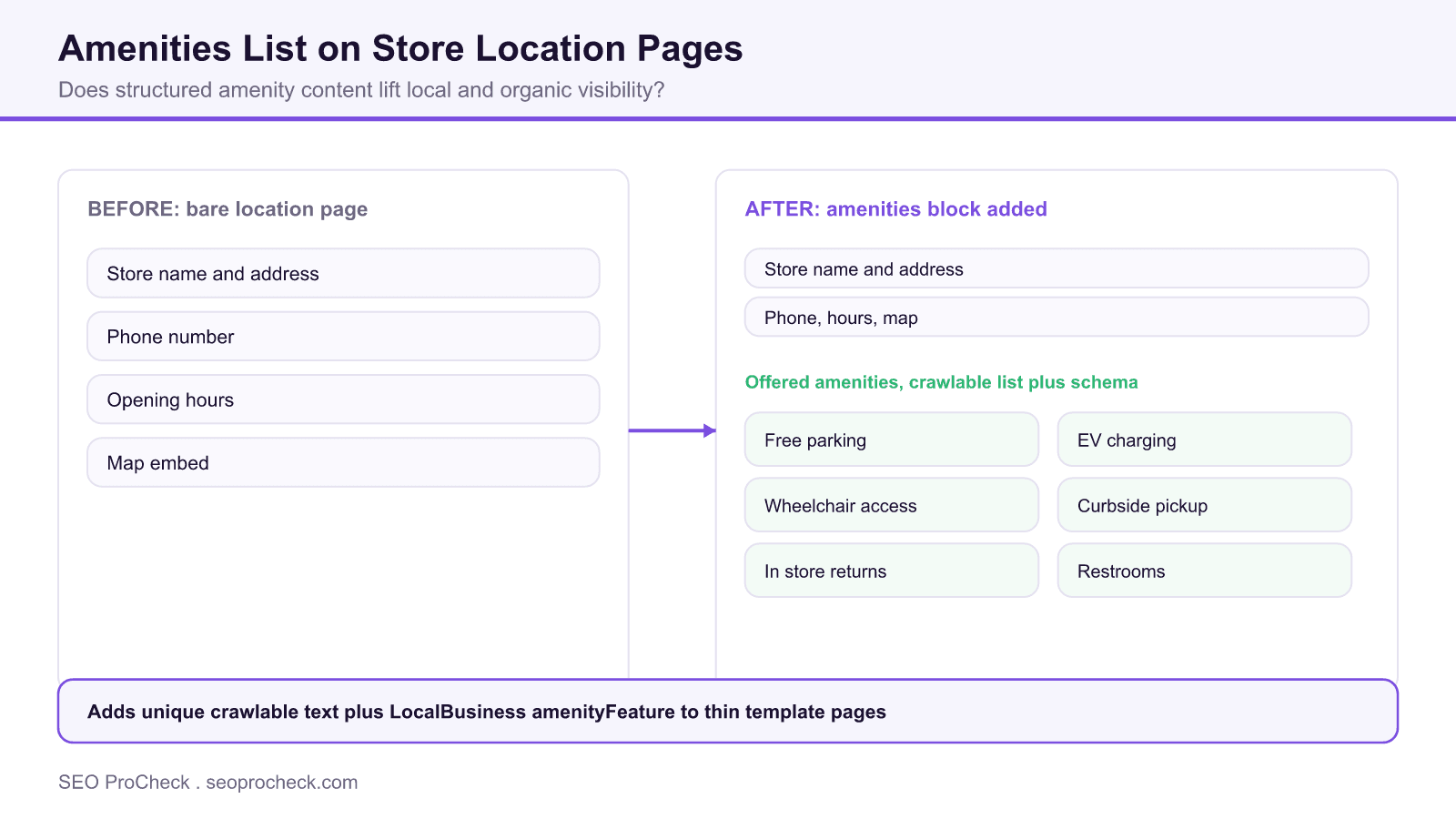
The variant adds a structured amenities block to the store location page: a labelled, crawlable list of the facilities and services available at that specific branch. In the before and after diagram above, the control page carries only name, address, hours and a map, while the variant adds an amenities section covering things like free parking, EV charging, wheelchair access, curbside pickup, in store returns and restrooms. The block is real text in the HTML, not an image, so search engines can read every item.
Mark it up, do not just print it
Plain text amenities help, but structured data compounds the benefit. Use LocalBusiness schema for each location and express facilities with properties such as amenityFeature (a LocationFeatureSpecification), publicAccess, paymentAccepted and openingHoursSpecification where relevant. For example, an amenityFeature entry can name "Wheelchair accessible" with a boolean value, and a separate entry can name "EV charging". This gives search engines and AI assistants a machine readable statement of what each branch offers, which supports rich results and answer style surfaces. Keep the structured data in sync with the visible list so the two never contradict each other.
Keep it accurate and specific per location
The fastest way to waste this tactic is to paste the same amenity list onto every page. That recreates the duplication problem you were trying to solve and, worse, states facilities that a given branch may not have. Pull amenity data from a source of truth, a store attributes feed or your location management system, so each page reflects reality. Accuracy also protects trust: a shopper who drives to a store expecting EV charging that does not exist will not forgive the page, and inconsistent data undermines your local presence across Google Business Profile and the site itself.
What has changed since this test
Structured amenity signals have become more important, not less. Google Business Profile now surfaces a rich set of attributes, and keeping those attributes consistent with the amenities stated on your own location pages strengthens the overall local entity. Answer engines and AI overviews increasingly assemble responses from explicit, structured facts, so a page that clearly declares "this branch has parking and step free access" is easier to cite than one that leaves it implied. The practical takeaway is unchanged: add real, specific, marked up amenities to each location page and measure the result.
Amenity data: visible text and structured markup
| Amenity | Query it can win | Schema property |
|---|---|---|
| Free parking | store with parking near me | amenityFeature (LocationFeatureSpecification) |
| EV charging | shops with EV charger nearby | amenityFeature, boolean value true |
| Wheelchair access | wheelchair accessible store | amenityFeature or isAccessibleForFree |
| Curbside pickup | curbside pickup near me | hasOfferCatalog or amenityFeature |
| Late opening hours | pharmacy open late | openingHoursSpecification |
Related reading on SEO ProCheck: local SEO fundamentals, local SEO case studies, on-page SEO techniques.
Frequently asked questions
Does adding amenities to store location pages really improve SEO?
In most cases yes, because it adds unique, query relevant text to pages that were near duplicates and it can be reinforced with structured data. The size of the lift depends on how specific and accurate the amenity data is, so confirm it with a split test.
Should amenities be plain text or schema?
Both. Show a readable list for users and mark it up with LocalBusiness amenityFeature for machines. The visible text and the structured data should always match so search engines see a consistent statement.
Which schema property describes an amenity?
Use amenityFeature with a LocationFeatureSpecification for most facilities, setting a name and a boolean value. Supporting properties like openingHoursSpecification, paymentAccepted and publicAccess cover related attributes.
Can I reuse the same amenity list on every location page?
Avoid it. Identical lists recreate the duplication problem and risk stating facilities a branch does not have. Populate each page from a store attributes feed so it reflects that specific location.
Do amenities help local pack rankings or just organic?
Both can benefit. Accurate amenities on the page reinforce the local entity, and keeping them consistent with your Google Business Profile attributes supports local visibility as well as classic organic results.
How do I measure the impact?
Run an A/B split test across the location page template, applying the amenities block to the variant group only, and compare organic entrances. Watch Search Console for new long-tail amenity queries appearing for those URLs.
Source: https://www.searchpilot.com/resources/case-studies/adding-amenities-to-store-location-pages/
Take this with you
The assistant links open with a question about this page already written. Nothing is sent until you press enter.
Claude Vincent is a technical SEO consultant focused on crawlability, rendering, and AI-search visibility. He writes the field guides and case studies at SEO ProCheck, with a bias toward the durable, unglamorous work that decides whether search engines and AI answer engines can actually read and cite a site.
About SEO ProCheck
Technical SEO consulting and GEO strategy with 20 years of enterprise experience. Case studies, resources, and tools for search and AI visibility.
Work With Me
Technical SEO audits, GEO strategy, site migrations, and international SEO. Hourly consulting for teams who need hands-on support, not just reports.
Subscribe to our newsletter!








Recent Posts
- Most Top Sites Never Say Who They Are in Structured Data October 14, 2026
- Homepage Titles Are Mostly Too Short, Not Too Long October 8, 2026
- Who Actually Serves an llms.txt? 184 Top Sites Measured September 29, 2026