

Does Changing Introductory Text and H1 Improve Click-Through Rate and Conversions?
- December 8, 2022
- Content
AI Summary
Rewriting introductory text and the H1 can improve click-through rate and conversions because clearer, benefit-led copy sets expectations, answers the query faster and guides the next action. Because copy changes affect both how the page ranks and how users behave once they arrive, an A/B split test is the right way to isolate the true effect.
- The H1 and opening lines are the first thing both users and search engines evaluate on the page.
- Specific, benefit-led copy tends to lift CTR from search and on-page conversion together.
- Generic boilerplate that repeats the title adds no value and gives no reason to keep reading.
- Isolate the impact with a controlled split test on the page template.
The H1 and the first paragraph do a disproportionate amount of work. They are the first thing a visitor reads after clicking, the copy search engines weigh most heavily for relevance, and often the text that shapes the snippet a searcher sees. This case study asks a focused question: if you rewrite the introductory text and the H1 from generic boilerplate into specific, benefit led copy, does click through rate and conversion rate improve?
Why the opening copy carries so much weight
A generic H1 that simply restates the category name, followed by an intro that repeats the title with no added context, gives the reader no reason to stay and gives search engines little to differentiate the page. A rewritten opening does three jobs at once. It confirms the visitor is in the right place by answering the query directly, it frames the scope of the page so expectations match reality, and it points to the next action, whether that is reading on, filtering, or converting. When the opening copy does those jobs well, both search click through and on-page conversion tend to move in the same direction.
The change that was tested
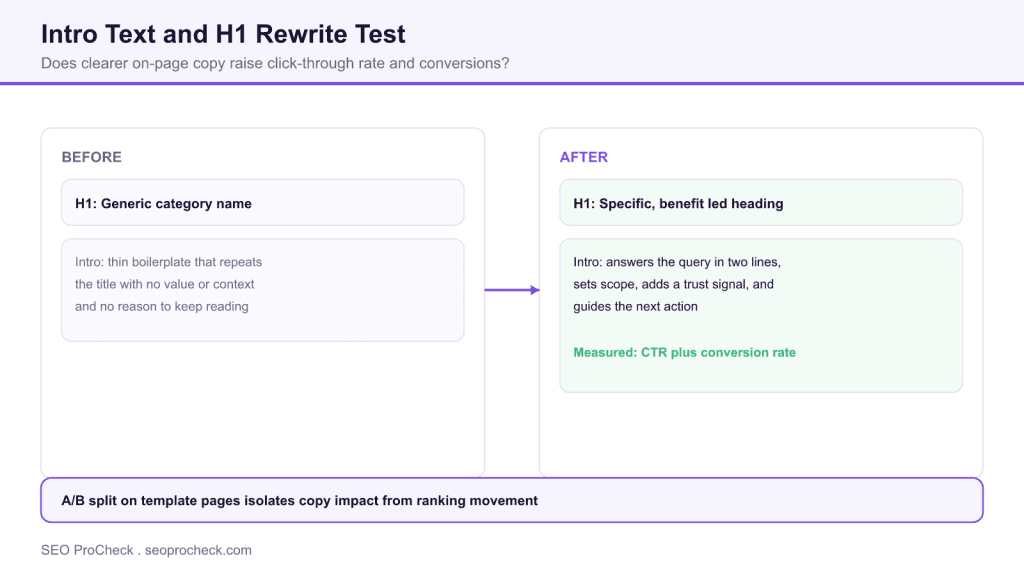
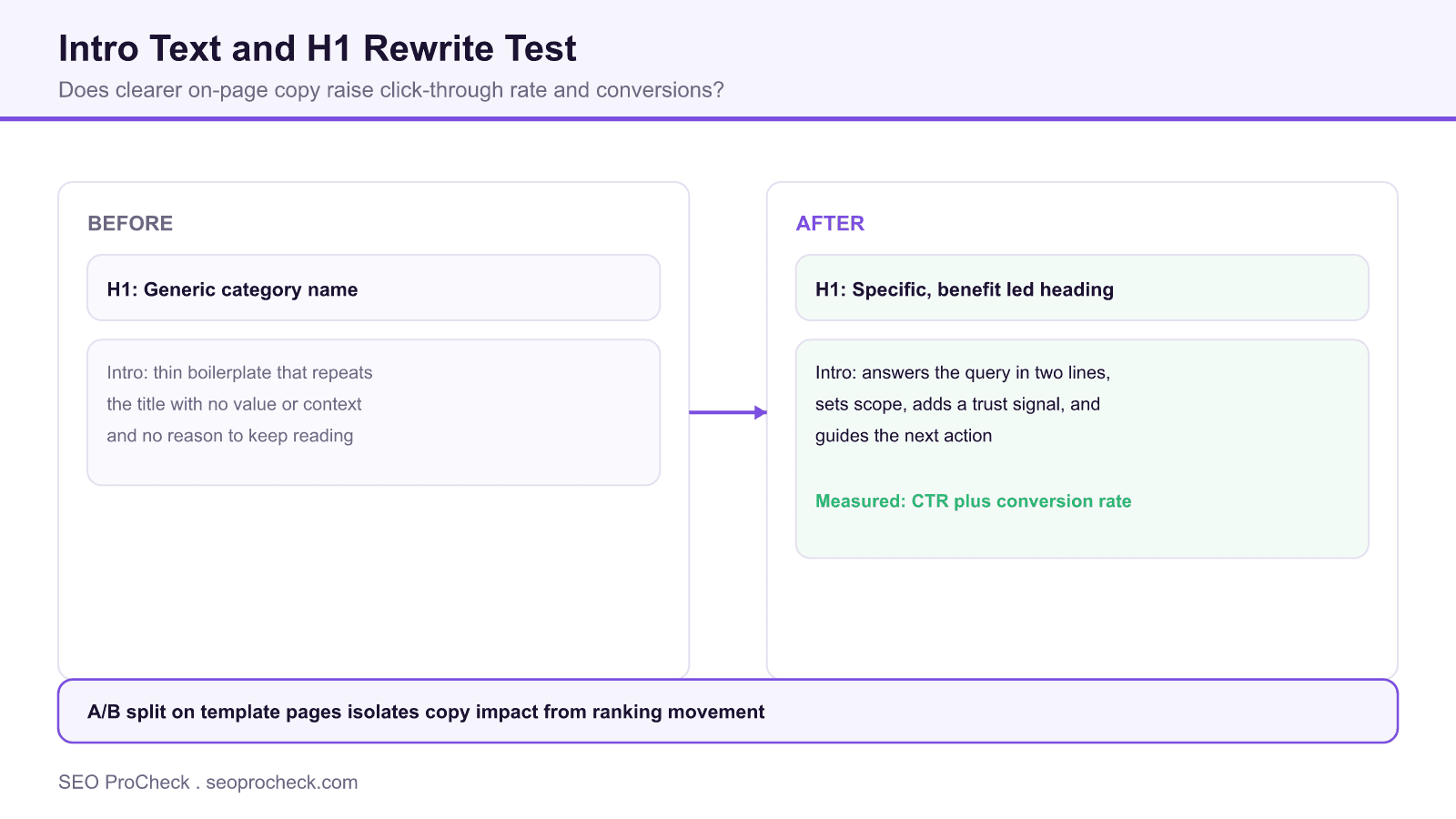
The variant replaces a generic H1 and a thin, self referential intro with a specific, benefit led heading and an intro that answers the query in the first two lines, sets scope and adds a trust signal before guiding the next step. In the before and after diagram above, the control is boilerplate that repeats the title, while the variant is purposeful copy written for the searcher. The metrics under test are click through rate from search results and conversion rate on the page.
How to write the rewritten opening
Lead with the answer. The first sentence should state, in plain language, what the page delivers and for whom. Make the H1 specific and benefit oriented rather than a bare label, while keeping it honest and aligned with the title tag so the snippet stays coherent. In the intro, add a concrete detail or a trust signal, a number, a credential, a guarantee, that a competitor page is unlikely to match, then finish by pointing to the next action. Keep it tight: two or three sentences that respect the reader beats a long preamble. Avoid keyword stuffing; write for the person and let relevance follow.
Isolate the effect with a test
Copy changes are tempting to judge by feel, but feel is unreliable. Because the same edit can influence both ranking and behavior, run a controlled A/B split test on the template so you can separate a genuine lift from normal fluctuation. Measure click through rate using Search Console for the affected URLs and conversion rate through your analytics, and read them together. A change that raises CTR but hurts conversion, or vice versa, is telling you something important about expectation matching between the snippet and the page.
What has changed since this test
Clear, answer first opening copy has become even more valuable. AI overviews and featured snippets reward pages that state the answer plainly near the top, and a benefit led H1 with a direct intro is exactly the shape those surfaces prefer to quote. Meanwhile Google continues to rewrite titles and snippets when it judges the on-page copy unhelpful, so writing a strong, honest H1 and intro increases the odds that the snippet users see is the one you intended.
Generic opening versus rewritten opening
| Element | Generic version | Rewritten version |
|---|---|---|
| H1 | Bare category label | Specific, benefit-led heading |
| First sentence | Repeats the title | Answers the query directly |
| Scope | Unclear | Stated up front |
| Trust signal | None | Number, credential or guarantee |
| Next action | Absent | Clearly pointed to |
| Metrics affected | Little movement | CTR and conversion rate |
Related reading on SEO ProCheck: on-page SEO techniques, content SEO strategy, content case studies.
Frequently asked questions
Does changing the H1 and intro really affect click-through rate?
It can, because the H1 and opening lines influence the snippet a searcher sees and how relevant the page looks. Clearer, benefit led copy tends to lift click through, though the size of the effect varies by page and should be tested.
Should the H1 match the title tag?
They should be aligned and consistent, but not necessarily identical. Keeping the H1 honest and in step with the title tag helps the snippet stay coherent, which supports both click through and trust.
What makes an intro convert better?
An intro that answers the query in the first line, sets the scope of the page, adds a concrete trust signal and points to the next action. Respecting the reader with tight, specific copy beats a long generic preamble.
How do I separate a CTR lift from a ranking change?
Run a controlled A/B split test on the template so the copy change is isolated. Read click through rate in Search Console and conversion rate in analytics together to understand the full effect.
Can better copy help with AI overviews and snippets?
Yes. Answer engines and featured snippets favor pages that state the answer plainly near the top, so a benefit led H1 and a direct intro make the page easier to quote.
What if CTR rises but conversions fall?
That usually means the snippet is promising something the page does not deliver. Realign the opening copy with what the page actually offers so expectation matches experience.
Source: https://www.searchpilot.com/resources/case-studies/changing-introductory-text-and-h1/
Take this with you
The assistant links open with a question about this page already written. Nothing is sent until you press enter.
Claude Vincent is a technical SEO consultant focused on crawlability, rendering, and AI-search visibility. He writes the field guides and case studies at SEO ProCheck, with a bias toward the durable, unglamorous work that decides whether search engines and AI answer engines can actually read and cite a site.
About SEO ProCheck
Technical SEO consulting and GEO strategy with 20 years of enterprise experience. Case studies, resources, and tools for search and AI visibility.
Work With Me
Technical SEO audits, GEO strategy, site migrations, and international SEO. Hourly consulting for teams who need hands-on support, not just reports.
Subscribe to our newsletter!








Recent Posts
- Most Top Sites Never Say Who They Are in Structured Data October 14, 2026
- Homepage Titles Are Mostly Too Short, Not Too Long October 8, 2026
- Who Actually Serves an llms.txt? 184 Top Sites Measured September 29, 2026