


AI Summary
A travel company ran 16 SEO split tests across six international domains, replacing unique hand written landing page content with generic default content, and the result was overwhelmingly undramatic: 12 of the 16 tests were inconclusive, and of the four that reached significance, three were positive and one was negative. On those particular pages, the unique content was not measurably earning its cost.
- The test inverted the usual question by removing unique content rather than adding it.
- 12 of 16 tests were inconclusive, meaning no detectable traffic effect either way.
- Of the four conclusive results, three favoured the generic default content and one favoured the unique content.
- No uplift percentages or confidence levels were published, so treat any precise figure you see quoted with suspicion.
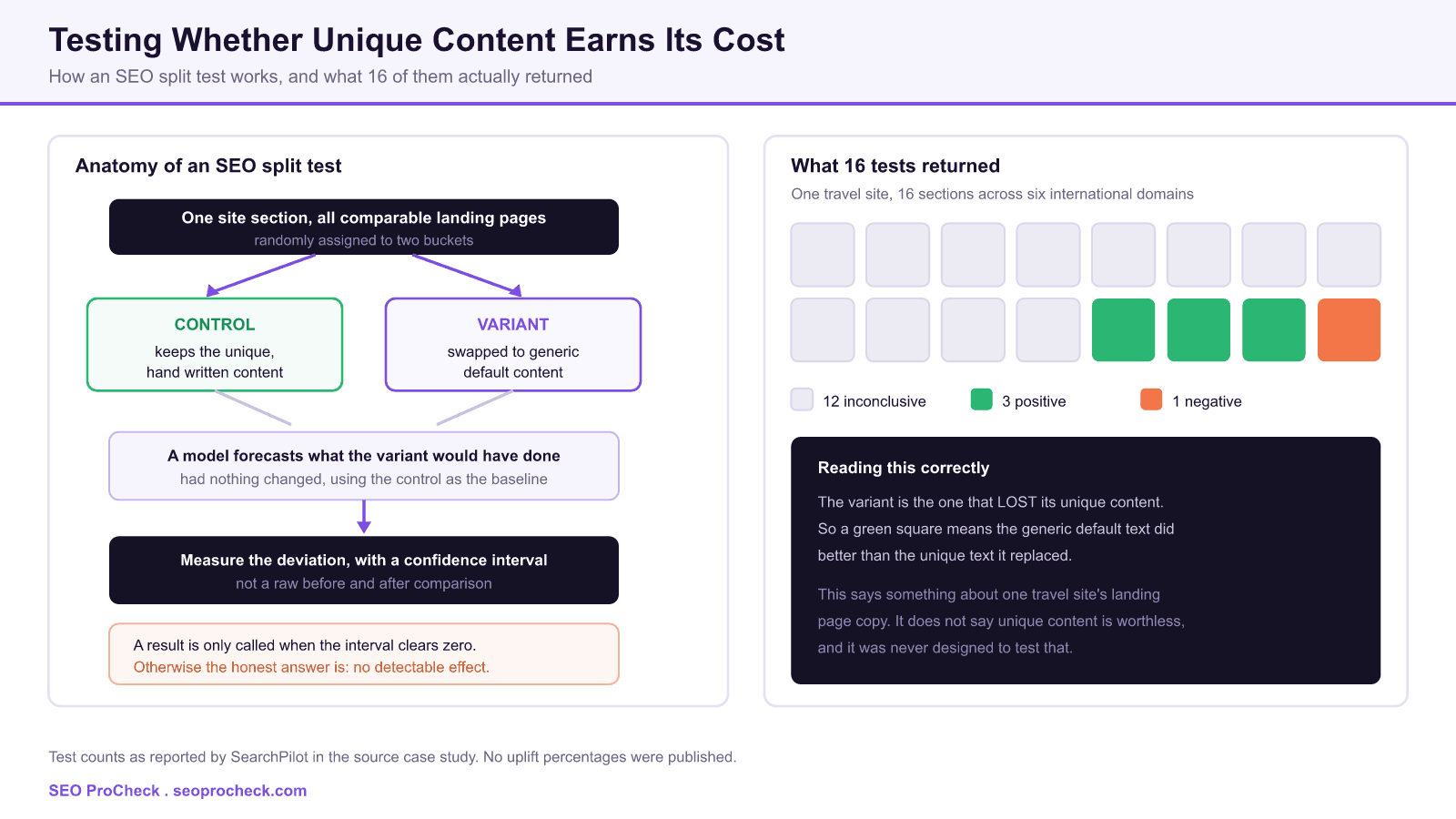
This case study is widely misquoted as proof that unique content does not matter. It shows something narrower and more useful: on one travel site, the supplementary descriptive copy sitting on landing pages was not producing a measurable traffic return over a generic default. That is a finding about a specific category of filler text, of the kind teams write because they believe they must rather than because a buyer asked for it. It is not a finding about the substantive content people actually search for. The real lesson is methodological: this team knew the answer because they tested it, and most teams arguing about content budgets are arguing from belief.
Almost every content team carries an unexamined assumption: that hand written copy on every template page is worth what it costs. It is expensive to produce, it is expensive to translate across international domains, and it is almost never measured. This case study is valuable precisely because someone finally measured it, and the answer was uncomfortable.
What was tested
The study evaluated whether unique content provides meaningful SEO value by testing its inverse: replacing unique content with generic default content. The work covered 16 different site sections across six international domains for a travel industry website, on landing pages of the type that would conventionally be assumed to benefit from customised copy.
Inverting the question this way is a smart design choice. Testing whether adding unique content helps requires you to write the content first, which means you have already spent the money you are trying to justify. Testing whether removing it hurts costs almost nothing and answers the same question. If nothing measurable happens when the copy disappears, the copy was not doing measurable work.
The results
The findings were remarkably inconclusive. The vast majority, 12 of the 16 tests, returned no significant result. Among the four conclusive outcomes, three were positive and one was negative. In the study's own framing, the default content either outperformed or produced no significant change to organic traffic compared with the unique content it replaced.
| Outcome | Number of tests | What it means here | How to act on it |
|---|---|---|---|
| Inconclusive | 12 | No detectable difference between unique and generic content on those pages | Stop funding the unique version on that page type until you have a reason beyond assumption |
| Positive | 3 | Traffic improved after unique content was replaced with the default | Investigate what the unique copy was doing wrong: length, keyword repetition, pushing content down |
| Negative | 1 | Traffic fell when the unique content was removed | That page type genuinely needed the copy, so keep it and look for what distinguishes that section |
| Uplift percentages | Not published | The study reports counts, not effect sizes or confidence levels | Do not repeat a specific percentage for this study, because none was given |
Counts as reported in the SearchPilot case study linked below. The interpretation column is SEO ProCheck commentary.
The single negative result deserves more attention than it usually gets. One section out of sixteen genuinely lost traffic without its unique content, which means the correct conclusion is not "unique content does not work" but "unique content works on some page types and not others, and you cannot tell which is which without checking."
Content strategy framework
The useful reframe from this study is to stop treating content as a single budget line and start segmenting it by the job the words are doing. Once you separate the categories, the question of whether uniqueness matters answers itself differently for each.
| Content category | Example | Does uniqueness pay? | Reasoning |
|---|---|---|---|
| Primary answer content | The guide, the review, the explanation a person searched for | Yes, decisively | This is the reason the page exists; a generic version has nothing to offer |
| Differentiating detail | First hand experience, original data, specifics a competitor cannot copy | Yes | It is the only content that cannot be replicated by anyone else |
| Functional template copy | Filter labels, delivery terms, standard policy wording | No | Consistency is a feature here and rewriting it per page adds risk, not value |
| Supplementary landing page prose | The paragraph beneath the listings that exists because someone said pages need words | Test it | This is exactly the category the study examined, and the result was mostly nothing |
Segmenting by job replaces an unwinnable general argument with four answerable specific ones.
Content development process
If supplementary copy on template pages is not reliably earning its keep, the process implication is to reallocate rather than to cut. The same production capacity spent on a smaller number of substantive pages generally produces more than the same capacity spread thinly across every template.
Three specific process changes follow. First, set a threshold for when a page type gets bespoke copy at all, and make the default position no copy rather than filler. Second, when template pages do need text, generate the factual parts from structured data you already hold and reserve human writing for the parts that require judgement. Third, and most importantly, build the measurement in from the start so this argument is never had on the basis of opinion again.
Be careful about the failure mode at the other end of this. Pages generated at scale with minimal differentiation are exactly what search engines scrutinise most closely, and our guides to local landing pages that avoid doorway problems and to duplicate content cover where the line sits. "The test said generic was fine" is not a licence to publish thousands of interchangeable pages.
Optimization and distribution
One plausible explanation for the three positive results is worth taking seriously, because it changes what you do next. Supplementary landing page copy is frequently placed above or between the elements people came for, pushing listings, prices and availability further down the page. Removing it can improve the page for users in a way that has nothing to do with the words themselves.
Before concluding that unique content is worthless on a page type, test the placement separately from the presence. Moving the same copy below the primary content is a different experiment from deleting it, and it distinguishes "this text is not useful" from "this text is in the way." Where the copy does stay, structuring it as direct answers to real questions is what makes it eligible for featured snippets rather than merely occupying space.
Results and attribution
The methodological contribution here outlasts the specific finding. An SEO split test works by splitting pages rather than users, because you cannot serve two versions of a URL to a search engine without cloaking. Comparable pages within a section are randomly assigned to control and variant groups, the change is deployed to the variant group only, and a model forecasts what those pages would have done without the change. The result is the deviation from that forecast, expressed with a confidence interval.
That last part is what separates a test from a story. A raw before and after comparison cannot distinguish your change from seasonality, an algorithm update, a competitor's launch or a tracking change. The forecast model absorbs those, because they hit control and variant alike. It is also why so many results come back inconclusive: the honest confidence interval frequently spans zero, and reporting that rather than picking a direction is what makes the framework trustworthy.
The prerequisite is scale. You need enough comparable pages carrying enough organic traffic that a real effect would be visible above the noise, which typically means hundreds of template pages. Below that threshold you are not running a test, and you should say so rather than dressing a staged rollout in statistical language. Sites of that shape usually get more value from consolidating into fewer, stronger pages, as covered in our guide to topic cluster architecture.
How to apply this without overreaching
- Do not generalise from one vertical. Travel landing pages compete on inventory, price and availability. Pages in a considered purchase or advisory category behave differently.
- Do not quote a percentage for this study. None was published. If you see one, someone invented it.
- Separate traffic from conversion. The test measured organic traffic. Copy that does not move rankings may still persuade the person who arrives, and deleting it can cost revenue silently.
- Test the highest cost category first. If you translate template copy across six domains, that is where an inconclusive result saves the most money.
- Keep the one negative result in view. A single section did need its content, and if you roll a change out globally on an aggregate finding you will damage that section without noticing.
FAQ
Yes, but not uniformly across every page on a site. This test suggests that on one travel site's landing pages, hand written descriptive copy was not earning its cost against a generic default. That is a finding about low value supplementary text on template pages, not about the substantive content people search for and read.
There is no penalty for duplicate content in the ordinary sense. What happens is consolidation: search engines pick one URL to represent a cluster of near identical pages and the others stop appearing. That is a visibility loss rather than a punishment, and it is managed with canonical tags and sensible page consolidation.
A conversion A/B test splits users. An SEO split test splits pages, because you cannot show search engines two versions of the same URL. Comparable pages are randomly assigned to control and variant groups, the change ships to the variant group, and a model forecasts what those pages would have done unchanged. The measured deviation from that forecast is the result.
It means the effect, if any, was too small to distinguish from normal fluctuation at the sample size and duration available. It is not a failed test. An inconclusive result on an expensive change is genuinely useful information, because it tells you the spend is not buying a detectable return.
Not on the basis of one study on someone else's site. What you should do is test it on yours. Take one category of low value template copy, run a controlled comparison, and let your own data decide. If the copy is genuinely useful to a buyer, it earns its place regardless of the traffic result.
Enough comparable pages with enough organic traffic that a real effect would be visible above the noise, which in practice usually means hundreds of similar template pages rather than dozens. Sites without that scale are better served by staged rollouts with careful before and after monitoring, accepting that the evidence will be weaker.
Do you know which of your content is actually earning its cost?
An audit segments content by the job it does and identifies which categories are candidates for testing rather than assumption.
Source: https://www.searchpilot.com/resources/case-studies/how-valuable-is-unique-content-seo
Take this with you
The assistant links open with a question about this page already written. Nothing is sent until you press enter.
Claude Vincent is a technical SEO consultant focused on crawlability, rendering, and AI-search visibility. He writes the field guides and case studies at SEO ProCheck, with a bias toward the durable, unglamorous work that decides whether search engines and AI answer engines can actually read and cite a site.
About SEO ProCheck
Technical SEO consulting and GEO strategy with 20 years of enterprise experience. Case studies, resources, and tools for search and AI visibility.
Work With Me
Technical SEO audits, GEO strategy, site migrations, and international SEO. Hourly consulting for teams who need hands-on support, not just reports.
Subscribe to our newsletter!








Recent Posts
- Most Top Sites Never Say Who They Are in Structured Data October 14, 2026
- Homepage Titles Are Mostly Too Short, Not Too Long October 8, 2026
- Who Actually Serves an llms.txt? 184 Top Sites Measured September 29, 2026