

AI Summary
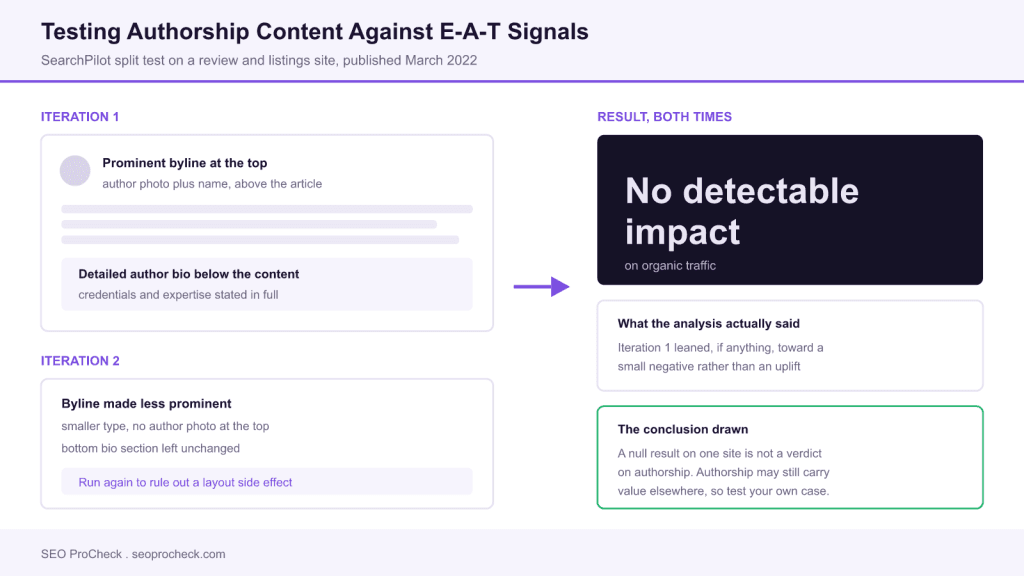
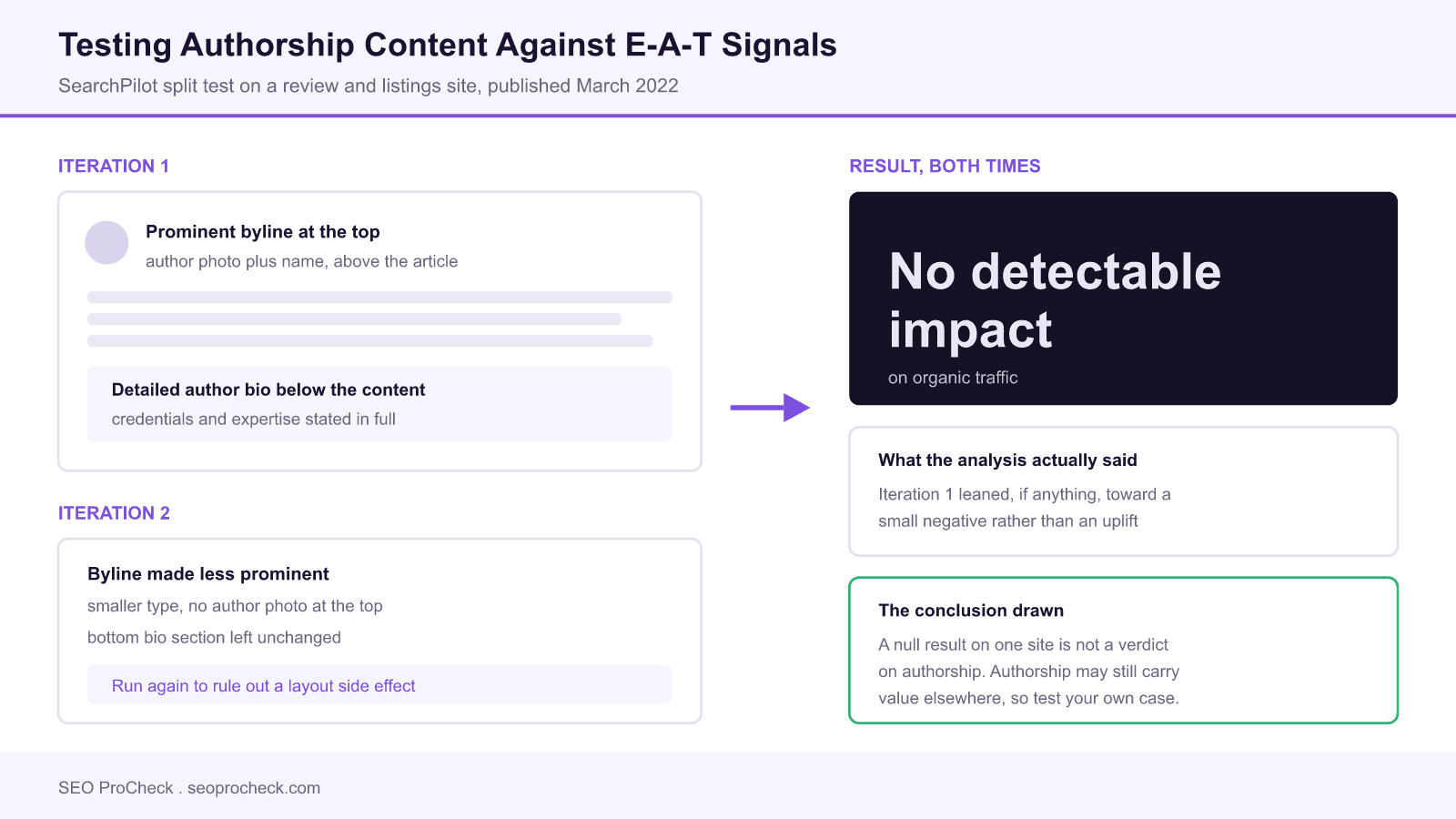
SearchPilot tested whether adding authorship content improved organic performance on a review and listings site, running two iterations: first a prominent byline with author image plus a detailed credentials bio, then a reduced byline with the bio unchanged. Both returned no detectable impact on organic traffic, with the first iteration's analysis leaning toward a small negative rather than an uplift.
- Published by SearchPilot on 31 March 2022; site type: review and listings.
- Two iterations tested, both inconclusive with no detectable organic impact.
- SearchPilot's reading: a possible disconnect between user-facing value and algorithmic benefit on this site.
- The framework itself changed in December 2022 when Google added Experience, making it E-E-A-T.
What was tested
The site was a review and listings property whose product content was based on market research rather than hands-on
testing. The hypothesis was the widely held one: that surfacing author identity and credentials would strengthen E-A-T
signals and improve organic performance.
The first iteration added a prominent byline at the top of the page, including an author image and name, and a detailed
bio section with credentials below the main content. The result was no detectable impact, and SearchPilot's analysis
indicated a small negative impact was more likely than an uplift. Suspecting the prominent top-of-page treatment might have
introduced a layout side effect, they ran a second iteration: the byline was made less prominent, with smaller type and no
author image at the top, while the bottom bio section was left unchanged. That iteration also returned no detectable
impact.
SearchPilot's stated conclusion was that while Google may want to measure authorship and use it to evaluate a page
against E-A-T metrics, there appeared to be a disconnect between the user-facing value and any algorithmic benefit on this
site. They were explicit that this does not mean authorship content will not be valuable for other sites, and framed the
whole exercise as a reason to test assumptions rather than inherit them.
Practitioner commentary: what a null result is actually worth
Null results are the most under-used output in SEO, because they are unpublishable as a win and therefore rarely shared.
This one is worth sitting with, because the industry advice it contradicts was near-universal at the time.
The key interpretive move is to separate three different explanations for the null, since each implies a different next
action.
The signal does not exist for this content type. The site's product content was based on market
research, not first-hand use. For that kind of page, an author byline adds a name but not additional evidence of expertise.
This is arguably the most likely reading, and it became more defensible eight months later when Google added Experience to
the framework precisely to distinguish first-hand knowledge from compiled knowledge.
The site was already above the threshold. Trust signals may behave more like a gate than a dial. A site
that already passes has nothing to gain by passing harder. Under this reading the test would return a null on a healthy
site and a large positive on an anonymous one, which means the result does not transfer to sites in worse shape.
The effect exists but is below the detection floor. Split tests can only detect effects larger than the
noise in the traffic they measure. A genuine 2 percent effect on a site with this traffic profile would present as no
detectable impact. This is why "no detectable impact" is the honest phrasing and "authorship does not work" is not.
The second iteration is the part practitioners should copy. Rather than publishing the first null and moving on,
SearchPilot changed the suspected confound, the visual prominence of the top byline, and re-ran. That is the discipline
that separates a test programme from a series of anecdotes.
What's changed since March 2022
This test predates several material shifts in how Google describes and evaluates page quality. Three matter.
December 2022: E-A-T became E-E-A-T. Google added Experience as a fourth element in its Search Quality
Rater Guidelines, and described Trust as the most important of the four. Experience covers first-hand involvement: having
actually used the product, visited the place, or lived the situation. For a review site whose content is compiled from
market research rather than hands-on testing, this update reframes the null result substantially. Adding a byline signals
who wrote it; it does not manufacture experience the content does not contain.
March 2024: helpful content signals moved into core ranking. Google retired the standalone helpful
content system and folded its signals into core ranking systems, alongside a spam policy update that named scaled content
abuse and site reputation abuse. The practical effect is that quality assessment is now continuous and diffuse rather than
a distinct classifier, so isolating any single quality element in a split test became harder, not easier.
The rise of AI answer surfaces changed the stakes. Generative results select and attribute a small
number of sources per query. Clear authorship, entity-consistent author pages and structured author markup are part of how
a source becomes identifiable and citable in that context. That value would not show up in the organic sessions metric this
test measured, which is a reason to widen your measurement rather than to conclude authorship is inert. Our
GEO and AI search consulting page covers what to instrument.
To be clear about the limits of this section: no published follow-up re-running this specific test after the E-E-A-T
update is available, so the above is contextual interpretation, not new evidence.
What to do with authorship in practice
Treat authorship as a trust and attribution investment rather than a ranking tactic, and implement it where it is
substantiated rather than everywhere by default.
| Content type | Does a byline add evidence? | Recommended treatment | What to measure |
|---|---|---|---|
| Hands-on product review | Yes, experience is the whole claim | Named author, testing methodology, photos from the actual test | Branded queries, direct returns, citations |
| Compiled or research-based listings | Weakly, this is the case tested here | Byline plus transparent sourcing and methodology page | Conversion rate, not organic sessions |
| Medical, legal or financial advice | Yes, credentials are a requirement | Named author with qualifications, plus a named reviewer and review date | Rater-facing trust, regulatory compliance |
| News and analysis | Yes | Author page with publication history and Person markup | Attribution in AI answers, syndication pickup |
| Utility and reference pages | Rarely | Organisational attribution is usually sufficient | Task completion |
Author markup should be consistent across bylines, author pages and structured data. Inconsistent naming produces multiple weak entities instead of one strong one.
Where you do implement authorship, do it fully. A byline with no author page behind it, or an author page
with no Person markup, gives neither readers nor machines anything to resolve. Link the byline to a real author
page, keep the name string identical everywhere it appears, and connect it to external profiles the author actually
controls. Our entity clarity checker
flags inconsistent naming, and our
content and E-E-A-T briefing
covers the executive framing of the same question.
And do not let a single null result drive a removal. The cost of keeping a byline is close to zero. The cost of being
an anonymous site in a category where every competitor names its experts is not measurable in a split test, but it is real
in the judgement of the human raters whose scores calibrate the systems that rank you.
FAQ
In this SearchPilot test on a review and listings site, it did not. Two iterations both returned no detectable impact on organic traffic, and the analysis of the first suggested a small negative was more likely than an uplift. That is one site and one content type, so it is not a general verdict, but it is strong evidence against treating author bios as a reliable ranking lever.
No, not directly. E-E-A-T is a framework in Google's Search Quality Rater Guidelines, used by human raters to evaluate whether search results are good. Raters do not change rankings for the pages they score. Google's systems are trained to align with those judgements over time, which makes E-E-A-T a description of what Google is aiming for rather than a switch you can flip on a page.
In December 2022 Google added an extra E for Experience to the front of the framework, making it Experience, Expertise, Authoritativeness and Trustworthiness. Trust is described as the most important member of the family. The addition of Experience recognised that first-hand use of a product or first-hand presence at an event can matter as much as formal credentials, which is directly relevant to review content of the kind tested here.
Several reasons, and they are not the same. The signal may genuinely not exist for that site type. The site may already have had sufficient trust signals, so the change added nothing at the margin. Or the effect may be real but smaller than the test's detection threshold given the traffic volume. A null result means the test could not measure an effect, which is not the same as proving there is none.
No. Bylines and bios serve readers, disclose who is responsible for advice, and matter for the human quality raters whose judgements calibrate Google's systems. They also matter increasingly for AI answer engines deciding which sources to attribute. Judging them purely by a single split test on organic sessions measures the wrong thing.
Change one element at a time and give it enough traffic to detect a plausible effect size. Measure more than organic sessions: track branded query volume, direct returns and conversion rate, because trust signals often move those before they move rankings. And decide the success criteria before you start, since an ambiguous null result is otherwise easy to read as whatever you hoped for.
Want to know which quality signals your site is actually missing?
An advanced audit assesses trust, authorship and entity consistency alongside the technical layer.
Source: https://www.searchpilot.com/resources/case-studies/authorship-content-and-eat-signals/
Take this with you
The assistant links open with a question about this page already written. Nothing is sent until you press enter.
Claude Vincent is a technical SEO consultant focused on crawlability, rendering, and AI-search visibility. He writes the field guides and case studies at SEO ProCheck, with a bias toward the durable, unglamorous work that decides whether search engines and AI answer engines can actually read and cite a site.
About SEO ProCheck
Technical SEO consulting and GEO strategy with 20 years of enterprise experience. Case studies, resources, and tools for search and AI visibility.
Work With Me
Technical SEO audits, GEO strategy, site migrations, and international SEO. Hourly consulting for teams who need hands-on support, not just reports.
Subscribe to our newsletter!








Recent Posts
- Most Top Sites Never Say Who They Are in Structured Data October 14, 2026
- Homepage Titles Are Mostly Too Short, Not Too Long October 8, 2026
- Who Actually Serves an llms.txt? 184 Top Sites Measured September 29, 2026