

AI Summary
Duplicate URLs are the same page served at more than one address, and they hurt not by triggering a penalty but by splitting crawl budget, link equity and ranking signals across variants. The fix is a four layer stack: 301 redirect the variants nobody needs, add self referencing canonicals, clean up internal links and sitemaps, and stop junk parameters becoming crawlable URLs in the first place.
- Google does not penalise technical duplication; it dilutes and mis-canonicalises instead.
- Search Console reports the damage under Duplicate, Google chose different canonical than user.
- Redirect what users never need, canonicalise what they do, and never block a duplicate in robots.txt.
- Session and tracking parameters are the single biggest generator of accidental duplicates on large sites.
Duplicate URLs are the quietest expensive problem in technical SEO. Nothing breaks. No error appears
in the browser. Every page loads, every template renders, and the site looks healthy in every dashboard a marketing team
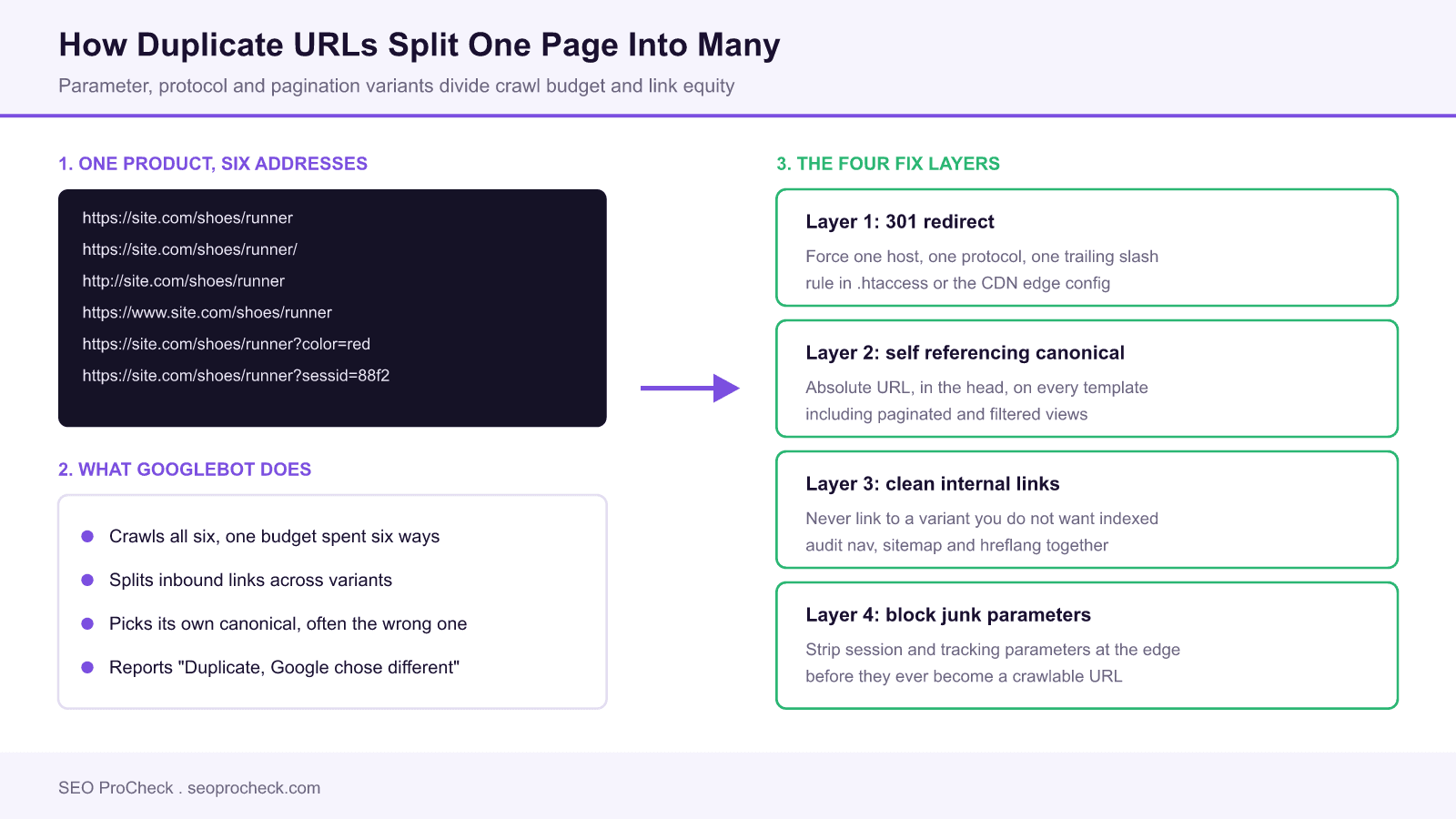
normally watches. Meanwhile Googlebot is fetching the same product page six times under six different addresses, spreading
the links pointing at that product across all six, and eventually choosing one of them as canonical without asking you.
This piece walks through how duplicates get created, how to measure the cost, and the exact remediation order that
resolves them.
What actually counts as a duplicate URL
A duplicate URL is any address that returns substantially the same content as another address and
returns HTTP 200 while doing it. That last clause matters. If the variant returns a 301 or a 404, it is not a duplicate,
it is handled. The problem only exists when two or more addresses each serve a live, indexable copy.
Crawlers treat URLs as opaque strings. They do not know that ?color=red is a cosmetic filter
or that ?sessid=88f2 is meaningless. Every distinct byte sequence before the fragment is a separate URL, which
is why the following six addresses are six pages as far as Googlebot is concerned, even though a human sees one product:
https://site.com/shoes/runner
https://site.com/shoes/runner/
http://site.com/shoes/runner
https://www.site.com/shoes/runner
https://site.com/shoes/runner?color=red
https://site.com/shoes/runner?sessid=88f2
The seven duplicate sources, ranked by how much damage they do
In audit after audit the same generators appear. The table below ranks them by the volume of junk URLs
they typically create and gives the layer that actually fixes each one. Fixing them out of order is the most common reason
a duplication cleanup fails to move anything.
| Source | Typical URL volume | Correct fix | Where you implement it |
|---|---|---|---|
| Faceted navigation and filters | Thousands to millions | Canonical plus selective noindex, or block link crawlability | Template and internal link markup |
| Session and tracking parameters | Unbounded | Strip at the edge before the URL is emitted | CDN or reverse proxy rule |
| Protocol and host variants | Exactly 3 extra per page | 301 to one canonical host and protocol | .htaccess, nginx.conf or edge redirect |
| Trailing slash mismatch | Doubles the URL space | 301 to one convention sitewide | Server config, not application code |
| Uppercase and lowercase paths | Varies by CMS | 301 to lowercase, then enforce in the router | Server config |
| Pagination and sort orders | Tens to hundreds per listing | Self referencing canonical on each page | Listing template head |
| Print and AMP style alternates | 1 extra per page | Canonical from the alternate to the main URL | Alternate template head |
Ordering matters: redirects run before canonicals are ever read, so fix rows three to five before touching row one.
Measuring the cost before you fix anything
The argument for prioritising duplication work is almost always a crawl efficiency argument, so gather
that evidence first. Three data sources, in this order:
Search Console, Pages report. The two rows that matter are Duplicate without
user-selected canonical, which means you gave Google no canonical signal at all, and Duplicate, Google chose
different canonical than user, which means you did give a signal and Google overruled it. The second is far more
serious: it tells you your canonical tags are being ignored, usually because internal links, sitemaps and redirects are all
pointing somewhere else. Export the URL list and group it by path pattern rather than reading it row by row.
Server logs. Pull thirty days of access logs filtered to verified Googlebot, then compute
the crawl ratio: unique URLs fetched divided by unique canonical URLs you want indexed. On a healthy site that number sits
close to one. When it passes two, crawl budget is being consumed by variants. Our log file analyzer
groups requests by status code and path pattern so the offending parameter shows up immediately.
A full crawl. Run Screaming Frog or Sitebulb with parameter handling turned off so you
see the URL space as Googlebot does. Sort the internal HTML list by content hash. Any hash appearing more than once is a
confirmed duplicate cluster. Cross-reference against the canonical column to see which clusters have a consistent canonical
and which are contradicting themselves.
The four fix layers, in order
Layer 1: redirect the variants nobody needs
Protocol, host and trailing slash variants have no user value whatsoever. They should never return 200.
Handle them at the server or edge, above the application, so no CMS plugin can undo the rule later. An Apache example that
forces HTTPS, the bare domain and no trailing slash:
RewriteEngine On
RewriteCond %{HTTPS} off [OR]
RewriteCond %{HTTP_HOST} ^www\. [NC]
RewriteRule ^(.*)$ https://site.com/$1 [R=301,L]

RewriteCond %{REQUEST_FILENAME} !-d
RewriteRule ^(.+)/$ /$1 [R=301,L]
Test the result with a chain check, not a single request. A variant that redirects to another variant
which then redirects again is a redirect chain, and chains lose signal at every hop. Our
redirect checker traces the full hop sequence and
flags anything longer than one step.
Layer 2: self referencing canonicals on every template
Every indexable page needs a canonical tag pointing at its own preferred absolute URL. Absolute, not
relative, and in the head, not injected by JavaScript after render. The pattern:
The subtlety is on filtered and paginated views. Page two of a category should carry a self referencing
canonical to page two, not to page one, because page two contains different products and canonicalising it away removes
those products from the index. A colour filter that merely reorders the same products, by contrast, should canonicalise to
the unfiltered category. The test is simple: if the variant contains items the target does not, it needs its own canonical.
Verify what is actually being served with our canonical checker,
because plugins routinely emit a second conflicting tag that never appears in the theme source.
Layer 3: make internal links and sitemaps agree
Canonical tags are hints. Internal links are votes. When your navigation links to the www version while
your canonical points at the bare domain, you are sending contradictory signals and Google resolves the contradiction by
majority. This is the usual root cause of Google chose different canonical than user.
Audit three places at once: the header and footer navigation, the XML sitemap, and any hreflang cluster.
All three must contain only canonical URLs. A single legacy menu item pointing at an old path can keep a duplicate alive
across an entire site. Validate the sitemap with our XML sitemap validator,
which flags entries that redirect, 404 or disagree with their own page canonical.
Layer 4: stop junk parameters becoming URLs
Session identifiers, affiliate tags and analytics parameters generate an unbounded URL space. The most
robust fix is not to manage them after the fact but to prevent them existing: strip known-junk parameters at the CDN edge
and 301 to the clean URL. That converts an infinite crawl surface into a finite one before Googlebot ever sees it.
Where a parameter must remain functional, keep the URL crawlable and let the canonical do the work. Do not
reach for robots.txt. Blocking a duplicate stops Google reading the very canonical tag that would have consolidated it, so
the variant can still appear in results as a bare URL with no title or snippet. This trade-off is the single most common
self-inflicted wound in duplication cleanups.
What recovery looks like
Duplication fixes are slow to show up because Google has to re-crawl every variant before it can retire it.
Expect the crawl ratio in your logs to improve within two to three weeks, Search Console duplicate counts to fall over four
to eight weeks, and ranking consolidation on the surviving canonical to follow after that. Because the timeline is long, log
data is the leading indicator worth reporting on: it moves first, and it moves in a direction you can attribute directly to
the work.
If duplication is one symptom of a broader indexation problem, the underlying crawl economics are covered in
our performance and indexation consulting overview,
and you can screen individual templates for near-identical bodies with the
duplicate content checker.
FAQ
No. Google has repeatedly said there is no duplicate content penalty for ordinary technical duplication. The damage is dilution rather than punishment: crawl budget gets spent re-fetching the same content, inbound links are split across variants, and Google may select a canonical you did not intend. The symptom is weaker rankings for the URL you actually optimised, not a manual action.
Start in Google Search Console under Pages, where the excluded reasons Duplicate without user-selected canonical and Duplicate, Google chose different canonical than user list the affected URLs directly. Then crawl the site with Screaming Frog or Sitebulb and sort by the hash or content column to group identical responses. Finish with a server log sample so you can see which variants Googlebot is genuinely wasting requests on.
Use a 301 when the duplicate has no reason to exist for users, for example the http version, the www variant, or a trailing slash mismatch. Use a canonical when the duplicate must remain reachable for users, for example a colour filter or a sort order on a category page. A canonical is a hint that Google can override; a redirect is an instruction it almost always honours.
For the root domain it makes no difference. For any other path, /shoes and /shoes/ are two distinct URLs to a crawler, and if both return HTTP 200 you have created a duplicate. Pick one convention, enforce it with a server level 301, and make every internal link and sitemap entry match it exactly.
Usually not, and it often makes things worse. Blocking a duplicate in robots.txt stops Google reading the canonical tag or redirect on that URL, so the variant can still get indexed as a URL-only entry with no content. Let the duplicate stay crawlable and signal consolidation with a redirect or canonical instead.
There is no absolute threshold, but a practical rule is the crawl ratio: divide the total URLs Googlebot fetched in your logs by the number of canonical URLs you actually want indexed. If that ratio climbs above roughly two to one on a large site, faceted navigation or session parameters are almost certainly generating URL variants faster than Google can consolidate them.
Not sure how much crawl budget your duplicates are consuming?
An advanced audit quantifies the crawl ratio, maps every duplicate cluster and gives you the fix order.
Source: https://seoprocheck.com/about/
Claude Vincent is a technical SEO consultant focused on crawlability, rendering, and AI-search visibility. He writes the field guides and case studies at SEO ProCheck, with a bias toward the durable, unglamorous work that decides whether search engines and AI answer engines can actually read and cite a site.
About SEO ProCheck
Technical SEO consulting and GEO strategy with 20 years of enterprise experience. Case studies, resources, and tools for search and AI visibility.
Work With Me
Technical SEO audits, GEO strategy, site migrations, and international SEO. Hourly consulting for teams who need hands-on support, not just reports.
Subscribe to our newsletter!







Recent Posts
- Can AI Crawlers Actually Read Your Site? I Measured 400 of the Biggest September 5, 2026
- The Pre-Publish Quality Gate for AI-Assisted Content August 6, 2026
- AGENTS.md vs llms.txt vs llms-full.txt: Which Agent File Does What July 18, 2026