

AI Summary
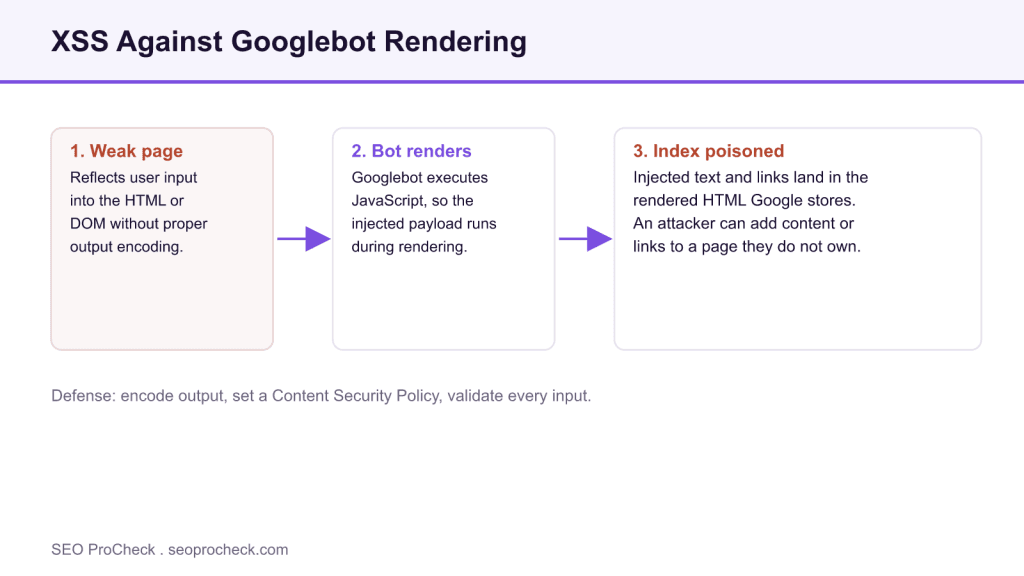
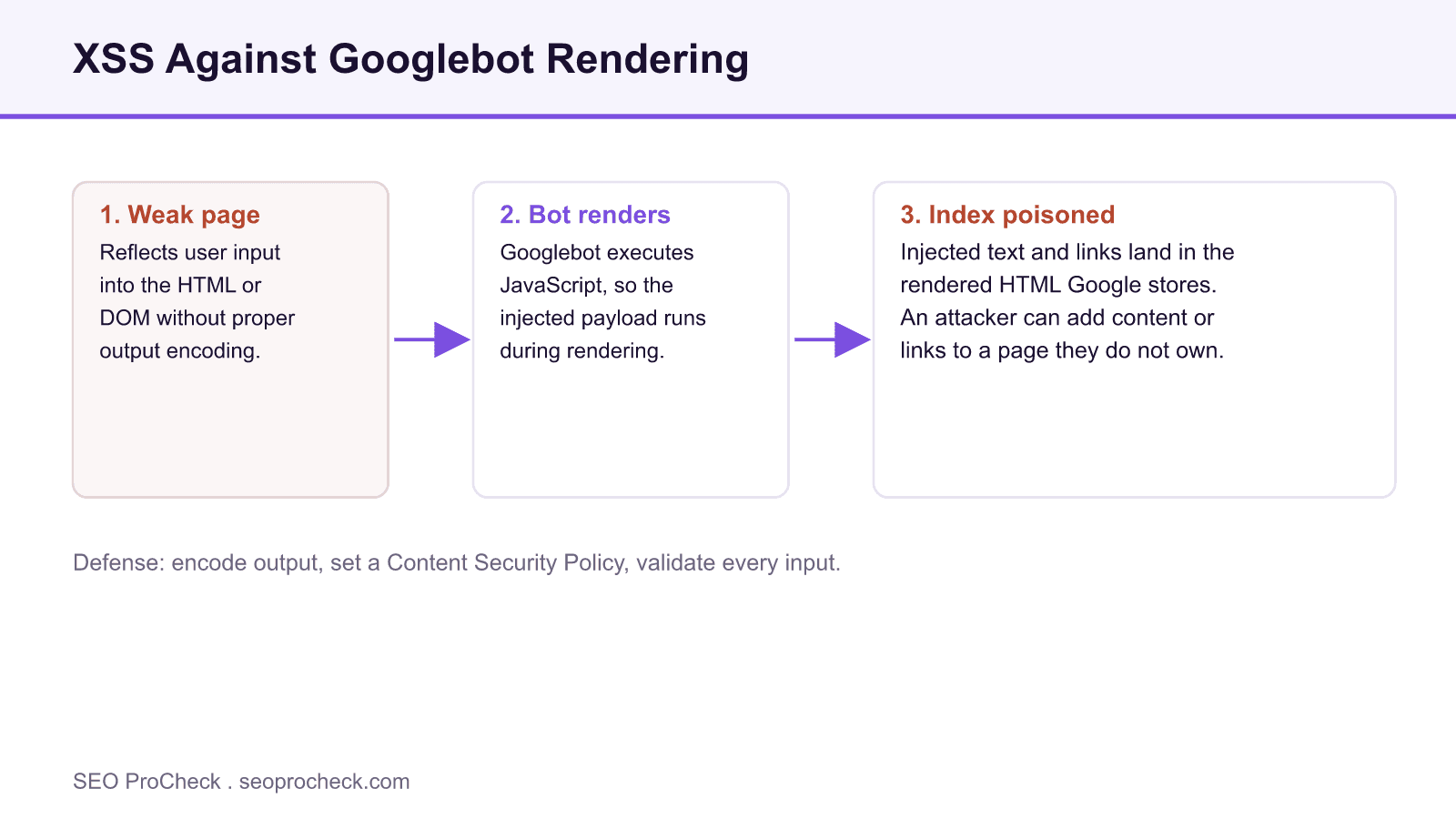
This research shows that a cross site scripting flaw can become a search problem, because Googlebot renders JavaScript. If a page reflects unsanitized input, an attacker can make injected markup and links appear in the rendered HTML that Google stores, effectively adding content to a page they do not control.
- Googlebot renders JavaScript, so reflected XSS can inject content into the indexed version of a page.
- An attacker can insert links or spam into a page they do not own, manipulating what Google indexes.
- The root cause is the same as any XSS: unsanitized input reaching the HTML or DOM.
- Defend with output encoding, a Content Security Policy, and strict input validation.
This SEO case study documents a successful optimization initiative, providing actionable insights for practitioners. The documented approach demonstrates how strategic SEO implementation drives measurable results.
Initial Situation
Understanding the starting point is essential context for evaluating any case study. This documentation covers the initial challenges, competitive position, and business objectives that shaped the SEO strategy.
Strategy and Approach
The strategic approach combined multiple SEO disciplines to address identified opportunities. Key decisions around prioritization and resource allocation provide a template for similar initiatives.
Implementation
Moving from strategy to execution required specific technical implementations, content development, and process changes. This case study documents the practical steps that translated strategy into action.
Results and Learnings
The outcomes demonstrate effectiveness through measurable improvements in rankings, traffic, and business metrics. Analysis of successes and challenges provides learning value for practitioners.
Case studies like this contribute to the SEO knowledge base, helping practitioners learn from documented real-world experiences.
Source: https://www.tomanthony.co.uk/blog/xss-attacks-googlebot-index-manipulation/
How rendering turns XSS into an SEO problem
Googlebot uses an evergreen, Chromium based rendering engine and executes JavaScript when it renders a page. That is normally a good thing, because it lets Google see content that depends on scripts. The risk appears when a page reflects user controlled input into the page without proper encoding. A classic reflected cross site scripting flaw lets an attacker craft a URL whose parameter is written straight into the HTML or the DOM. When Googlebot renders that URL, the injected markup runs and becomes part of the rendered HTML that Google stores for the page.
Why an attacker would bother
The abuse is subtle. Instead of stealing a session, the attacker uses the flaw to shape what Google indexes. They can inject links pointing at a site they want to promote, so a trusted domain appears to link out to them. They can inject spam text or misleading content onto a reputable page. In the worst framing, they manipulate how a competitor page is represented in the index. Because the injection only needs to survive rendering, it does not require any of the usual signs of a defacement that a human would notice.
The defenses that matter
The fixes are the standard web security controls, applied with search rendering in mind:
- Output encoding: never write user input into HTML as raw markup. Encode it for the context, and prefer safe DOM APIs such as textContent over innerHTML when inserting values.
- Content Security Policy: a strong policy limits where scripts can load from and blocks inline injection. A minimal starting point is
Content-Security-Policy: default-src 'self', tightened from there. - Input validation: validate and constrain every parameter server side, and reject anything that does not match the expected shape.
- Trusted Types: this browser feature makes dangerous DOM sinks refuse plain strings, which closes many DOM based injection paths.
Verify what Google actually renders
Use the URL Inspection tool in Search Console to view the rendered HTML of a page and confirm no unexpected content or links appear. Test the parameters that feed into the page with encoded and malicious looking values, and confirm they are neutralized. Since the exposure depends on how Googlebot fetches and renders your pages, it connects to how Googlebot fetches pages and to how page content is composed for rendering.
Attack vector, impact, and mitigation
| Vector | Search impact | Mitigation |
|---|---|---|
| Reflected parameter in HTML | Injected text indexed on your page | Context aware output encoding |
| DOM sink via innerHTML | Injected links indexed as yours | Use textContent, add Trusted Types |
| Inline script injection | Arbitrary rendered content | Content Security Policy |
What has changed since this research
Googlebot moved to an evergreen rendering engine in 2019, so it now tracks the current stable Chromium closely rather than lagging on an old version. That makes the rendering step more capable and more consistent, which is good for legitimate JavaScript sites and also means injection that survives modern rendering is reliably processed. On the defensive side, Content Security Policy Level 3 and Trusted Types are now widely supported, giving developers stronger tools to stop DOM based injection. The core lesson holds: because Google renders JavaScript, cross site scripting is not only a security bug, it is a search integrity bug, and it deserves the same seriousness as any other injection flaw.
Related on SEO ProCheck
Frequently asked questions
How can XSS affect search rankings?
Because Googlebot renders JavaScript, a reflected cross site scripting flaw can inject content and links into the rendered HTML Google stores. That lets an attacker place text or links on a page they do not own, manipulating what gets indexed.
Does Googlebot execute JavaScript?
Yes. Googlebot uses an evergreen Chromium based rendering engine and runs JavaScript when it renders pages, which is why a script injection that survives rendering can reach the index.
What is the main defense against this?
Stop untrusted input from becoming markup. Use context aware output encoding, prefer safe DOM APIs like textContent, validate every input server side, and deploy a Content Security Policy.
Will a Content Security Policy stop the attack?
A strong policy blocks many injection paths by restricting where scripts run and load from, but it is a layer, not a complete fix. Combine it with output encoding and input validation for real protection.
How do I check if my page is exposed?
Use the URL Inspection tool in Search Console to view the rendered HTML, and test the parameters that flow into the page with malicious looking values to confirm they are neutralized before rendering.
Is this the same as a normal website hack?
It is a form of injection, but the goal is different. Rather than defacing a page visibly, the attacker aims to influence what Google indexes, so the manipulation can be quiet and easy to miss.
Take this with you
The assistant links open with a question about this page already written. Nothing is sent until you press enter.
Claude Vincent is a technical SEO consultant focused on crawlability, rendering, and AI-search visibility. He writes the field guides and case studies at SEO ProCheck, with a bias toward the durable, unglamorous work that decides whether search engines and AI answer engines can actually read and cite a site.
About SEO ProCheck
Technical SEO consulting and GEO strategy with 20 years of enterprise experience. Case studies, resources, and tools for search and AI visibility.
Work With Me
Technical SEO audits, GEO strategy, site migrations, and international SEO. Hourly consulting for teams who need hands-on support, not just reports.
Subscribe to our newsletter!








Recent Posts
- Most Top Sites Never Say Who They Are in Structured Data October 14, 2026
- Homepage Titles Are Mostly Too Short, Not Too Long October 8, 2026
- Who Actually Serves an llms.txt? 184 Top Sites Measured September 29, 2026