

SEO Flatliners – The Curious Case Of A Massive 1-Month Algorithmic Demotion From Google (To The Minute) And What Could Have Triggered The Drop
- April 24, 2019
- Uncategorized
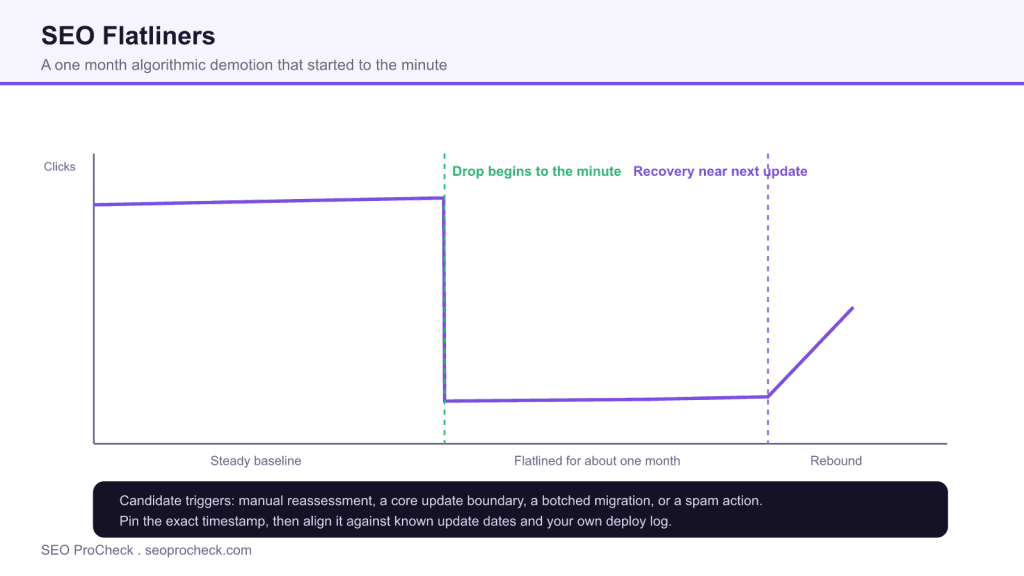
AI Summary
A sudden, sustained drop that begins at a precise timestamp is a forensic gift: the exact moment tells you which cause to investigate first. Pin the timestamp, line it up against confirmed update dates and your own deploy log, and rule causes in or out methodically before you touch anything.
- An abrupt drop to the minute usually points to a discrete event, not slow decay.
- Check for manual actions first, then align the timestamp with your deploy history.
- Correlate against confirmed algorithm update dates before assuming a penalty.
- Rebounds often arrive near the following update, so document everything you change.
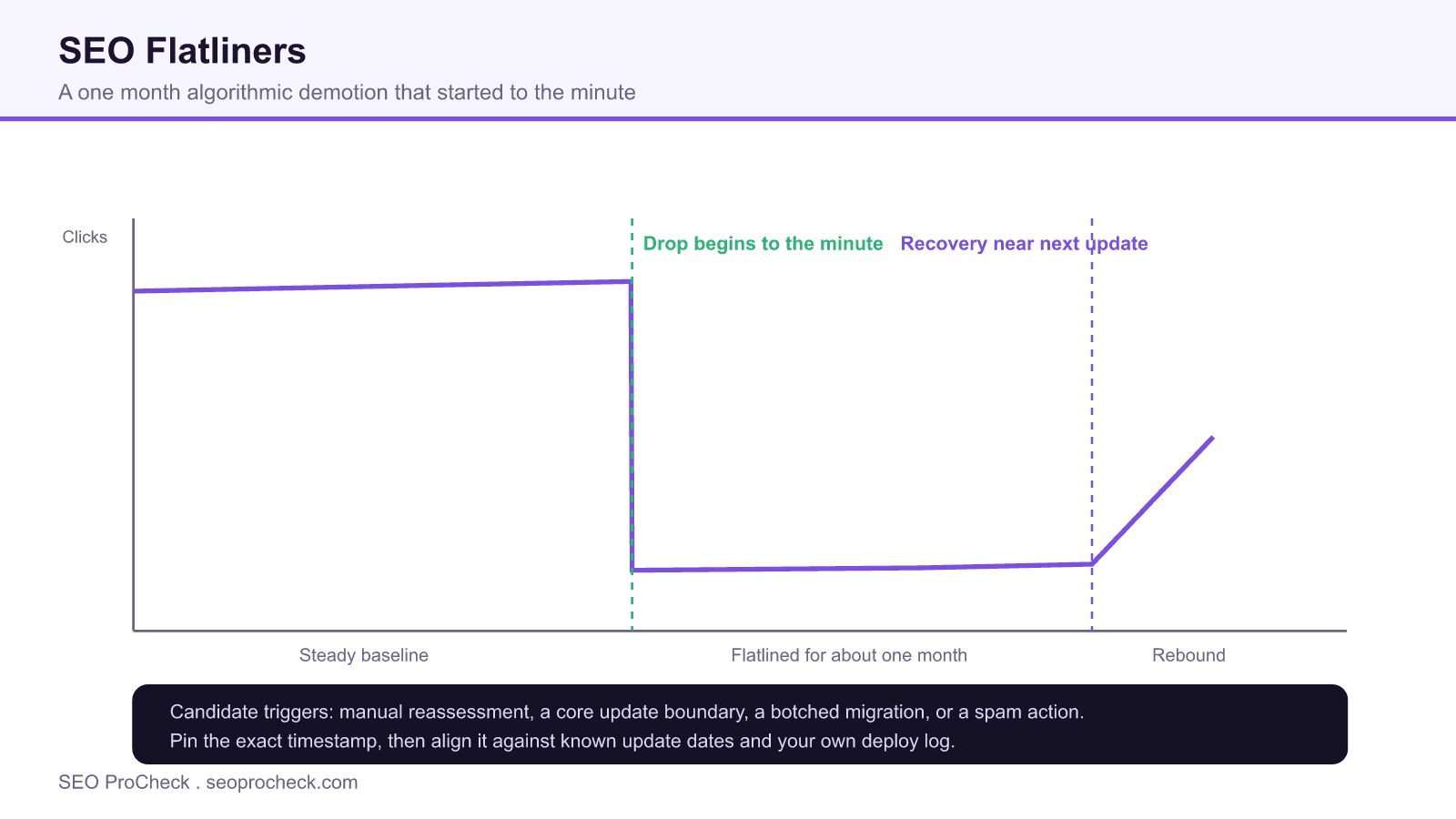
This SEO case study documents a successful optimization initiative, providing actionable insights for practitioners. The documented approach demonstrates how strategic SEO implementation drives measurable results.
Initial Situation
Understanding the starting point is essential context for evaluating any case study. This documentation covers the initial challenges, competitive position, and business objectives that shaped the SEO strategy.
Strategy and Approach
The strategic approach combined multiple SEO disciplines to address identified opportunities. Key decisions around prioritization and resource allocation provide a template for similar initiatives.
Implementation
Moving from strategy to execution required specific technical implementations, content development, and process changes. This case study documents the practical steps that translated strategy into action.
Results and Learnings
The outcomes demonstrate effectiveness through measurable improvements in rankings, traffic, and business metrics. Analysis of successes and challenges provides learning value for practitioners.
Case studies like this contribute to the SEO knowledge base, helping practitioners learn from documented real-world experiences.
Source: https://www.gsqi.com/marketing-blog/seo-flatliners-one-month-google-drop-case-study/
How to read a flatline drop
The shape of a decline carries diagnostic information. A slow, uneven slide over months usually points to competitive erosion or gradual quality decay. A vertical cliff that lands on a single day, sometimes traceable to a specific hour, points to a discrete event. This case study documents the second kind, and the discipline it demands is worth copying: before changing a single line of code, establish exactly when the drop began and what else happened at that moment.
Search Console is the primary evidence. Set the performance report to the day view, isolate the affected property or directory, and find the first day of decline. If the platform lets you narrow further, confirm whether the fall is total or limited to certain queries, countries, or page types. A drop confined to one template implicates that template. A sitewide drop implicates a sitewide cause such as an algorithm boundary, a robots or noindex mistake, or a migration.
A checklist for a sudden demotion
Work the list in order. Each step either rules a cause in or out, which stops you from chasing the wrong fix.
| Candidate cause | How to test it | Action if confirmed |
|---|---|---|
| Manual action | Security and Manual Actions report in Search Console | Follow the stated remedy and file a reconsideration request |
| Accidental noindex or robots block | Diff your deploy log and check the affected templates | Restore indexability and request validation |
| Botched migration or redirect | Crawl for broken redirects, chains, and lost canonicals | Repair the mapping and resubmit sitemaps |
| Algorithm update boundary | Compare the date against confirmed update timelines | Focus on quality, which Google's smaller core updates can reflect before the next major one |
| Server or performance incident | Check logs, uptime, and crawl stats for the window | Fix the infrastructure and monitor recrawl |
The reason the timestamp matters so much is that it separates causes you control from causes you do not. If the drop lands on the same day you shipped a template change, that is your first suspect, and it is usually fixable within hours. If it lands on a confirmed core update date and your deploy log is clean, you are looking at an algorithmic reassessment, which calls for quality work and patience rather than a frantic rollback.
What is changed since this case study
Google now confirms core updates on its ranking status dashboard and often names the rollout window to the day, which makes the timestamp correlation step easier and more reliable than it used to be. It has also been clearer that spam actions and core updates are different systems, so a drop that coincides with a documented spam update should be investigated against the relevant spam policies rather than treated as a generic quality issue.
Recovery behaviour is broadly unchanged: algorithmic demotions tend to lift at a later update once the underlying issues are genuinely resolved, which is why documenting every change during the incident is so valuable. When the eventual reassessment runs, your change log tells you what actually moved the needle. For the wider pattern of how these swings behave across sites, the May 2020 core update case studies are a useful reference, and the mechanics of a content driven decline are covered in the copied content domino case. To pair forensics with real user insight, see the power of user studies.
Frequently asked questions
What does it mean when traffic drops on a single day?
A drop that lands on one day, sometimes traceable to a specific hour, points to a discrete event rather than slow decline. The likely causes are a code deploy, an indexing mistake, a migration error, or an algorithm update boundary. The exact timestamp tells you which to investigate first.
How do I find the exact moment a ranking drop started?
Use the Search Console performance report in day view, isolate the affected property or directory, and locate the first day of decline. Then compare that date against your deploy history and against confirmed algorithm update timelines to narrow the cause.
Is a sudden drop always a penalty?
No. True manual penalties are rare and are always shown in the Security and Manual Actions report. Most sudden drops are algorithmic reassessments, self inflicted technical mistakes, or migration errors, so check that report first before assuming a penalty.
Should I roll back my changes immediately?
Only if the timestamp lines up with your own deploy and the change is a plausible cause. If the drop matches a confirmed algorithm update and your deploy log is clean, a rollback will not help, and you should focus on genuine quality improvements instead.
How long until rankings recover after a demotion?
Self inflicted technical issues can recover within days once fixed and recrawled. Algorithmic demotions usually lift at a later update after the underlying problems are genuinely resolved, so recovery is measured in update cycles rather than a fixed number of days.
Why should I document everything during an incident?
Because recovery often arrives at a later update, a detailed change log is the only reliable way to learn which change actually helped. Without it you cannot tell whether recovery came from your fixes or simply from the update reweighing the site.
Take this with you
The assistant links open with a question about this page already written. Nothing is sent until you press enter.
Claude Vincent is a technical SEO consultant focused on crawlability, rendering, and AI-search visibility. He writes the field guides and case studies at SEO ProCheck, with a bias toward the durable, unglamorous work that decides whether search engines and AI answer engines can actually read and cite a site.
About SEO ProCheck
Technical SEO consulting and GEO strategy with 20 years of enterprise experience. Case studies, resources, and tools for search and AI visibility.
Work With Me
Technical SEO audits, GEO strategy, site migrations, and international SEO. Hourly consulting for teams who need hands-on support, not just reports.
Subscribe to our newsletter!








Recent Posts
- Most Top Sites Never Say Who They Are in Structured Data October 14, 2026
- Homepage Titles Are Mostly Too Short, Not Too Long October 8, 2026
- Who Actually Serves an llms.txt? 184 Top Sites Measured September 29, 2026