

AI Summary
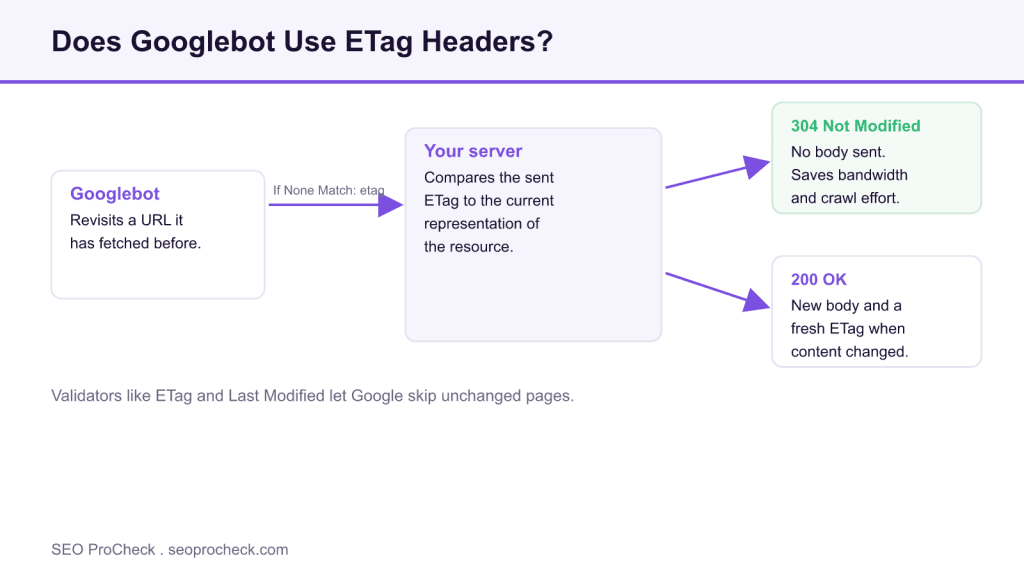
Yes. Testing shows Googlebot supports HTTP conditional requests, sending validators such as If Modified Since and If None Match so a server can reply 304 Not Modified when a page has not changed. Honouring ETag and Last Modified lets Googlebot skip unchanged content and spend its crawling on pages that actually moved.
- Googlebot sends conditional request headers and understands a 304 Not Modified response.
- A strong ETag or a correct Last Modified header lets your server return 304 with no body.
- 304 responses save bandwidth and crawl effort, which helps large and frequently crawled sites.
- Emit validators consistently and only change the ETag when the content truly changes.
This SEO case study documents a successful optimization initiative, providing actionable insights for practitioners. The documented approach demonstrates how strategic SEO implementation drives measurable results.
Initial Situation
Understanding the starting point is essential context for evaluating any case study. This documentation covers the initial challenges, competitive position, and business objectives that shaped the SEO strategy.
Strategy and Approach
The strategic approach combined multiple SEO disciplines to address identified opportunities. Key decisions around prioritization and resource allocation provide a template for similar initiatives.
Implementation
Moving from strategy to execution required specific technical implementations, content development, and process changes. This case study documents the practical steps that translated strategy into action.
Results and Learnings
The outcomes demonstrate effectiveness through measurable improvements in rankings, traffic, and business metrics. Analysis of successes and challenges provides learning value for practitioners.
Case studies like this contribute to the SEO knowledge base, helping practitioners learn from documented real-world experiences.
Source: https://tamethebots.com/blog-n-bits/does-googlebot-use-etags
Conditional requests in plain terms
HTTP has a built in way to avoid resending content that has not changed. When a server first serves a page it can include an ETag header, which is a fingerprint of that version of the resource, and a Last Modified header with a timestamp. On a later visit the client sends those values back in an If None Match or If Modified Since header. If nothing changed, the server replies 304 Not Modified with no body, and the client reuses what it already had. This is standard caching behaviour, and Googlebot participates in it.
What the testing found
Practical testing of Googlebot traffic shows it does send these validators on revisits and does act on a 304 response by treating the stored version as current. That matters for crawl efficiency: a 304 costs your server almost nothing to produce and saves Googlebot from downloading a full response it already has. Across a large site with many stable pages, that saved effort can be redirected toward the URLs that changed, which ties directly to how crawl budget works.
How to check your own responses
You can inspect the headers yourself. Request the page and look at the response headers to confirm an ETag or Last Modified value is present:
curl -sSI "https://example.com/page/"Then repeat the request while sending the value back, and confirm the server answers 304 rather than 200:
curl -sS -o /dev/null -w "%{http_code}\n" \
  -H 'If-None-Match: "the-etag-value-here"' \
  "https://example.com/page/"
If you get a 200 with a full body even though nothing changed, your stack is not honouring validators, and you are giving up an easy crawl efficiency win.
Getting it right
Emit a strong, stable ETag that only changes when the content changes, and keep Last Modified accurate. Avoid tying the ETag to values that shift on every request, such as a timestamp or a per request identifier, because that defeats the purpose and forces a full fetch every time. Many CDNs and application servers handle this automatically for static assets, but dynamic pages often need explicit configuration. The rendering and fetching theme also connects to how pages are composed and fetched.
Validators and responses at a glance
| Response header | Request header sent back | Result when unchanged |
|---|---|---|
| ETag | If None Match | 304 Not Modified, no body |
| Last Modified | If Modified Since | 304 Not Modified, no body |
| Either changed | Either header | 200 OK with fresh body and new validator |
What has changed since this case study
Google has been increasingly explicit that supporting HTTP caching and conditional requests helps crawling. Its crawl budget guidance now calls out that serving 304 responses for unchanged content is a legitimate way to make crawling more efficient, which lines up with what independent testing observed. Nothing about the underlying HTTP mechanism has changed, because ETag and Last Modified are long standing standards. What has shifted is the emphasis: as sites grow and Google pushes for crawl efficiency, correctly implemented validators have moved from a nice to have to a practical lever for large sites.
Related on SEO ProCheck
Frequently asked questions
Does Googlebot really send If None Match and If Modified Since?
Yes. Observed Googlebot traffic includes these conditional request headers on revisits, and Googlebot acts on a 304 Not Modified response by keeping the version it already has.
What is the difference between ETag and Last Modified?
ETag is a fingerprint of a specific version of a resource, while Last Modified is a timestamp of the last change. Both act as validators, and a server can use either or both to decide whether to send a 304 response.
How does a 304 response save crawl budget?
A 304 Not Modified reply has no body, so it is tiny and fast to produce. Googlebot avoids downloading content it already has, which frees crawl capacity for pages that actually changed.
How do I test if my server supports conditional requests?
Fetch the page and note its ETag, then request it again sending that value in an If None Match header. If the server replies 304 rather than 200, conditional requests are working.
Can a bad ETag hurt me?
Yes. If your ETag changes on every request, for example because it is tied to a timestamp, the server can never return 304 and Googlebot must download the full page each time, wasting the efficiency the mechanism is meant to provide.
Do I need to configure this manually?
Static assets are often handled by your CDN or web server automatically. Dynamic pages frequently need explicit configuration to emit a stable ETag or an accurate Last Modified value.
Take this with you
The assistant links open with a question about this page already written. Nothing is sent until you press enter.
Claude Vincent is a technical SEO consultant focused on crawlability, rendering, and AI-search visibility. He writes the field guides and case studies at SEO ProCheck, with a bias toward the durable, unglamorous work that decides whether search engines and AI answer engines can actually read and cite a site.
About SEO ProCheck
Technical SEO consulting and GEO strategy with 20 years of enterprise experience. Case studies, resources, and tools for search and AI visibility.
Work With Me
Technical SEO audits, GEO strategy, site migrations, and international SEO. Hourly consulting for teams who need hands-on support, not just reports.
Subscribe to our newsletter!








Recent Posts
- Most Top Sites Never Say Who They Are in Structured Data October 14, 2026
- Homepage Titles Are Mostly Too Short, Not Too Long October 8, 2026
- Who Actually Serves an llms.txt? 184 Top Sites Measured September 29, 2026