

How Carta Uses Unsexy Content Marketing to Drive Millions in Direct & Organic Traffic
- July 7, 2022
- Growth
AI Summary
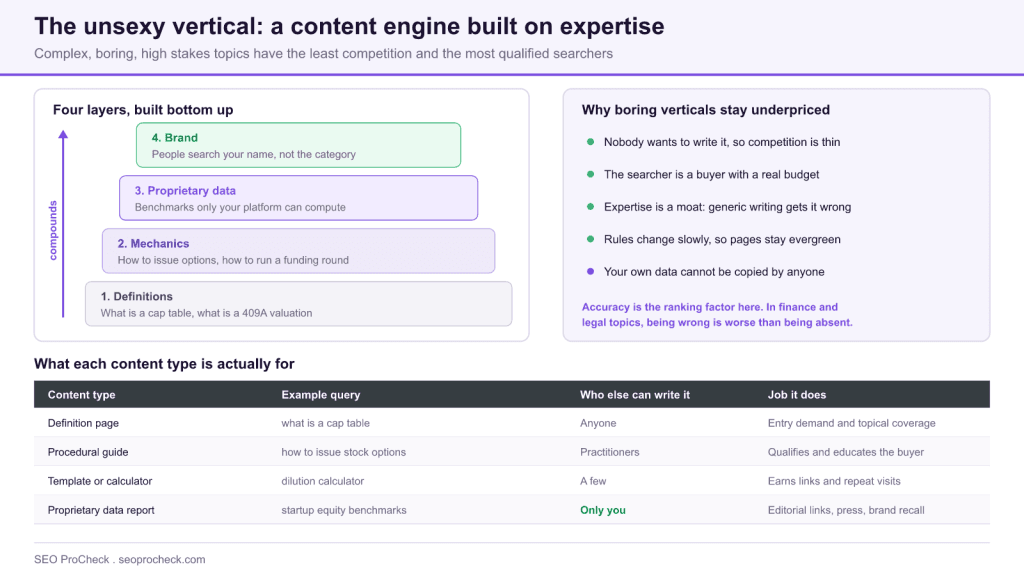
"Unsexy" content marketing means owning a complex, unglamorous, high stakes subject that nobody else wants to write about properly. In verticals like equity, tax and compliance the competition is thin precisely because the material is hard, and the people searching are qualified buyers rather than casual readers.
- Build in layers: definitions, then mechanics, then proprietary data, then brand.
- Proprietary benchmark data is the only layer competitors cannot copy, and it is what earns editorial links.
- In money and legal topics accuracy is the ranking factor: being wrong costs more than being absent.
- Direct traffic growth is the lagging indicator that the brand layer is working.
This case study documents a successful organic growth strategy, demonstrating how strategic SEO implementation drives measurable business results. The approach provides actionable insights for practitioners facing similar challenges.
Challenge and Context
Every successful SEO initiative begins with understanding the starting position and objectives. This case study reveals the initial challenges, competitive landscape, and business goals that shaped the strategy. Understanding context helps practitioners assess applicability to their own situations.
Strategic Approach
The methodology employed combined technical optimization, content strategy, and authority building in a coordinated approach. Key decisions around prioritization, resource allocation, and tactical execution provide a template for similar initiatives. The strategy balanced quick wins with sustainable long-term growth.
Implementation Details
Moving from strategy to execution required specific technical implementations, content creation processes, and measurement frameworks. This case study documents the practical steps taken, tools used, and workflows developed. These implementation details help practitioners translate strategy into action.
Results and Analysis
The outcomes demonstrate the effectiveness of the approach through measurable metrics: traffic growth, ranking improvements, and business impact. Analysis of what worked best and what could have been done differently provides learning value beyond the raw results.
This case study contributes to the evidence base for effective SEO strategy, helping practitioners learn from documented successes.
Why "unsexy" is a competitive advantage
Equity management, cap tables, 409A valuations and employee stock option mechanics are not topics anybody chooses for fun. They are technical, heavily regulated, and getting them wrong has consequences measured in money and legal exposure. That is exactly why they are worth owning.
Content marketing crowds toward subjects that are enjoyable to write and easy to research, which is why the competitive market for "productivity tips" is saturated while the market for "how option repricing affects existing grants" is not. Three forces keep the boring categories underpriced:
- Supply is genuinely constrained. Writing accurately about equity mechanics requires somebody who understands equity mechanics. That is a hiring problem, not a briefing problem, and it stops most competitors before they start.
- The audience is pre qualified. Nobody idly searches "83(b) election deadline". The person searching it is a founder, an employee with a grant, or a finance lead, and they have a decision to make this week.
- The content does not decay. Fundamental mechanics change slowly. A well built explainer keeps earning for years, which changes the return calculation on the effort it costs to produce.
The four layers, and why order matters
The mistake teams make in complex verticals is starting at the top with a flashy data report before the foundation exists. Build bottom up.
| Layer | Example | Search intent | Who can replicate it | Business job |
|---|---|---|---|---|
| 1. Definitions | What a cap table is | Informational, entry level | Anyone | Topical coverage and first contact |
| 2. Mechanics | How to issue options to a new hire | Procedural, task in progress | Genuine practitioners | Qualifies and educates the buyer |
| 3. Tools | Dilution or vesting calculator | Transactional utility | Few, it needs engineering | Earns links and repeat visits |
| 4. Proprietary data | Benchmarks drawn from platform data | Research and citation | Nobody, you own the dataset | Editorial links, press, brand recall |
The bottom two layers are table stakes: they establish that you cover the subject and they capture demand. The top two are where differentiation lives. And the fourth layer only becomes available if the business itself generates data, which is the structural advantage a platform has over an agency or a publisher writing about the same subject.
Proprietary data is the only durable moat
Every layer below can eventually be matched by a competitor with budget and patience. Aggregate data drawn from your own platform cannot, because they do not have the customers.
Turning that into a content asset has a repeatable shape. Pick a question practitioners genuinely argue about and cannot resolve without data. Aggregate and anonymise rigorously, because publishing anything traceable to an identifiable customer destroys the trust the whole strategy depends on. Publish the methodology alongside the findings so journalists and analysts can assess it. Then repeat it annually so the report becomes a reference point people wait for.
The link acquisition characteristics are what make this worth the effort. Nobody links to your definition of a cap table, because a hundred equivalents exist. People do link to a number they cannot get anywhere else, and those citations come from publications whose links carry real weight. This is the editorially earned end of the spectrum described in our link building fundamentals guide, and it is the kind of link that is hard to acquire any other way.
Accuracy is a ranking factor in this vertical
In finance, tax and legal adjacent categories, the quality bar is different. Google's guidance around content that can affect a person's finances or wellbeing puts unusual weight on expertise and trust signals, and readers in this space verify things. A single materially wrong statement about a filing deadline does more damage than ten missing articles.
Concretely, that means:
- Name the author and show why they are qualified. A real byline with real credentials, linked to a substantive author page. Anonymous or ghostwritten content underperforms here in a way it does not in softer categories.
- Add a reviewer. Have qualified counsel or an accountant review the material and say so on the page, with the review date.
- Date everything and re-verify on a schedule. Thresholds and filing rules change. A visible "last reviewed" date is a trust signal and an internal forcing function.
- State jurisdiction explicitly. Tax and securities guidance is jurisdiction bound. Content that does not say which country it applies to is worse than useless to a reader outside it.
- Keep the boundary between education and advice clear. Explain the mechanics, do not tell an individual reader what to do with their own situation.
These are the same signals discussed in our notes on content scoring systems, which cover how quality is assessed at scale.
Why direct traffic is the metric that matters
A note on the "direct and organic traffic" framing in this case study's title. Direct traffic in a B2B context is largely a brand measurement: people typing the domain, using a bookmark, or arriving from an untagged source. It is the lagging indicator of everything the content did before.
The causal chain runs organic first, brand second, direct third. Someone finds an explainer through search, the explainer solves their actual problem, they remember the name, and the next time they come straight to you. That takes quarters, not weeks, which is why teams optimising on a monthly organic sessions target tend to abandon this strategy right before it starts working.
Track the leading indicator instead: branded query volume. In Search Console, filter Performance by queries containing your brand and watch that curve separately from everything else. It moves earlier than direct traffic and it is far less ambiguous. Our Search Console FAQ covers query filtering and the limits of the data.
Adapting this if you are not the platform of record
Not everybody has a proprietary dataset. The transferable parts of the strategy still work:
- Find the topics your competitors avoid. Look for subjects where the ranking results are shallow, out of date, or clearly written by somebody who does not understand the subject. That is an opening.
- Buy or build the expertise. Hire the practitioner, or pay one to review. It is the single highest leverage expenditure in a technical vertical.
- Manufacture data you can own. A rigorous survey of your customers or industry produces a citable dataset even without a platform behind it. Original research beats another opinion piece.
- Build utility, not just prose. A calculator that does a tedious job correctly earns links and returning users that an article on the same topic never will.
- Commit to the maintenance cycle. The compounding only happens if the pages stay correct. Set review dates and honour them.
FAQ
It means deliberately targeting complex, unglamorous, high stakes subjects that most content teams avoid because they are hard to write well. The advantage is structural: thin competition, a pre qualified audience of people with a decision to make, and material that stays relevant for years rather than weeks.
Because the supply of competent competing content is genuinely limited. Writing accurately about equity, tax or compliance requires subject matter expertise that most content operations cannot buy at scale, so the pages that do exist are often shallow or out of date. Doing the work properly is the whole moat.
Pick a question practitioners argue about and cannot settle without data, aggregate your own platform data to answer it, and anonymise rigorously so nothing traces back to an identifiable customer. Publish the methodology with the findings, then repeat the report annually so it becomes a reference point people cite and wait for.
Indirectly, and with a long lag. Direct traffic in B2B is mostly a brand measurement: people who already know your name arriving without a referrer. Content earns the first visit through search, the quality of that visit builds recall, and recall shows up as direct sessions quarters later. Branded query volume moves earlier and is a better leading indicator.
Very, and more so than in general categories. Content that can affect someone's finances is held to a higher standard, so name real authors with real credentials, add a qualified reviewer and say so on the page, date the content visibly, and state the jurisdiction it applies to. Readers in this space verify claims, and one material error costs more trust than several missing articles.
Longer than most content programmes are given. The definition and mechanics layers can start earning within a couple of quarters, but the brand and direct traffic effects that make the strategy compelling are measured in years. Teams judging it against a monthly sessions target tend to abandon it just before the compounding begins.
Source: https://foundationinc.co/lab/carta-content-marketing
Claude Vincent is a technical SEO consultant focused on crawlability, rendering, and AI-search visibility. He writes the field guides and case studies at SEO ProCheck, with a bias toward the durable, unglamorous work that decides whether search engines and AI answer engines can actually read and cite a site.
About SEO ProCheck
Technical SEO consulting and GEO strategy with 20 years of enterprise experience. Case studies, resources, and tools for search and AI visibility.
Work With Me
Technical SEO audits, GEO strategy, site migrations, and international SEO. Hourly consulting for teams who need hands-on support, not just reports.
Subscribe to our newsletter!







Recent Posts
- Finding a Competitor's Sitemap, and Turning It Into a Change Log September 15, 2026
- AI Crawler User Agents: The Current Names, and Which Ones Sites Actually Block September 9, 2026
- Can AI Crawlers Actually Read Your Site? I Measured 400 of the Biggest September 5, 2026