

How Stacker.com Earned 1M+ Organic Monthly Visits Through Content Syndication
- July 7, 2022
- Content
AI Summary
Content syndication grows organic traffic by placing one well made story on many publisher sites, each of which links or canonicalizes back to the origin. Done with clear attribution, it earns backlinks, referral visits, and brand reach without splitting ranking signals, which is how a data driven newsroom model can compound into very large organic numbers.
- Syndication is republishing your content on third party sites by agreement, not scraping.
- Attribution is the whole game: a credit link or a canonical to your URL protects the origin.
- The payoff is backlinks, referral traffic, and authority that lifts the rest of your site over time.
- Guard against site reputation abuse rules by keeping placements editorial and clearly credited.
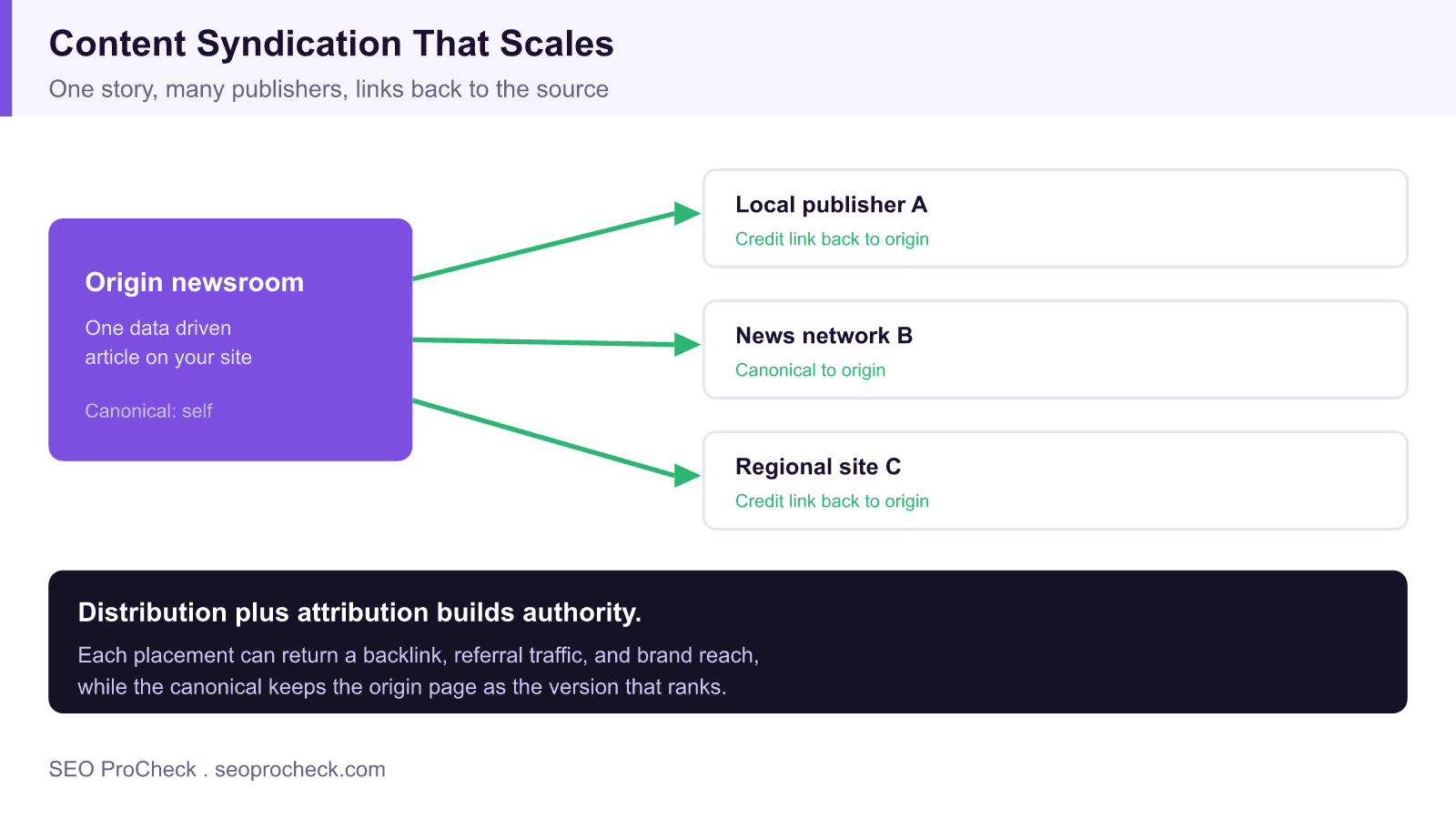
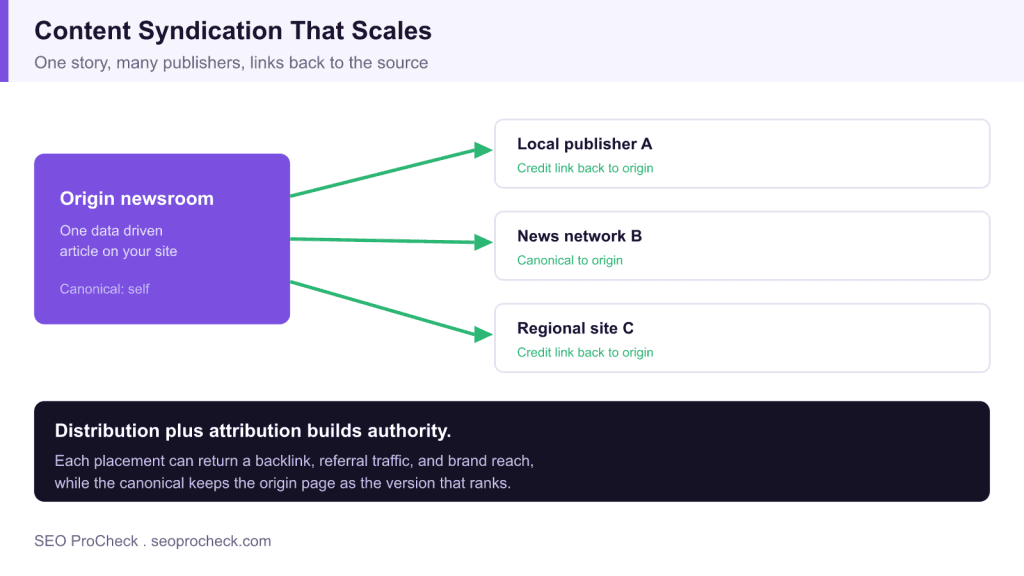
Content syndication is one of the few distribution tactics that compounds. Instead of publishing a story once and hoping it ranks, you produce something genuinely useful, usually data driven, and license it to publishers who want ready made editorial. Each placement can send a link and referral traffic back to you. Repeat that across dozens or hundreds of outlets and the aggregate authority can lift an entire domain into seven figure organic territory.
What syndication is, and what it is not
Syndication means republishing your content on another site with permission, usually as part of a formal partnership. It is not scraping, and it is not spinning up thin copies you control. The publisher runs your article, ideally with a credit link to the original or a canonical tag pointing at your URL. That single attribution decision is what separates a growth engine from a duplicate content mess.
The newsroom model behind the numbers
The reason data journalism scales so well is supply and demand. Local and regional publishers need a steady stream of credible, visual, well sourced stories and rarely have the staff to produce them. A newsroom that turns public datasets into clean, rankable articles can offer exactly that at volume. Every outlet that picks up a story typically credits the source, and those credits accumulate into a broad, editorially earned link profile that is very hard to replicate with outreach alone.
How to keep syndication from cannibalizing your rankings
The fear with syndication is that a big partner outranks you for your own article. You control the outcome with the attribution method you require in the agreement:
- Canonical to your URL. The partner adds
rel="canonical"pointing at your original. Their copy consolidates ranking signals to you. - Noindex on the partner copy. The republished version carries a robots noindex, so only your page is eligible to rank.
- Credit link back. At minimum, a visible do follow link to your original. This is the lightest option and the one most publishers accept.
Get your version indexed first, keep the canonical self referencing on your side, and prefer partners who will honor a canonical or a clear credit link. If a partner refuses any attribution, the placement is worth far less and can work against you.
What has changed since: site reputation abuse
In 2024 Google formalized a policy against site reputation abuse, sometimes called parasite SEO, targeting third party content published on an authoritative domain mainly to exploit that domain's ranking power. Legitimate editorial syndication is not the target, but the line matters. Keep placements genuinely editorial, relevant to the host publication, and clearly attributed. Avoid arrangements whose only purpose is to rent a strong domain to rank content that has nothing to do with that site. The safe version of syndication is the one where a real publisher runs a real story their readers want.
Syndication attribution methods compared
| Method | Who can rank | Link value to you | Best when |
|---|---|---|---|
| Canonical to origin | Your page | High, consolidated | Partner will edit their head tags |
| Noindex on partner copy | Your page | Referral plus brand | Partner uses a CMS you cannot control fully |
| Credit link only | Either page | Moderate backlink | Partner accepts only a visible link |
| No attribution | Often the partner | Low or negative | Avoid this arrangement |
Related reading
- The duplicate content guide explains how Google handles the same story on many URLs.
- The canonical tag reference shows exactly how a partner should point a canonical at your origin.
- Index bloat covers why uncontrolled duplicate copies can dilute a site.
Case study summary and source
Content-driven SEO success requires strategic approaches to creation, optimization, and management. This case study demonstrates how content strategy directly drives organic growth when aligned with user needs and search behavior.
Content Strategy Framework
Effective content strategy begins with understanding target audiences, their questions, and the competitive content landscape. This case study outlines the strategic framework that guided content decisions, from topic selection to format choices.
Content Development Process
Moving from strategy to published content requires efficient processes for research, creation, and optimization. This case study documents workflows, quality standards, and production approaches that enabled consistent, high-quality output.
Optimization and Distribution
Published content requires ongoing optimization based on performance data. This case study covers how content was refined post-publication, how internal linking supported content performance, and how distribution amplified content reach.
Results and Attribution
Measuring content ROI requires connecting content efforts to business outcomes. This case study demonstrates the traffic, engagement, and business results achieved through strategic content investment. Attribution methodology helps validate content strategy effectiveness.
Content SEO case studies help practitioners build cases for content investment with documented results.
Source: https://moz.com/blog/content-syndication-case-study
Frequently asked questions
What is content syndication in SEO?
It is republishing your content on third party sites by agreement, usually with a credit link or canonical back to your original. It is a distribution tactic that earns backlinks, referral traffic, and reach, not a way to spin up duplicate pages you control.
Will syndication cause a duplicate content penalty?
No. There is no duplicate content penalty. The risk is that a partner outranks you or that Google consolidates signals to their copy. You prevent that by requiring a canonical to your URL, a noindex on their copy, or at minimum a clear credit link.
How does syndication drive so much organic traffic?
Each placement can return a backlink and referral visits. Across many publishers those links accumulate into a broad, editorially earned profile that raises the authority of your whole domain, which in turn helps unrelated pages rank better over time.
Which attribution method is best?
A canonical to your origin is strongest because it consolidates ranking signals to you. A noindex on the partner copy also protects you. A credit link only is the lightest option and the one publishers most often accept.
Is syndication still safe after the site reputation abuse policy?
Yes, when it is genuinely editorial. Google's 2024 policy targets third party content placed on an authoritative domain mainly to exploit its ranking power. Keep placements relevant to the host publication and clearly attributed and you stay on the right side of it.
Should I get my own copy indexed before syndicating?
Yes. Publish and request indexing of your version first so Google establishes it as the source, then syndicate with a canonical or credit link. Being indexed first strengthens your claim to be the canonical version.
Claude Vincent is a technical SEO consultant focused on crawlability, rendering, and AI-search visibility. He writes the field guides and case studies at SEO ProCheck, with a bias toward the durable, unglamorous work that decides whether search engines and AI answer engines can actually read and cite a site.
About SEO ProCheck
Technical SEO consulting and GEO strategy with 20 years of enterprise experience. Case studies, resources, and tools for search and AI visibility.
Work With Me
Technical SEO audits, GEO strategy, site migrations, and international SEO. Hourly consulting for teams who need hands-on support, not just reports.
Subscribe to our newsletter!





Recent Posts
- Can AI Crawlers Actually Read Your Site? I Measured 400 of the Biggest September 5, 2026
- The Pre-Publish Quality Gate for AI-Assisted Content August 6, 2026
- AGENTS.md vs llms.txt vs llms-full.txt: Which Agent File Does What July 18, 2026