

Emoji in Meta Descriptions: SEO Split Testing Lessons from SearchPilot
- September 22, 2020
- Metadata
AI Summary
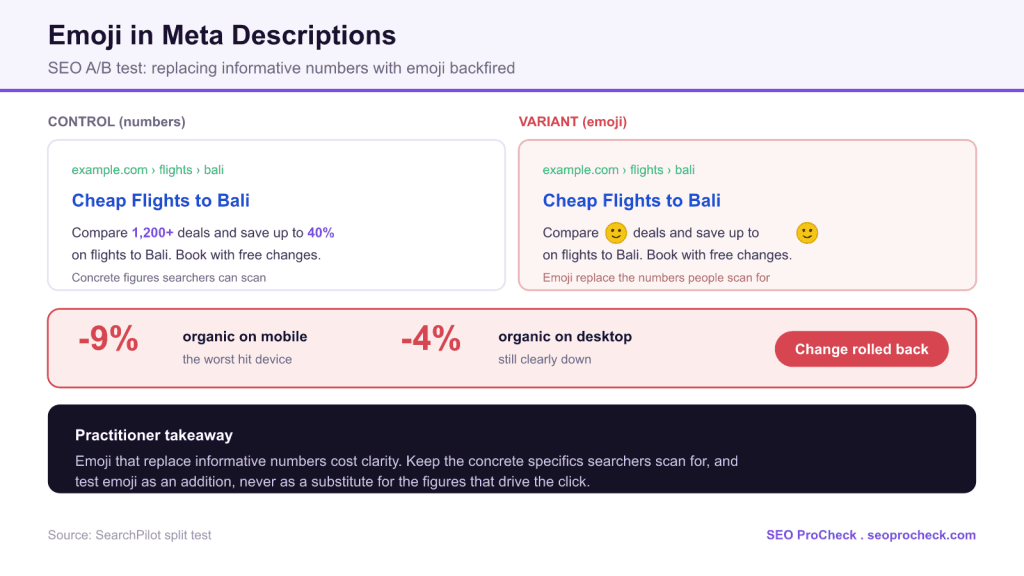
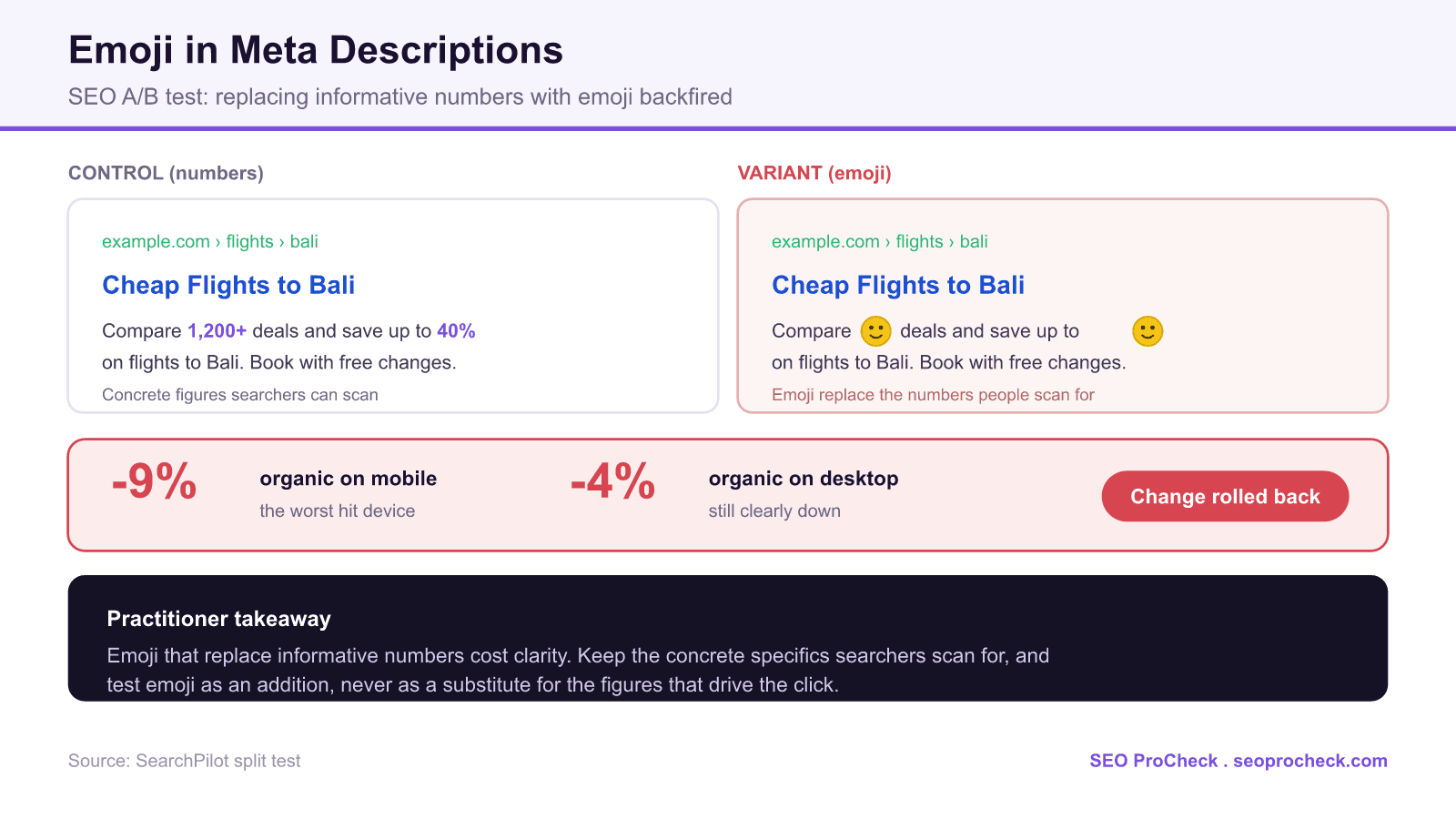
Replacing informative numbers with emoji in meta descriptions backfired. In a SearchPilot split test the change was clearly negative for organic traffic, with about a 9 percent drop on mobile and a 4 percent drop on desktop, so it was rolled back. Meta description edits usually have a small effect, which makes a result this negative worth paying attention to.
- The loss came from removing concrete figures, such as counts and percentages, that searchers scan for.
- Emoji are fine as an addition, but not as a substitute for the specifics that drive the click.
- The damage was larger on mobile, where snippet space and scanning behavior differ.
- Meta descriptions are not a ranking factor, but they shape click-through when Google shows them.
Emoji in search snippets are tempting: they add color to a wall of blue links and can catch the eye. But a meta description is doing a specific job, persuading a searcher that your result answers their query, and anything that competes with that job is a risk. This case study tested a pointed version of the idea: not adding emoji, but using them to replace the numbers already in the description.
Initial Situation
The meta description is not a ranking factor. Its influence is on click-through: when Google chooses to show your description rather than rewrite it, a compelling snippet earns more clicks from the same ranking position. The starting descriptions contained concrete numbers, the kind of specifics that make a snippet persuasive: counts of options, percentage savings, and similar figures a searcher can evaluate at a glance.
Strategy and Approach
The variant replaced those numbers with emoji. The hypothesis a test like this probes is whether visual symbols can stand in for figures and still carry the message, perhaps while standing out more in the SERP. SearchPilot measured it with a full-funnel SEO A/B test, splitting comparable pages into control and variant groups and reading the effect on organic traffic separately by device, which turned out to matter.
Implementation
Meta descriptions are set per template or per page in your CMS or SEO plugin, so a test like this swaps the description format across a group of similar URLs. Two technical realities shape any emoji test. First, Google frequently rewrites meta descriptions and does not always show the one you wrote, so part of any emoji change may never reach the SERP. Second, Google renders some emoji in snippets and strips or ignores others, and how a symbol displays differs between mobile and desktop. The safe framing is simple:
Control:  Compare 1,200+ deals and save up to 40% on flights to Bali.
Variant:  Compare [emoji] deals and save up to [emoji] on flights to Bali.
Result:   the variant removed the exact figures that made the snippet convincing.
Emoji in meta descriptions: what the result implies
| Choice | Effect on the snippet | Recommendation |
|---|---|---|
| Emoji replacing numbers | Removes the specifics searchers evaluate | Avoid, this tested clearly negative |
| Emoji added alongside text | Adds visual accent without losing information | Test cautiously, keep the facts |
| Concrete numbers kept | Gives a scannable reason to click | Keep, they carry the value |
| Emoji-heavy description | Risks a Google rewrite or stripped symbols | Not worth the volatility |
| Mobile snippet | Shorter, scanned faster, less tolerant of noise | Prioritize clarity over decoration |
Results and Learnings
The result was clearly negative. SearchPilot reported roughly a 9 percent decrease in organic traffic on mobile and about 4 percent on desktop, consistent enough across device types that the change was rolled back. The explanation is straightforward: the numbers were doing real persuasive work. "1,200 deals" and "40 percent off" give a searcher a concrete reason to click, and a symbol cannot carry that specificity. Swapping the figures for emoji stripped the snippet of exactly what made it convincing. It is the same lesson that shows up across metadata tests, including dynamic prices in title tags: concrete, accurate specifics win clicks, and removing them costs traffic.
How to use emoji in snippets without losing traffic
- Add, do not replace. If you want an emoji, place it alongside your numbers, never in place of them. Keep every concrete figure a searcher might scan for.
- Lead with the specifics. Counts, prices, percentages, and dates are the persuasive core of a snippet. Protect them.
- Expect rewrites. Google may replace your description entirely, so treat emoji as an occasional accent, not a strategy you depend on.
- Watch mobile separately. This test hit mobile hardest. Read your results by device, because a change can be roughly neutral on desktop and clearly negative on mobile.
What has changed since this test
Google rewrites meta descriptions more often than many people realize, frequently generating its own snippet from on-page text, so the description you control reaches the SERP less reliably than it once did. AI Overviews and AI Mode add another layer, summarizing pages in ways that bypass your meta description entirely. None of that changes the core finding: when your description is shown, clarity and concrete specifics earn the click, and decoration that removes information costs it. Write meta descriptions for the human scanning the result, keep the numbers, and treat emoji as a rare accent at most.
Common mistakes
- Replacing facts with symbols. An emoji cannot convey "40 percent off" or "1,200 options," and removing those figures tested clearly negative.
- Ignoring device differences. The mobile snippet behaves differently; a change that looks mild on desktop can be sharply negative on mobile.
- Assuming your description will show. Google often rewrites it, so emoji you add may never appear anyway.
- Chasing visual novelty over clarity. Standing out means nothing if the snippet no longer gives a reason to click.
FAQ
Not when they replace information. In a SearchPilot split test, swapping numbers for emoji in meta descriptions was clearly negative, roughly a 9 percent drop on mobile and 4 percent on desktop, and was rolled back. Emoji are not a ranking factor and can cost click-through if they remove specifics.
The numbers were doing the persuasive work. Figures like a deal count or a percentage off give searchers a concrete reason to click, and an emoji cannot carry that specificity. Removing the figures stripped the snippet of what made it convincing.
No. Meta descriptions do not directly affect rankings. Their value is in click-through: when Google shows your description rather than rewriting it, a clear, specific snippet earns more clicks from the same position.
As an addition, used sparingly, yes. The mistake in this test was using emoji to replace information. If you want an emoji accent, keep every concrete figure and place the symbol alongside the text rather than in place of it.
Mobile snippets are shorter and scanned faster, so they are less tolerant of anything that removes clarity. The test showed about a 9 percent drop on mobile versus 4 percent on desktop, which is why you should always read snippet tests by device.
Maybe not. Google frequently rewrites meta descriptions and renders some emoji while stripping others, and display differs by device. That unpredictability is another reason to rely on clear text and concrete numbers rather than symbols.
Source: https://www.searchpilot.com/resources/case-studies/seo-split-test-lessons-emoji-meta-descriptions/
Are your snippets earning the clicks your rankings deserve?
Meta descriptions, titles, and structured data all shape click-through, and small wording choices move real traffic. An audit finds the snippets quietly costing you clicks.
Take this with you
The assistant links open with a question about this page already written. Nothing is sent until you press enter.
Claude Vincent is a technical SEO consultant focused on crawlability, rendering, and AI-search visibility. He writes the field guides and case studies at SEO ProCheck, with a bias toward the durable, unglamorous work that decides whether search engines and AI answer engines can actually read and cite a site.
About SEO ProCheck
Technical SEO consulting and GEO strategy with 20 years of enterprise experience. Case studies, resources, and tools for search and AI visibility.
Work With Me
Technical SEO audits, GEO strategy, site migrations, and international SEO. Hourly consulting for teams who need hands-on support, not just reports.
Subscribe to our newsletter!








Recent Posts
- Most Top Sites Never Say Who They Are in Structured Data October 14, 2026
- Homepage Titles Are Mostly Too Short, Not Too Long October 8, 2026
- Who Actually Serves an llms.txt? 184 Top Sites Measured September 29, 2026