

AI Summary
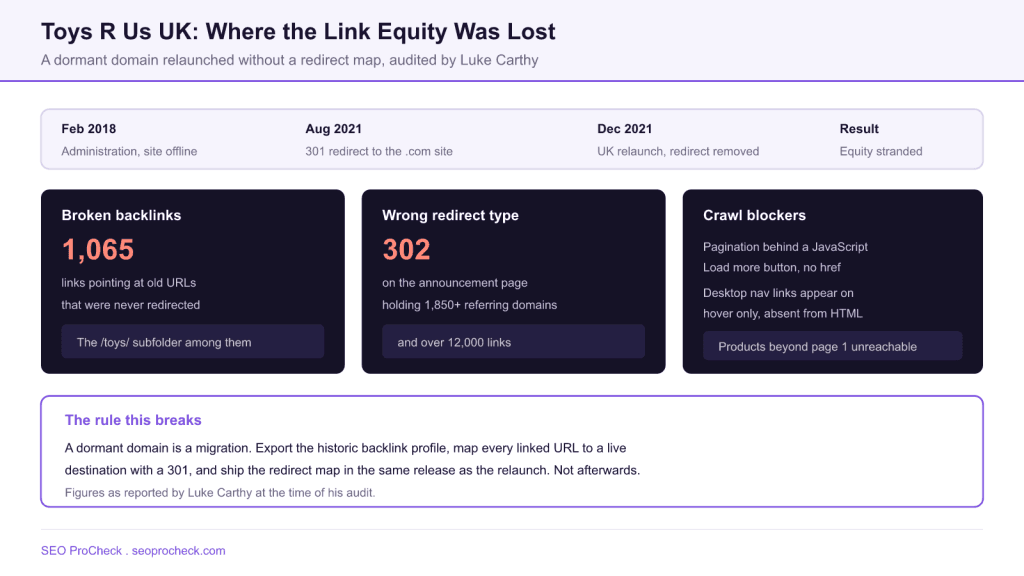
Toys R Us UK went into administration in February 2018, its site went offline, and the domain was relaunched in December 2021 with the interim redirect to the .com site removed. Luke Carthy's audit found roughly 1,065 broken backlinks pointing at unredirected legacy URLs, a 302 on a page holding more than 1,850 referring domains, and JavaScript pagination that stopped search engines reaching most of the catalogue.
- Legacy URLs including the entire /toys/ subfolder were never mapped to live destinations.
- The former announcement page kept over 1,850 referring domains and 12,000 links behind a temporary 302.
- Babies R Us links were sent to the Toys R Us homepage rather than to the new babiesrus.co.uk domain.
- Product pagination and desktop navigation relied on JavaScript, leaving no crawlable anchor links.

The timeline that created the problem
Toys R Us entered administration on 26 February 2018 and the UK website was taken offline. The domain sat dormant for years. In August 2021 a 301 redirect was applied sending it to the .com site. In December 2021 the company relaunched UK operations and removed that redirect so the domain could serve its own content again.
That last step is where it broke. Removing a redirect and standing up a fresh site on the same domain is a migration, whether or not anyone in the project called it one. Every URL that ever earned a link is now either mapped to something live or throwing a 404, and the default outcome of doing nothing is the 404.
Failure one: 1,065 backlinks pointing at nothing
The audit identified approximately 1,065 broken backlinks aimed at old URLs. Critically, that included the /toys/ subfolder and hundreds of product pages. These are exactly the URLs a toy retailer's historic links accumulate on, because that is what people linked to when the site was trading.
Compounding it, links pointing at the old Babies R Us subdirectory were redirected to the Toys R Us homepage rather than to the separate babiesrus.co.uk domain that had been set up for that brand. A redirect to an irrelevant page is closer to a 404 than to a correct redirect, because the topical match that justified the link no longer exists at the destination.
Failure two: a 302 on the highest value URL on the domain
During the dormant years, the announcement page explaining the closure accumulated, in the audit's words, in excess of 1,850 referring domains and over 12,000 links. Every news story about the collapse of a household name pointed at it. That single URL was almost certainly the most linked page the domain has ever had.
It was given a 302. A temporary redirect instructs search engines to keep the source URL indexed and treat the destination as a stopgap. On a permanent change that is the wrong instruction on the wrong page at the worst possible moment.
| Status code | What you are telling search engines | Correct use on a relaunch |
|---|---|---|
| 301 Moved Permanently | This URL has moved for good, consolidate signals onto the destination | The default for every legacy URL that has a live equivalent |
| 302 Found | Temporary. Keep the original URL indexed and come back later | Genuine short term diversions only, such as a two week campaign page |
| 404 Not Found | This page does not exist, no opinion on whether it will return | Legacy URLs with no links and no traffic, though a redirect to a parent is usually better |
| 410 Gone | Deliberately removed, drop it faster | Content you never want back, where you accept losing any link value it held |
| 200 on a thin holding page | This URL is fine and this is the content | Never. A holding page that returns 200 keeps the URL alive with nothing on it |
Status code semantics on a relaunch. The failure at Toys R Us UK was applying the second row to a page that needed the first.
Failure three: the site was hard to crawl once you got there
Two rendering problems compounded the redirect issues. Product pagination relied entirely on a JavaScript Load more button with no accompanying HTML links, so search engines could not reach products beyond the initial batch. Desktop navigation links only appeared on hover and were not present in the HTML, which limits both crawlability and the internal linking structure that distributes authority through a catalogue.
The pattern to internalise is that this is not a JavaScript problem, it is a link problem. Googlebot discovers URLs from anchor elements with resolvable href attributes. A click handler is not a link. The fix is to emit real paginated URLs in the HTML and attach the progressive loading behaviour on top of them.
<!-- Not crawlable: no URL exists for page 2 -->
<button class="load-more" data-page="2">Load more</button>

<!-- Crawlable: real URL, JS enhances it -->
<a href="/toys/?page=2" rel="next" class="load-more">Load more</a>

# Verify with:
curl -s https://example.com/toys/ | grep -o 'href="[^"]*page=[0-9]*"'
What has changed since
Checked live in July 2026, the picture is mixed. The toysrus.co.uk domain resolves and serves a live UK site. However the /toys/ subfolder that the original audit flagged still returns a 404, so at least some of the legacy path structure carrying historic links was never restored or redirected. The babiesrus.co.uk domain no longer resolves at all, which means any Babies R Us links that were eventually pointed there have now lost their destination a second time.
The durable lesson is about sequencing rather than about this retailer. Redirect maps get progressively harder to build over time: backlink indexes drop links to URLs that have 404ed for years, and institutional knowledge of the old URL structure leaves with the people who built it. The redirect map is cheapest to build on day one of a relaunch and most expensive to build four years later.
A relaunch checklist for a dormant domain
| Stage | Action | Why it is ordered here |
|---|---|---|
| Before any build | Export the full historic backlink profile from Ahrefs and Majestic, plus a Wayback Machine URL list | Your own analytics has nothing for the dormant period. Third party indexes are the only record. |
| Before any build | Sort linked URLs by referring domains descending, cap at the top few hundred | A small number of URLs hold most of the value. Manual mapping is affordable at that scale. |
| During the build | Map each URL to the closest live topical equivalent, not the homepage | Homepage redirects preserve far less of the original relevance. |
| Same release as launch | Deploy the 301 map with the site, not as a follow up ticket | Every day of 404s is recrawl budget spent teaching search engines the URL is dead. |
| Launch day | Crawl the live site and confirm every mapped URL returns 301 to a 200 | Redirect chains and redirects into 404s are the two most common implementation bugs. |
| Week one | Verify pagination and navigation links exist in the rendered HTML | A perfect redirect map into an uncrawlable catalogue still fails. |
Relaunch sequence for a domain that has been offline. The ordering matters more than any individual item.
Related reading: fixing self referencing redirect loops covers the most common implementation bug in a large redirect map, broken external links covers the auditing side, the JavaScript SEO rendering guide covers why the Load more pattern fails, and diagnosing a ranking drop covers attribution when a launch and a core update land in the same week.
FAQ
Three things at once. Roughly 1,065 backlinks pointed at legacy URLs that were never redirected, including the whole /toys/ subfolder. The former announcement page, which had accumulated more than 1,850 referring domains and over 12,000 links, was given a 302 rather than a 301. And product pagination sat behind a JavaScript Load more button with no crawlable links, so most of the catalogue was unreachable.
A 302 tells search engines the move is temporary and the original URL should stay in the index. On a permanent relaunch that is simply wrong, and it delays or dilutes the consolidation of signals onto the new URL. Google can eventually treat a long lived 302 as permanent, but you are hoping rather than instructing, on a page carrying twelve thousand links.
Export the historic backlink profile from Ahrefs, Majestic or the Wayback Machine, because your own analytics and Search Console will have nothing for a dormant period. Sort by referring domains, map every linked URL to the closest live destination, and 301 them. Links do not expire while a site is down, so this is usually the highest value hour of work in the whole relaunch.
The button itself is fine. The problem is when it is the only route to page two. Search engines follow anchor elements with href attributes, so if your pagination is a click handler with no underlying links, everything past the first batch is invisible. The fix is to render real paginated URLs and layer the Load more behaviour on top.
Yes, if they are injected on hover rather than merely hidden with CSS. Links present in the HTML and hidden visually are still discovered and followed. Links that do not exist until a mouseover event fires are not, because Googlebot does not hover. Check the rendered HTML rather than the visual behaviour.
It depends entirely on whether you fix the redirects. Ship a correct 301 map and recovery typically begins within weeks as pages are recrawled. Leave legacy URLs 404ing and there is no recovery to wait for, because the equity is not delayed, it is discarded. Recrawl speed on a low authority relaunched domain is also slower than teams expect.
Relaunching a domain that has been offline?
An advanced audit builds the historic redirect map from third party link indexes before anything ships.
Source: https://lukecarthy.com/blog/toys-r-us-are-back-but-their-links-and-traffic-are-not/
Take this with you
The assistant links open with a question about this page already written. Nothing is sent until you press enter.
Claude Vincent is a technical SEO consultant focused on crawlability, rendering, and AI-search visibility. He writes the field guides and case studies at SEO ProCheck, with a bias toward the durable, unglamorous work that decides whether search engines and AI answer engines can actually read and cite a site.
About SEO ProCheck
Technical SEO consulting and GEO strategy with 20 years of enterprise experience. Case studies, resources, and tools for search and AI visibility.
Work With Me
Technical SEO audits, GEO strategy, site migrations, and international SEO. Hourly consulting for teams who need hands-on support, not just reports.
Subscribe to our newsletter!








Recent Posts
- Most Top Sites Never Say Who They Are in Structured Data October 14, 2026
- Homepage Titles Are Mostly Too Short, Not Too Long October 8, 2026
- Who Actually Serves an llms.txt? 184 Top Sites Measured September 29, 2026