

How Pinterest runs Traffic-based Interlinking experiments for SEO
- October 8, 2020
- Website Architecture

AI Summary
Pinterest engineering treats internal linking as a controlled experiment: it routes links from its highest-traffic pages into related targets, then measures the organic lift before rolling changes out. The lesson for any site is that internal links from high-traffic pages carry real equity, and you should test link changes against a baseline rather than adding links blindly.
- Route internal links from your highest-traffic pages into related priority pages.
- Split comparable pages into control and variant groups, then compare actual organic results to a forecast.
- Keep only the link changes that produce a statistically significant lift.
- You can copy the logic at small scale using Search Console clicks and one batch at a time.
Link acquisition remains a critical ranking factor. This case study documents effective approaches to earning links that improved domain authority and supported ranking growth.
Link Building Context
Every link building initiative operates within specific constraints: industry, resources, existing authority, and competitive landscape. This case study establishes the context that shaped link building strategy and tactics.
Strategy and Tactics
Sustainable link building requires approaches that earn editorial links rather than manufacture artificial signals. This case study details the specific tactics employed: content-driven outreach, digital PR, resource creation, or relationship building.
Outreach and Execution
Link building requires efficient outreach processes and compelling value propositions. This case study documents outreach methodology, response rates, and relationship development approaches that yielded results.
Impact Assessment
Link building value manifests in domain authority growth, ranking improvements for target keywords, and referral traffic from acquired links. This case study quantifies the impact of link building efforts and their contribution to overall SEO success.
Link building case studies help practitioners understand effective approaches in an increasingly sophisticated link landscape.
What traffic-based interlinking actually means
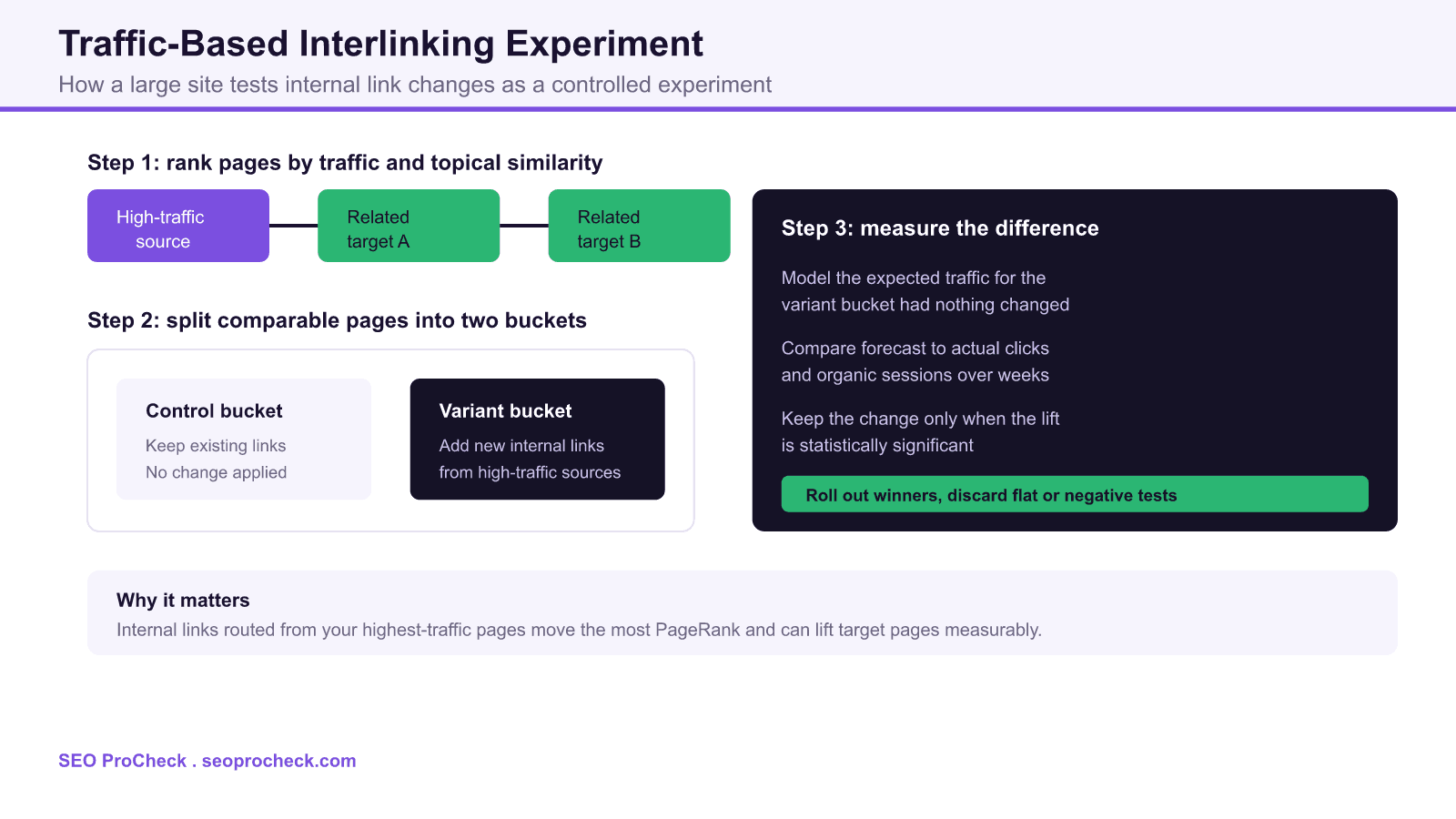
Pinterest engineering published a widely read account of how their team treats internal linking as a measurable, experiment-driven system rather than a manual guessing game. The core idea is simple to state and hard to do at scale: route internal links from the pages that already earn the most organic traffic into related pages that deserve more visibility. Because a high-traffic page tends to be crawled often and to hold more link equity, a contextual link from that page passes more value than a link buried on a low-traffic page. At Pinterest scale, with hundreds of millions of pages, this is automated: the system scores candidate source pages by traffic and candidate target pages by topical relatedness, then proposes links that connect the two.
The reason this deserves an experiment rather than a blanket rollout is that not every internal link helps, and some can dilute focus or create noise. Adding thousands of links across a large site is a real change to the crawl graph and the PageRank flow, so the responsible way to ship it is to test a slice, measure the organic result against a forecast, and only keep changes that move the metric.
How the controlled experiment is structured
The experiment design mirrors a classic SEO split test. Comparable pages are divided into a control group that keeps its existing links and a variant group that receives new internal links from high-traffic sources. Because you cannot show two versions of the same URL to Googlebot at once, the comparison is between groups of similar pages rather than between two versions of one page. The team then forecasts what the variant group would have earned had nothing changed, using the control group and historical trend as the baseline, and compares that forecast to the actual organic sessions the variant group receives over a multi-week window. If the observed lift clears a significance threshold, the change is a winner and gets rolled out more broadly. If the result is flat or negative, the change is discarded, which prevents shipping link patterns that look sensible but do not pay off.
Practitioner takeaways you can apply without Pinterest scale
You do not need a machine learning pipeline to borrow the logic. Pull your top organic landing pages from Google Search Console, then ask which of your priority commercial or pillar pages are topically related to each one. Add a small number of genuinely relevant contextual links from those high-traffic sources into the priority targets, using descriptive anchor text rather than generic phrases. Change one batch at a time, note the date, and watch impressions and clicks on the target pages over the following weeks. This gives you a lightweight version of the same forecast-versus-actual comparison, and it keeps your internal link graph intentional instead of accidental.
| Experiment element | Pinterest scale approach | Small and mid site equivalent |
|---|---|---|
| Pick source pages | Automated traffic scoring across millions of URLs | Sort Search Console pages by clicks, take the top set |
| Pick targets | Topical relatedness model | Map priority pillar and money pages by topic |
| Split | Control versus variant page buckets | Change one batch, hold the rest as a baseline |
| Measure | Forecast versus actual, significance test | Compare impressions and clicks before and after |
| Decide | Roll out winners, drop losers | Keep links that lift, remove links that do not |
Common pitfalls when copying the method
Two mistakes undo most internal linking experiments. The first is adding links that are not truly relevant, which can confuse both users and crawlers and rarely lifts rankings. The second is changing many things at once, which makes it impossible to attribute a result to the link change rather than to a core update, a seasonal swing, or a separate content edit. Isolate the variable, keep a stable baseline, and give each test enough time to clear the noise. For a deeper foundation, see our internal linking complete guide and the practical checklist in 15 internal linking best practices. To route equity deliberately, study internal link sculpting, and for a real split test on this exact lever, review adding internal links to the home page footer.
Frequently Asked Questions
What is traffic-based interlinking?
It is the practice of choosing internal links based on which pages already earn the most organic traffic. Links from high-traffic pages tend to pass more equity and get crawled more often, so routing them into related priority pages can lift those targets. Pinterest engineering popularized running this as a measured experiment rather than a manual task.
How does Pinterest test internal link changes?
They split comparable pages into a control group that keeps existing links and a variant group that receives new links from high-traffic sources, then forecast what the variant group would have earned without the change and compare it to the actual result. Changes are kept only when the organic lift is statistically significant.
Can small sites use traffic-based interlinking?
Yes. Pull your top pages by clicks from Search Console, identify topically related priority pages, and add a few descriptive contextual links from the high-traffic pages into those targets. Change one batch at a time and watch impressions and clicks to see whether it helped.
Does adding more internal links always help rankings?
No. Only relevant links from pages with real authority and traffic tend to help, and irrelevant or excessive links can dilute focus. That is exactly why the method is run as an experiment: you keep the links that lift metrics and discard the ones that do not.
What anchor text should traffic-based internal links use?
Use descriptive, keyword-relevant anchor text that tells users and crawlers what the target page is about, rather than generic phrases like click here. Clear anchors reinforce the topical relationship that makes the link valuable in the first place.
How long should an internal linking experiment run?
Give it several weeks so the change clears normal ranking noise, crawl delays, and seasonality. Long enough that a lift is visible against the baseline, but watch for confounding events such as a core update that could distort the comparison.
Take this with you
The assistant links open with a question about this page already written. Nothing is sent until you press enter.
Claude Vincent is a technical SEO consultant focused on crawlability, rendering, and AI-search visibility. He writes the field guides and case studies at SEO ProCheck, with a bias toward the durable, unglamorous work that decides whether search engines and AI answer engines can actually read and cite a site.
About SEO ProCheck
Technical SEO consulting and GEO strategy with 20 years of enterprise experience. Case studies, resources, and tools for search and AI visibility.
Work With Me
Technical SEO audits, GEO strategy, site migrations, and international SEO. Hourly consulting for teams who need hands-on support, not just reports.
Subscribe to our newsletter!








Recent Posts
- Most Top Sites Never Say Who They Are in Structured Data October 14, 2026
- Homepage Titles Are Mostly Too Short, Not Too Long October 8, 2026
- Who Actually Serves an llms.txt? 184 Top Sites Measured September 29, 2026