

Increasing the number of related article links: SEO Split Testing Lessons from SearchPilot
- June 9, 2021
- Website Architecture
AI Summary
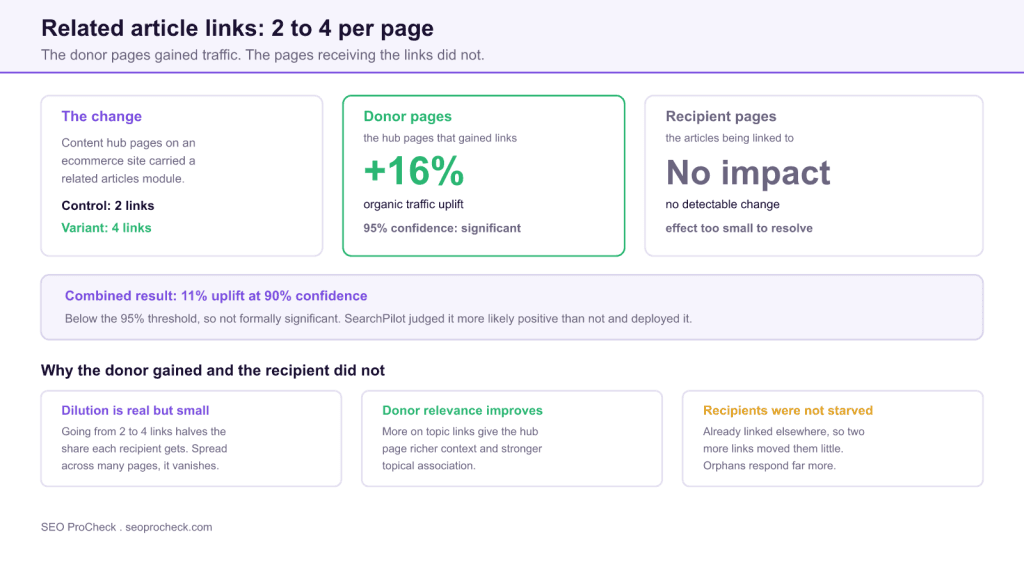
Raising related article links from two to four per page produced an 11% organic traffic uplift at 90% confidence in a SearchPilot split test on an ecommerce content hub. The gain landed on the donor pages that gave the links, not on the recipient pages that received them.
- Donor pages gained 16% at 95% confidence, a statistically significant result.
- Recipient pages showed no detectable impact, most likely because they were already well linked internally.
- Dilution from two extra links was too small to measure, so keeping modules artificially small is not supported here.
- Measure donor and recipient groups separately, a blended number would have hidden the entire finding.
Related article modules are one of the least examined parts of a content template. Someone picked
a number of links years ago, usually two or three, and nobody has revisited it since. SearchPilot ran
the obvious experiment on an ecommerce content hub: raise it from two to four and see what happens.
The headline result was an 11% uplift at 90% confidence. The interesting result was hiding
underneath it.
The result that matters is the split
When SearchPilot separated the pages that gave the new links from the pages that
received them, the two groups behaved completely differently.
| Measurement group | What it covers | Result | Confidence |
|---|---|---|---|
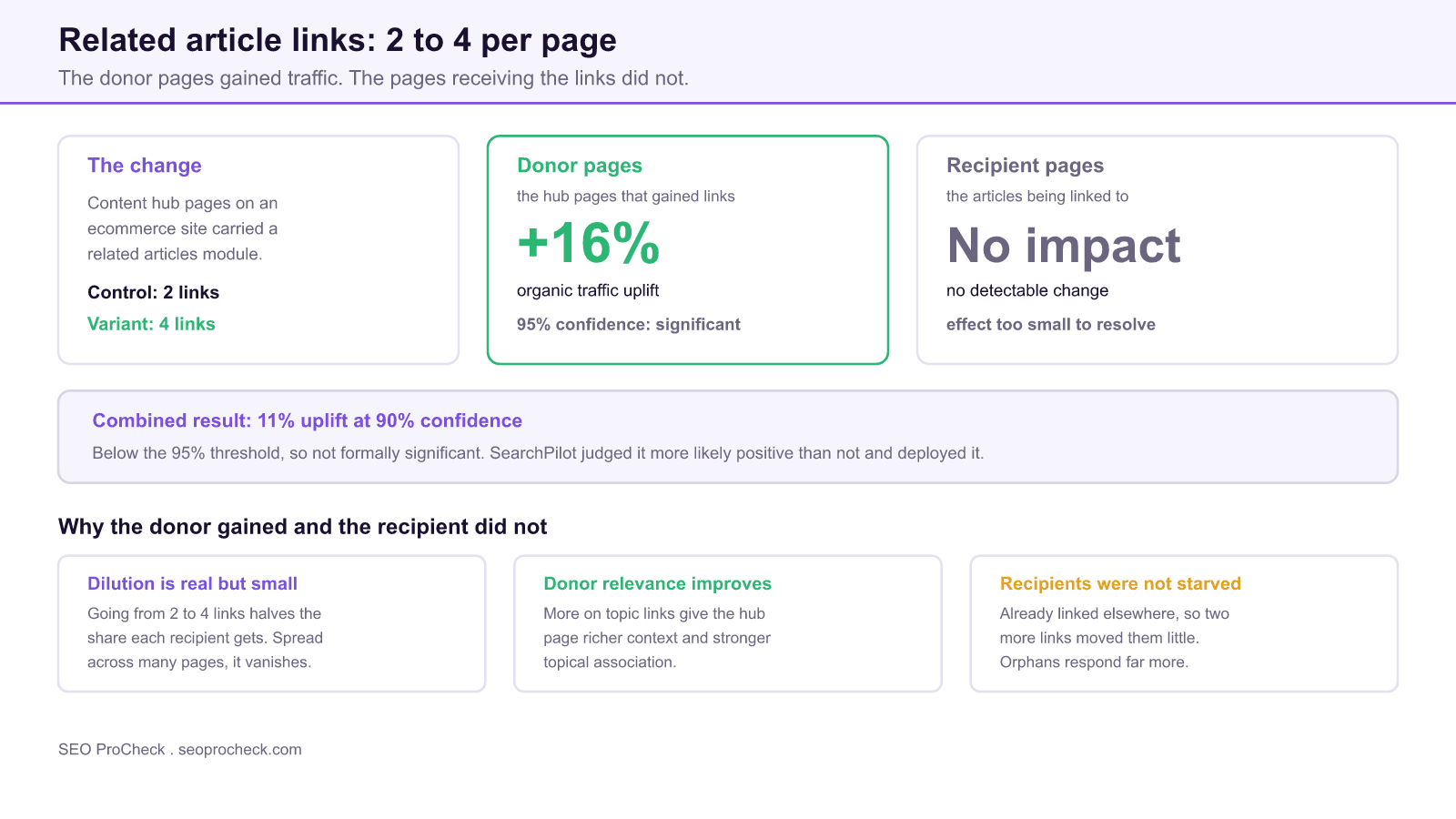
| Donor pages | Content hub pages where links went from 2 to 4 | 16% organic traffic uplift | 95%, statistically significant |
| Recipient pages | The articles receiving the new links | No detectable impact | Not resolvable |
| Combined | Both groups together | 11% uplift | 90%, below the standard threshold |
SearchPilot split test results. Reporting donor and recipient groups separately is what makes this test informative; a single blended number would have obscured the pattern.
The donor pages, the hub pages whose related module went from two links to four, gained 16% organic
traffic at 95% confidence. That is a clean, significant result. The recipient pages, the articles now
being linked to, showed no detectable change at all.
This is the opposite of how most people justify internal linking. The standard argument is that you
add links in order to push equity into the target pages. Here the targets did not move, and
the pages doing the linking did.
Why the donor pages gained
SearchPilot did not claim a mechanism, and neither should we with confidence. But there are three
explanations consistent with the data, and they are not mutually exclusive.
The donor page becomes a better page. Adding two more genuinely related links gives
the hub page more on topic content, more relevant anchor text, and a clearer signal about what the
page is about. A page that links to four closely related articles looks more like a topical hub than
one linking to two. That association can improve how the page itself is understood and ranked.
User behaviour improves on the donor. More relevant onward paths means a higher
chance the visitor finds their next step rather than bouncing back to the results page. Whether or not
you believe engagement is a direct ranking input, a page that satisfies more visits tends to
accumulate the secondary signals that do matter.
The recipients were not short of links to begin with. This is the most likely
reason the target pages did not move. They were already linked from elsewhere on the site. Two
additional links to a page that already has forty changes its internal standing by a rounding error.
The pages that respond dramatically to new internal links are the ones that had almost none, which is
exactly what SearchPilot found in a separate test on
adding links to nearby location pages,
where genuinely starved pages gained 7%.
What about dilution?
The obvious objection to adding links is dilution. Every outbound link on a page splits the equity
that page passes, so going from two links to four halves what each recipient gets. If that effect were
strong, the donor pages should have lost ground.
They gained instead. The likely reason is scale: on a large content hub, the equity flowing through
a related articles module is a small fraction of the page's total outbound links once navigation,
breadcrumbs and body links are counted. Adding two more links to a page that already carries eighty
is a marginal change to the denominator.
Dilution is real arithmetic, but it becomes a practical constraint at dozens or hundreds of links
per page, not in single digits. Treating it as a reason to keep modules artificially small is a
misapplication of the concept.
Deploying on a 90% result
The combined 11% figure did not reach 95% confidence, the conventional threshold for calling a
result significant. SearchPilot deployed the change anyway, on the reasoning that it was more likely
positive than not.
That decision is defensible, and it is worth understanding why rather than treating it as sloppy
statistics. Significance thresholds exist to control the risk of acting on noise. The appropriate
threshold depends on what acting costs you. This change was a template edit, cheap to make, trivially
reversible, and showed no evidence of harm in either group. Under those conditions, waiting for 95%
means forgoing a probably positive change for months.
The calculus reverses for expensive or risky changes. A site wide navigation rebuild showing 11% at
90% confidence deserves a longer test, because the cost of being wrong is high and the change is hard
to unwind. Match the evidence bar to the stakes.
How to apply this to your own templates
The transferable lesson is not "use four links." It is that the link count in your related module
is an untested assumption sitting in a template, and it is cheap to test.
- Audit what your modules currently output. Check the rendered HTML, not the design
spec. Modules that lazy load or inject links via JavaScript after interaction may not be contributing
links at all. - Check the links are genuinely related. A module driven by recency or random
selection produces weak topical signals. Relevance is doing real work in this result. - Measure donor pages separately. This is the specific methodological lesson. If
SearchPilot had reported one blended number, the 16% donor gain would have been invisible. - Prioritise recipients that are actually under linked. Pointing new links at pages
that already have plenty is where this test found nothing.
| Signal | How to read it | Action |
|---|---|---|
| Page has 0 to 1 internal inlinks | Effectively orphaned, crawler may rarely reach it | Highest priority, add links from relevant hubs |
| Page has impressions but position 11 to 25 | Google knows it, does not rate it highly enough | Strong candidate, added links can push it onto page one |
| Page is linked only from paginated archives | Equity arrives diluted and deep in the crawl | Add contextual links from body content instead |
| Page already has 50 or more inlinks | Well established internally | Low priority, added links change little |
| Related module shows fewer than 3 links | Template is under using available space | Test raising the count, measure donor pages |
A triage model for deciding which pages actually need more internal links. The test above suggests the module count itself is worth testing, not just the individual targets.
To find the under linked pages on your own site, the inlink count export is the fastest route:
# Screaming Frog: pull internal inlink counts for every URL
Crawl > Internal tab > filter HTML
Sort by: Inlinks (ascending)
Export: Bulk Export > Links > All Inlinks

# Anything at 0 or 1 inlinks is effectively orphaned
# Cross reference with Search Console impressions to find
# pages Google already knows about but ranks poorly
Our internal link analyzer
covers the same ground without a desktop crawler, and the
one followed internal link check
isolates the near orphan pages directly.
Make sure the links actually count
A related module only transmits signals if crawlers can see it. The most common way this test's
result fails to replicate is that the module is not really passing links at all.
# A related-articles module worth testing (server rendered, crawlable)
<aside class="related-articles">
<h2>Related articles</h2>
<ul>
<li><a href="/guides/internal-linking/">Internal linking guide</a></li>
<li><a href="/guides/crawl-budget/">Crawl budget explained</a></li>
<li><a href="/guides/site-structure/">Site structure basics</a></li>
<li><a href="/guides/canonical-tags/">Canonical tags</a></li>
</ul>
</aside>

# Requirements that decide whether this counts at all:
# 1. Present in the raw HTML, not injected after load
# 2. Real anchor text, not "read more"
# 3. No rel=nofollow, no JavaScript click handlers as the only path
Check three things in the raw source. First, the anchors must exist in the server rendered HTML.
Second, the anchor text must be descriptive; a module of four links all reading "read more" gives up
most of the topical benefit that likely drove the donor gain. Third, no stray
rel="nofollow" on internal links, which is a surprisingly common template leftover.
Where this fits in a linking strategy
Related article modules are automated internal linking, and automation has a ceiling. It is good at
guaranteeing every page has some onward paths and no page is orphaned. It is poor at the judgement
calls: which specific page most needs support right now, which anchor text matches the query you are
targeting, where a link belongs inside the body copy rather than in a box at the bottom.
Use the module as your floor and contextual body links as your lever. Our
complete internal linking guide
covers the manual side, and
topic cluster architecture
covers how to decide which pages should be linking to which in the first place. The split test tells
you the module is worth more than you assumed. It does not tell you the module is enough.
FAQ
There is no universal number, but this test moved from two to four and saw a positive net outcome, so two was leaving value on the table. The practical approach is to treat it as a testable variable on your own templates rather than adopting someone else's count. Start by raising a low number and measure the donor pages, not just the targets.
Mathematically yes, each additional link on a page reduces the share every other link receives. In practice the dilution from going from two links to four is spread across a large site and was too small to detect here. Dilution becomes a real concern at dozens or hundreds of links per page, not at single digits.
Donor pages are the pages where the new links were added, so they are the ones giving link equity away. Recipient pages are the pages being linked to. Splitting results this way matters because the two groups can move in opposite directions, and a combined number can hide that.
The most plausible explanation is that additional on topic links improve the donor page itself, by strengthening its topical context and giving users a reason to stay. The recipients in this test were already linked from elsewhere, so two extra links did not change their standing much. Pages that are genuinely under linked respond far more strongly.
It depends on the cost and the downside. SearchPilot deployed this one because the change was cheap, reversible, and showed no sign of harm, so the expected value was positive even without formal significance. A 90% result on an expensive or risky change deserves more caution or a longer test.
Look for pages with very few incoming internal links relative to their commercial value. Crawl the site and sort by inlink count ascending, then cross reference against pages that already earn impressions in Search Console but sit low in position. Those are the under linked pages where added links tend to pay off.
Is your related content module earning its place?
Most related modules run on a link count nobody has revisited in years. An audit shows what your templates are actually passing.
Take this with you
The assistant links open with a question about this page already written. Nothing is sent until you press enter.
Claude Vincent is a technical SEO consultant focused on crawlability, rendering, and AI-search visibility. He writes the field guides and case studies at SEO ProCheck, with a bias toward the durable, unglamorous work that decides whether search engines and AI answer engines can actually read and cite a site.
About SEO ProCheck
Technical SEO consulting and GEO strategy with 20 years of enterprise experience. Case studies, resources, and tools for search and AI visibility.
Work With Me
Technical SEO audits, GEO strategy, site migrations, and international SEO. Hourly consulting for teams who need hands-on support, not just reports.
Subscribe to our newsletter!








Recent Posts
- Most Top Sites Never Say Who They Are in Structured Data October 14, 2026
- Homepage Titles Are Mostly Too Short, Not Too Long October 8, 2026
- Who Actually Serves an llms.txt? 184 Top Sites Measured September 29, 2026