

Measuring Brand Mentions in AI Responses
- January 20, 2025
- GEO (Generative Engine Optimization), AI and Search
AI Summary
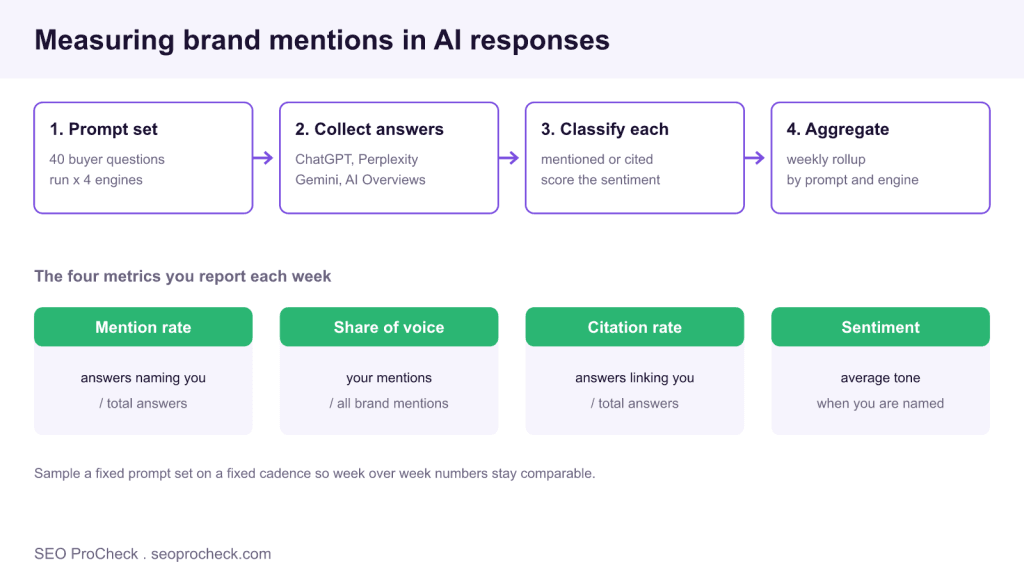
To measure brand mentions in AI responses you run a fixed set of buyer questions across the engines your audience uses, repeat each prompt several times, and classify every answer for whether it names you, cites you, and how positively it frames you. You then report five stable metrics: mention rate, share of voice, citation rate, sentiment, and first position rate, on a weekly cadence.
- Keep the prompt set fixed so week over week numbers stay comparable.
- Run each prompt three to five times because generative answers vary.
- A mention names you, a citation links to your domain, and the two are tracked separately.
- Report each engine on its own, since ChatGPT, Perplexity, Gemini and AI Overviews differ widely.

Classic rank tracking tells you where a page sits on a results page. It says nothing about whether ChatGPT recommends you, whether Perplexity cites your documentation, or whether a Google AI Overview names a competitor instead of you. Measuring brand mentions in AI responses is the discipline of turning those fuzzy impressions into numbers you can trend, defend in a report, and act on. This guide lays out a repeatable method that avoids the two failure modes of AI visibility work: eyeballing a single ChatGPT session, and drowning in unstructured screenshots.
Define the prompt set before you measure anything
Your measurement is only as good as your prompts. Build a set of 30 to 50 questions that reflect how buyers actually ask in your category: unbranded demand ("best invoicing app for freelancers"), competitor comparisons ("alternatives to a named rival"), and problem framed queries ("how to reduce churn in a SaaS trial"). Freeze that set and version it. The instant you change prompts, you lose the ability to compare this week to last week, which is the entire point of measurement.
Sample across engines, and repeat each prompt
Two rules separate signal from noise. First, treat each engine as a separate channel: ChatGPT, Perplexity, Gemini, and Google AI Overviews return different answers with different citation behavior, so a blended number hides more than it reveals. Second, never trust a single run. Generative answers are probabilistic, so the same prompt can name you once and skip you the next time. Run each prompt three to five times and record a rate rather than a binary. The scorecard you report is a set of rates, not a set of yes and no flags.
prompts = [
  "best project management tool for agencies",
  "top alternatives to ",
  "which invoicing app integrates with Xero",
]
engines = ["chatgpt", "perplexity", "gemini", "aio"]
runs_per_prompt = 5

for engine in engines:
  for prompt in prompts:
    for i in range(runs_per_prompt):
      answer = ask(engine, prompt)
      row = {
        "engine": engine,
        "prompt": prompt,
        "mentioned": brand_in(answer),
        "cited": domain_linked(answer),
        "rank": first_position(answer),
        "sentiment": tone(answer),
      }
      log(row)
The loop above is deliberately simple. Whether you drive it with a paid platform, a headless browser, or an API, the structure is identical: iterate engines and prompts, capture the raw answer, then classify it into a row you can aggregate.
Classify every answer three ways
For each captured answer, extract three facts. Was your brand mentioned anywhere in the text? Was your domain cited or linked as a source? And what was the sentiment of the framing when you were named? Keep mention and citation strictly separate, because a model can praise you by name while linking a competitor as its source, and that gap is exactly the thing you want to close. For sentiment, a coarse positive, neutral, or negative label is enough at first, applied consistently.
The five metrics worth reporting
Roll the classified rows up into a small, stable scorecard. Five metrics cover almost every decision a stakeholder needs to make.
| Metric | Formula | What it tells you |
|---|---|---|
| Mention rate | answers naming you / total answers | Baseline visibility in the category |
| Share of voice | your mentions / all brand mentions | Position versus named competitors |
| Citation rate | answers linking your domain / total answers | Whether models read your pages, not just your name |
| Sentiment | average tone when named | Quality of the framing, positive or negative |
| First position rate | answers naming you first / total answers | Primacy, which correlates with recall |
Share of voice is the one executives grasp fastest, because it frames the result competitively: of every brand named in answers to your category questions, what fraction were you. First position rate is the sleeper metric, since being named first correlates strongly with what a reader remembers.
Tooling: build, buy, or both
You have three practical paths. Purpose built AI visibility platforms such as Profound and the AI tracking modules now shipping inside Semrush and Ahrefs automate collection and give you dashboards out of the box, which is the fastest route for a team. A custom script gives you full control of the prompt set and classification logic, and is cheap if you already have API access. Many teams run both: a platform for the executive trend line and a lightweight script to interrogate specific prompts when a number moves. Whatever you choose, store the raw answers, not just the rollups, so you can re classify later without rerunning history.
Turn measurement into action
Numbers only matter if they change what you ship. A low citation rate despite a healthy mention rate means the models know your name but are not reading your pages, so the fix is quotable, well structured, machine readable content. A weak share of voice on comparison prompts points at missing comparison and alternatives pages. Negative sentiment on a specific prompt is a content and reputation task, not a technical one. Tie each metric to an owner and a next step, or the scorecard becomes a wall decoration.
Related reading
This metric sits inside the wider practice of generative engine optimization. To go deeper, see how the disciplines relate in SEO versus AEO versus GEO, the tactics behind becoming a cited source in AI answers, and the full set of generative engine optimization guides.
Frequently asked questions
What is the difference between a mention and a citation?
A mention is any time the model names your brand in its answer text. A citation is when the answer also links to or attributes a specific source from your domain. Citations are rarer and more valuable because they can send referral traffic and confirm the model is reading your pages, not just recalling your name.
How many prompts do I need to get a stable read?
Start with 30 to 50 prompts that mirror real buyer questions in your category, and keep that set fixed. A small set that never changes gives you comparable week over week trends, whereas a shifting set makes any movement impossible to interpret. Expand the set deliberately and version it when you do.
How often should I sample?
Weekly is the practical default for most brands. AI answers change frequently, but daily sampling adds noise and cost without changing decisions. Sample on the same day and, where the platform allows, hold temperature and model version steady so the run is repeatable.
Can I trust one run of a prompt?
No. Generative answers vary between runs, so a single query is anecdote, not data. Run each prompt three to five times and record the mention rate across runs. Report the rate, not a yes or no, because that is what smooths out the model randomness.
Which engines should I track?
Track the surfaces your buyers actually use: ChatGPT, Perplexity, Google AI Overviews, and Gemini cover most demand for English language B2B and consumer queries. Add Copilot or a vertical assistant if your audience lives there. Report each engine separately, since coverage differs a lot between them.
Do brand mentions in AI answers affect my SEO?
They are a visibility metric in their own right rather than a classic ranking factor. Being named and cited in AI answers wins attention at the moment of decision, and the same signals that earn citations, clear entity data and quotable facts, also tend to help traditional search.
Take this with you
The assistant links open with a question about this page already written. Nothing is sent until you press enter.
Claude Vincent is a technical SEO consultant focused on crawlability, rendering, and AI-search visibility. He writes the field guides and case studies at SEO ProCheck, with a bias toward the durable, unglamorous work that decides whether search engines and AI answer engines can actually read and cite a site.
About SEO ProCheck
Technical SEO consulting and GEO strategy with 20 years of enterprise experience. Case studies, resources, and tools for search and AI visibility.
Work With Me
Technical SEO audits, GEO strategy, site migrations, and international SEO. Hourly consulting for teams who need hands-on support, not just reports.
Subscribe to our newsletter!








Recent Posts
- Most Top Sites Never Say Who They Are in Structured Data October 14, 2026
- Homepage Titles Are Mostly Too Short, Not Too Long October 8, 2026
- Who Actually Serves an llms.txt? 184 Top Sites Measured September 29, 2026