

FAQ Schema: Implementation Guide for Rich Results
- March 1, 2017
- Schema and Structured Data, Technical SEO
AI Summary
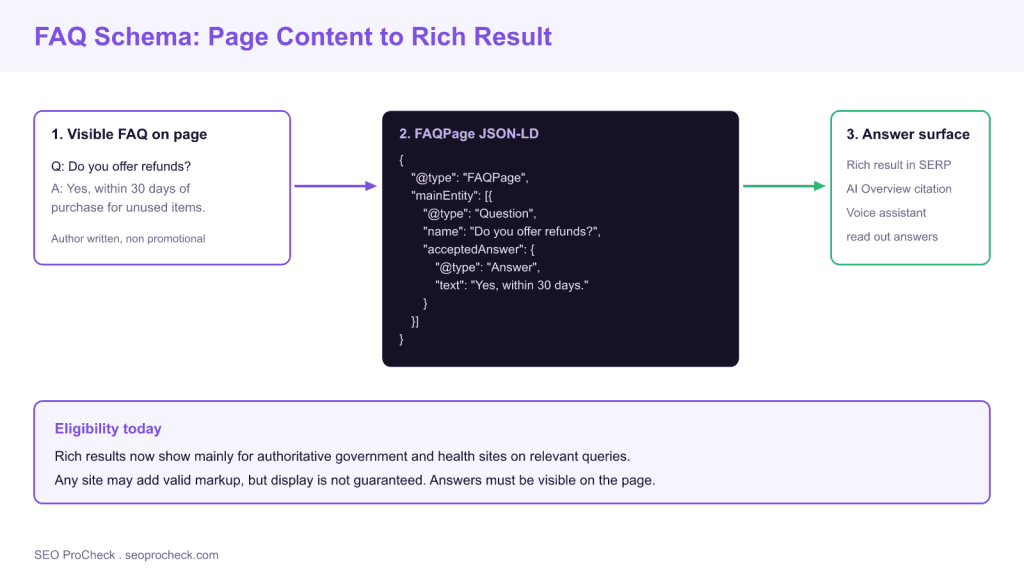
FAQ schema (FAQPage JSON-LD) marks up genuine question and answer pairs that are visible on the page so search engines can read them as structured data. Google limited FAQ rich results to authoritative government and health sites in 2023 and stopped showing them for every site on May 7, 2026, but valid markup still helps AI answer engines, voice assistants, and internal quality signals.
- Use FAQPage only for author written questions that are visible on the page, never for user generated Q&A (use QAPage) or ads.
- Each Question needs a name plus an acceptedAnswer with a text property; keep answers concise and complete.
- Google no longer displays FAQ rich results, so treat schema as an extraction aid for AI and voice, not a ranking lever.
- Validate with the Rich Results Test and monitor the FAQ report in Search Console Enhancements.

Understanding FAQ Schema
FAQPage schema markup once enabled expanded question-and-answer displays directly in Google search results, significantly increasing your listing's visual footprint. When implemented correctly, FAQ rich results showed questions that users could click to expand and see answers without leaving the search results page. This feature works particularly well for service pages, product pages, and informational content where common questions naturally arise. However, Google became selective about displaying FAQ rich results in 2023, and on May 7, 2026 it stopped showing them for every site.
Eligibility and Guidelines
Google tightened its guidelines for FAQ rich results in 2023, limiting them to well-known, authoritative government and health websites, then stopped showing them for every site on May 7, 2026 and removed its FAQPage documentation on June 15, 2026. Any site may still implement FAQ markup for other engines and AI assistants, but Google will not display it as a rich result. Content must genuinely answer common questions, be written by the site (not user-generated), and be visible on the page. Each question should be unique and provide substantive value. Avoid using FAQ schema for promotional content, contact forms, or navigation elements disguised as questions.
| Eligible Content | Ineligible Content |
|---|---|
| Genuine frequently asked questions | User-generated Q&A (use QAPage instead) |
| Product/service FAQs | Single question pages |
| How-to questions with brief answers | Advertising disguised as FAQ |
| Company/policy information | Questions not visible on page |
Implementation Structure
FAQPage schema requires a mainEntity property containing an array of Question entities. Each Question needs name (the question text) and acceptedAnswer containing an Answer entity with text property. The answer text supports limited HTML including links, lists, and paragraph breaks. Keep answers concise but complete, as excessively long answers may be truncated. Structure your JSON-LD with the FAQPage as the root type, not nested within Article or other schemas.
Content Strategy for FAQ Sections
Effective FAQ content addresses genuine user questions discovered through customer service data, search query analysis, and competitor research. Group related questions logically on appropriate pages rather than creating one massive FAQ page. Product pages benefit from product-specific FAQs, while service pages need service-related questions. Avoid duplicating FAQ content across pages, as this can create thin content issues. Update FAQs regularly based on new questions from users and changes to your products or services.
Measuring FAQ Performance
Google Search Console's Enhancements section shows FAQ rich result status, including valid pages, warnings, and errors. Track click-through rates for pages with FAQ markup to assess impact. Note that rich result impressions don't always correlate with clicks, as users may find answers directly in the expanded FAQ without clicking through. If FAQ rich results stopped appearing despite valid markup, that is expected: Google retired them for every site on May 7, 2026.
A Working FAQPage Example
The markup below is a complete, valid FAQPage block for two visible questions. Place it in the page head or body, keep the answer text identical to what site visitors can read, and never inject questions that do not appear on the rendered page. Answers accept a small amount of HTML (links, lists, paragraphs), which Google strips back to plain text for display.
<script type="application/ld+json">
{
  "@context": "https://schema.org",
  "@type": "FAQPage",
  "mainEntity": [
    {
      "@type": "Question",
      "name": "How long does shipping take?",
      "acceptedAnswer": {
        "@type": "Answer",
        "text": "Standard orders ship in 2 to 3 business days."
      }
    },
    {
      "@type": "Question",
      "name": "Do you offer refunds?",
      "acceptedAnswer": {
        "@type": "Answer",
        "text": "Yes, within 30 days of purchase for unused items."
      }
    }
  ]
}
</script>
Common validation failures come from a mismatch between markup and visible text, missing acceptedAnswer objects, answers that contain disallowed elements, and nesting FAQPage inside an Article graph. Keep FAQPage as its own top level type so parsers read it cleanly.
Deciding Which Pages Deserve FAQ Markup
Not every page benefits. Because Google narrowed FAQ rich results to authoritative government and health domains in 2023 and retired them for every site on May 7, 2026, the practical value now comes from three places: cleaner extraction into AI Overviews and answer engines, better voice assistant read outs, and a tidy internal signal that your page directly answers common questions. Prioritise pages where genuine questions cluster and where a concise answer resolves intent. For a deeper primer on when markup still earns its keep, see our companion note on whether FAQ schema is still worth it.
| Page Type | Add FAQPage? | Why |
|---|---|---|
| Service and product pages | Yes, if questions are real | Resolves buyer intent and feeds answer engines |
| Support and policy pages | Yes | Refund, shipping, and warranty questions extract cleanly |
| Blog and guide posts | Selectively | Only where a compact Q&A adds value beyond the prose |
| Community threads | No, use QAPage | User generated answers require the QAPage type |
| Landing pages with no real FAQs | No | Fabricated questions risk a manual action |
Validation and Testing Workflow
Treat validation as a repeatable step rather than a one time check. Run each template through the Rich Results Test at search.google.com/test/rich-results to confirm the FAQPage parses and the questions are detected. Use the Schema Markup Validator at validator.schema.org for strict syntax checking that is not tied to Google eligibility. After deployment, watch the FAQ report inside Search Console under Experience and Enhancements for valid, warning, and error states, and set a monthly cadence to catch template regressions. When you optimise the same answers for AI answer engines, pair this markup with the practices in our answer engine optimization guide and structure the visible copy for citation as described in the AI Overviews optimization guide.
Frequently Asked Questions
Does FAQ schema still generate rich results in 2026?
Not in Google. Google restricted FAQ rich results to well known authoritative government and health sites in 2023, then stopped showing them for every site on May 7, 2026. Sites can still add valid markup, and the practical payoff is cleaner extraction for AI answers, voice, and other engines such as Bing.
What is the difference between FAQPage and QAPage?
FAQPage is for author written questions and answers published by the site owner. QAPage is for pages where users submit and vote on answers, such as forums and community threads. Using FAQPage for user generated content is a guideline violation.
Do the answers need to be visible on the page?
Yes. Google requires that the full question and answer text is present and visible to users on the page. Hidden, tabbed away, or markup only answers that do not appear in the rendered content can trigger a structured data manual action.
How long should FAQ answers be?
Keep answers concise but complete, typically one to three sentences. Overly long answers may be truncated and add little value for extraction. Focus each answer on directly resolving the question rather than upselling.
Can I put FAQPage schema inside my Article schema?
Keep FAQPage as its own top level type rather than nesting it inside Article or Product. A flat graph is easier for parsers to read and less likely to produce validation warnings, though multiple types can coexist in one graph array.
Which tools validate FAQ markup?
Use Google's Rich Results Test to check eligibility and detection, and the Schema Markup Validator for strict syntax. After launch, monitor the FAQ enhancement report in Search Console for valid, warning, and error counts across your templates.
Take this with you
The assistant links open with a question about this page already written. Nothing is sent until you press enter.
Claude Vincent is a technical SEO consultant focused on crawlability, rendering, and AI-search visibility. He writes the field guides and case studies at SEO ProCheck, with a bias toward the durable, unglamorous work that decides whether search engines and AI answer engines can actually read and cite a site.
About SEO ProCheck
Technical SEO consulting and GEO strategy with 20 years of enterprise experience. Case studies, resources, and tools for search and AI visibility.
Work With Me
Technical SEO audits, GEO strategy, site migrations, and international SEO. Hourly consulting for teams who need hands-on support, not just reports.
Subscribe to our newsletter!








Recent Posts
- Most Top Sites Never Say Who They Are in Structured Data October 14, 2026
- Homepage Titles Are Mostly Too Short, Not Too Long October 8, 2026
- Who Actually Serves an llms.txt? 184 Top Sites Measured September 29, 2026