

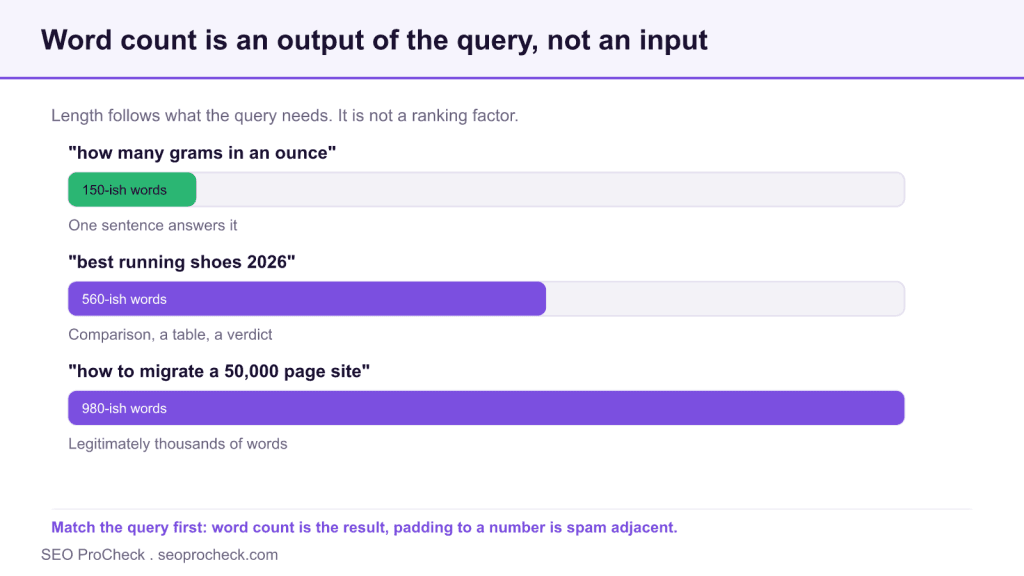
Word count is simply the number of words on a page, and Google has stated repeatedly that it is not a ranking factor. Treat length as an output of matching the query rather than a target, so you neither pad thin answers nor starve topics that need depth.
- Correlation studies find long pages rank well because comprehensive topics tend to be long, not because length itself ranks.
- A definitional query can be fully answered in a sentence, while a migration guide legitimately needs thousands of words.
- Thin means unhelpful, not brief; a short page that resolves the query is complete.
- Use content optimizers for topic gap ideas, not for a word quota to hit.
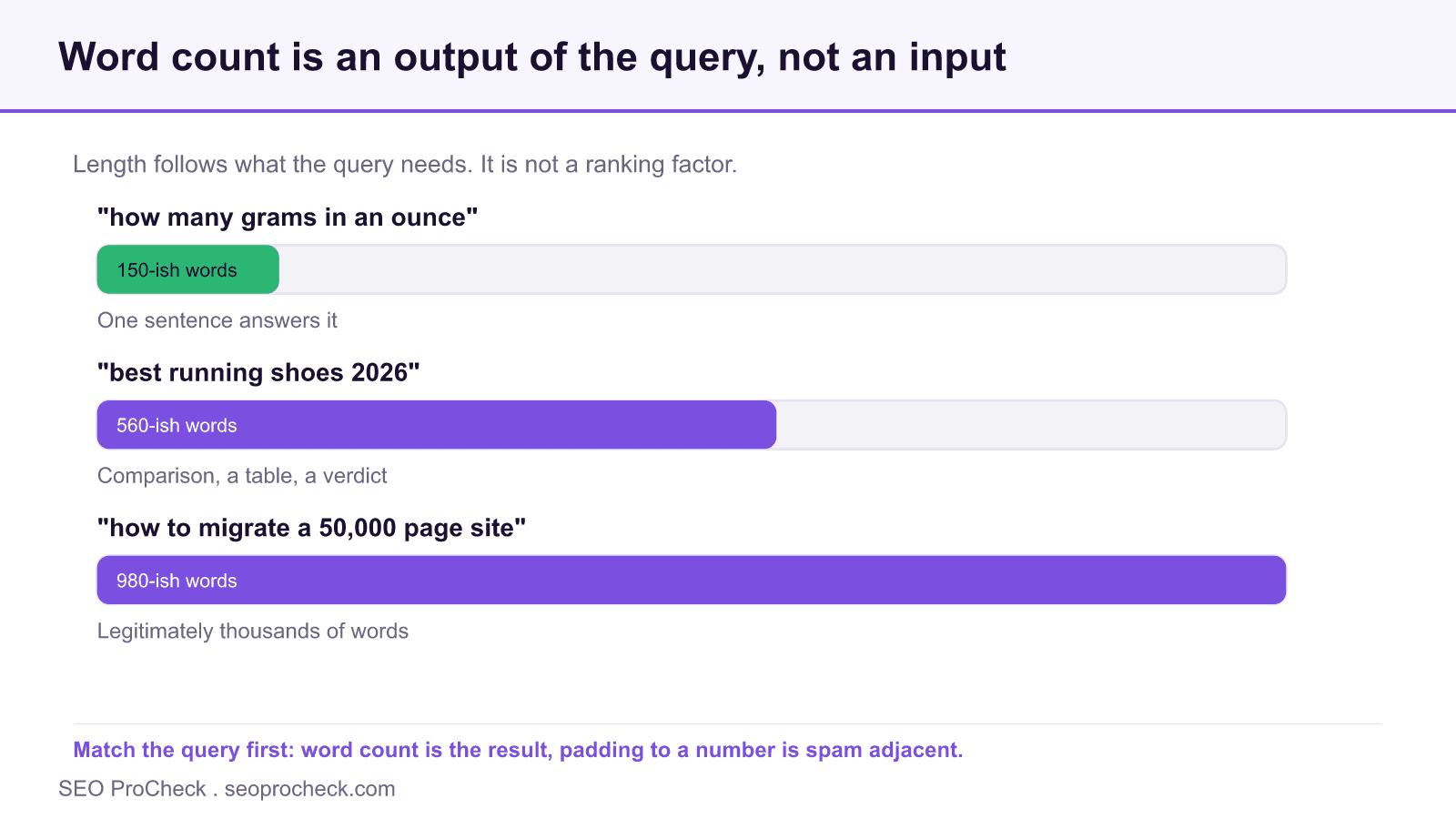
Word count is simply the number of words on a page. It's a descriptive metric, useful for spotting outliers, and it is not a ranking factor, no matter how many "optimal length" charts you've seen. Treat it as a target and you'll ship bloated content; ignore it entirely and you'll miss pages that are too thin to answer anything.
Let's kill the myth first
Google's John Mueller has said flatly, on multiple occasions across office-hours sessions and social posts, that word count is not a ranking factor, that a page isn't better just because it's longer. This isn't a controversial reading of tea leaves; it's about as direct as Google statements get.
So why does everyone believe longer content ranks better? Because correlation studies keep finding that top-ranking pages average 1,500 to 2,000+ words, and people read the causation backwards. Comprehensive pages tend to be long. Long pages are not therefore comprehensive. The 3,000-word recipe intro about someone's grandmother exists because of this exact confusion, and Google's systems reward the recipe, not the padding. We unpack the correlation trap in the content length myth.
The honest framing: word count is an output of matching the query, not an input you optimize. "How many grams in an ounce" is fully answered in one sentence. "How to migrate a 50,000-page site" legitimately needs thousands of words. Writing 2,000 words for the first query is spam-adjacent; writing 300 for the second is malpractice.
What length actually serves the query
| Content type | What the query needs | Sane range | Where teams screw it up |
|---|---|---|---|
| Definitional / factual query | The answer, fast, plus enough context to trust it | 100 to 600 words | Padding to 1,500 because "Google likes long" |
| Product page | Specs, differentiators, objections handled, proof | 300 to 800 words + structured data | Boilerplate paragraphs pasted across 200 SKUs |
| Comparison / "vs" page | Honest criteria, a real verdict, a comparison table | 800 to 1,500 words | Fence-sitting filler that never picks a side |
| How-to / tutorial | Every step to done, screenshots, edge cases | As long as the task, 500 to 4,000+ | Cutting steps to hit a word budget |
| News / update post | What changed, who's affected, what to do | 200 to 600 words | Recapping five years of backstory above the news |
| Pillar / definitive guide | Full topic coverage that earns links and rankings | 2,000 to 5,000+ words | Length without structure, a wall nobody navigates |
| Glossary entry | Definition, example, how-to, edge cases | 600 to 1,600 words | A two-line definition that answers nothing (ask us how we know) |
Those ranges describe what typically serves each intent, they're diagnostic, not quotas. Our content-length study by content type shows how wide the spread really is even among ranking pages.
How to check it on your own site
- Crawl with Screaming Frog and sort the word count column both ways. You're hunting outliers: 80-word pages targeting competitive queries, and 4,000-word pages for questions a table would answer.
- Spot-check individual pages with our free word counter, it counts what's actually in the content area, not your nav and footer.
- Compare against the query, not competitors. Search your target term and ask what the searcher needs to be done. If the top results are all bloated, that's an opening to be the concise one, not an instruction to match their bloat.
- Cross-reference with Search Console. Thin pages with high impressions and no clicks are your best expansion candidates, demand exists, the page just doesn't answer enough of it.
- Check for template padding. If every page carries 400 words of identical boilerplate, your "word counts" are lying to you across the whole site.
Common word count mistakes (and fixes)
- Writing to a tool's target. Content optimizers that demand "2,400 words to be competitive" are averaging the SERP, not reading the query. Fix: use them for topic-gap ideas, ignore the word quota.
- Padding intros to delay the answer. Users scroll-hunt, then bounce. Fix: answer in the first paragraph; spend the remaining words on depth, not throat-clearing.
- Equating short with thin. Thin means unhelpful, not brief, a 150-word page that fully answers its query is complete. Fix: judge pages on whether they resolve the query, then check keyword density obsessions at the door too.
- Trimming purely to shorten. Cutting real substance to hit some "ideal length" is the same mistake mirrored. Fix: cut redundancy, keep information.
- Averaging the top 10 and adding 10%. This arms race is how every SERP filled up with interchangeable 2,500-word posts. Fix: differentiate on information and format instead.
FAQ
Is there a minimum word count to rank?
No. Pages rank with a few dozen words when they satisfy the query, weather answers, conversion calculators, definitions. What Google needs is enough content to understand and trust the page, and that bar depends entirely on the query.
Then why do long posts seem to rank better?
Selection effect. Topics that deserve long treatment are competitive, so the pages winning them are thorough, and thoroughness produces length. Copying the length without the substance copies nothing that matters.
Does word count affect how often Google crawls or indexes a page?
Not as a length threshold. Extremely thin pages can fall into "crawled, currently not indexed" because they add no value, but that's a value judgment, not a word floor. Fixing it means adding usefulness, not filler.
Should long content be split into multiple pages?
Only if the pieces each serve a distinct query. Splitting one intent across three URLs just makes three weak pages compete with each other.
How does word count relate to readability?
They're independent axes, a long page can be effortless to read and a short one can be sludge. Length decides whether the answer is complete; readability decides whether anyone gets through it.
Take this with you
The assistant links open with a question about this page already written. Nothing is sent until you press enter.
Claude Vincent is a technical SEO consultant focused on crawlability, rendering, and AI-search visibility. He writes the field guides and case studies at SEO ProCheck, with a bias toward the durable, unglamorous work that decides whether search engines and AI answer engines can actually read and cite a site.
About SEO ProCheck
Technical SEO consulting and GEO strategy with 20 years of enterprise experience. Case studies, resources, and tools for search and AI visibility.
Work With Me
Technical SEO audits, GEO strategy, site migrations, and international SEO. Hourly consulting for teams who need hands-on support, not just reports.
Subscribe to our newsletter!








Recent Posts
- Most Top Sites Never Say Who They Are in Structured Data October 14, 2026
- Homepage Titles Are Mostly Too Short, Not Too Long October 8, 2026
- Who Actually Serves an llms.txt? 184 Top Sites Measured September 29, 2026