

AI Summary
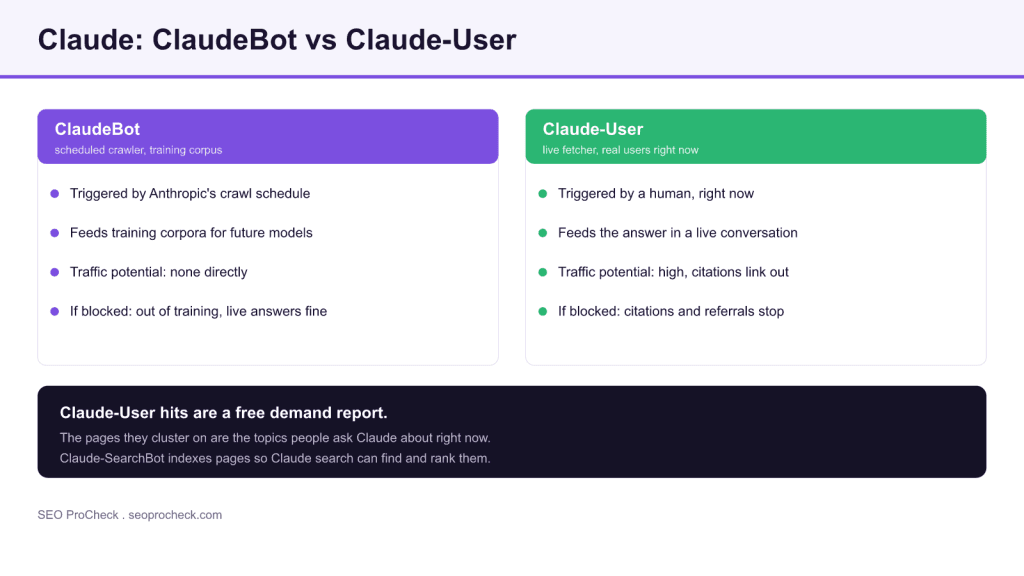
Claude is Anthropic's AI assistant, and with web search on it reads live pages mid conversation and answers with source links. For a site owner that is two things to manage: ClaudeBot, the training crawler that sends no traffic, and Claude-User, the live fetcher whose visits produce citations and referrals.
- Match exact tokens; a wildcard for anything containing Claude can kill Claude-User and every citation.
- Claude-User hits are a free demand report: they show the topics users ask Claude about right now.
- Blocking ClaudeBot only opts you out of future training, not out of live citations.
- Claude reads delivered HTML, so content that only exists after hydration is invisible to it.
What Claude is (for site owners)
Claude is Anthropic’s AI assistant, and with web search enabled it reads live pages mid-conversation and answers with source links. For a site owner that makes Claude two separate things to manage: a training pipeline that may absorb your content into future models, and a real-time reading channel where your page gets pulled in front of a user the moment they ask the right question.
The stakes are the same asymmetry as every AI platform: the training side gives you nothing measurable, while the live side produces citations and referral visits, and one careless robots.txt line can kill both.
How Claude gets web content
Anthropic operates distinct agents with separate robots.txt tokens:
- ClaudeBot: the scheduled crawler collecting public pages for training future Claude models.
- Claude-User: the fetcher that retrieves a page while a human is actively talking to Claude, either through web search or a pasted URL.
- Claude-SearchBot: Anthropic’s indexing agent, improving how Claude’s search finds and ranks pages.
Same-named hits in your logs therefore mean very different things, and the ClaudeBot/Claude-User distinction is the one worth internalizing:
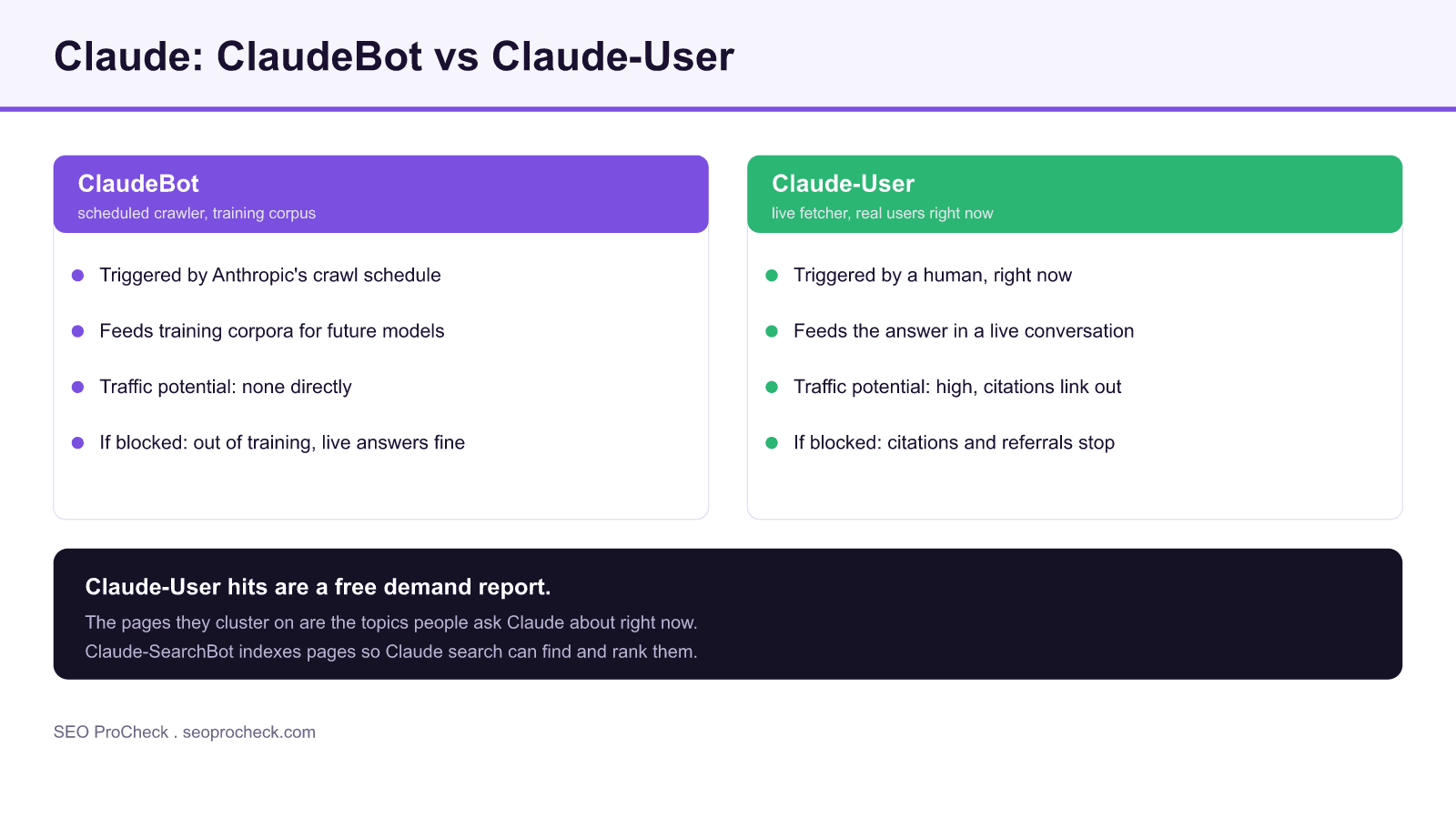
ClaudeBot vs Claude-User: what each hit means
| ClaudeBot | Claude-User | |
|---|---|---|
| Who triggered the fetch | Anthropic’s crawl schedule, nobody asked about you | A human, right now, whose question led Claude to your page |
| What it feeds | Training corpora for future Claude models | The answer being written in a live conversation |
| Traffic potential | None directly, training produces no links | High: citations link out, and the reader is mid-research |
| What a log spike means | A crawl pass over your site; volume tracks your page count | Real demand: people are asking Claude questions your pages answer |
| If you block it | Content excluded from future training runs; live answers unaffected | Claude can’t read your pages for users: citations and referrals stop |
| Robots.txt token | ClaudeBot | Claude-User |
Put bluntly: ClaudeBot hits are Anthropic’s interest in your content, Claude-User hits are users’ interest. Only one of those pays you back this quarter.
Example: reading a week of logs
Here’s the pattern from a mid-size B2B blog, one week, filtered to Anthropic agents:
  412  ClaudeBot          (spread across ~400 URLs, sitewide sweep)
   38  Claude-User        (31 of them on /integrations/ and /pricing/)
    9  Claude-SearchBot
The 412 ClaudeBot hits are corpus collection, interesting, worth nothing today. The 38 Claude-User hits concentrated on two commercial pages are the signal: dozens of real conversations this week needed those pages. That’s a topic-demand insight most keyword tools can’t give you, sitting in a log file nobody reads.
Robots.txt for Claude
The setup for a site that wants visibility but not training inclusion:
User-agent: ClaudeBot
Disallow: /

User-agent: Claude-SearchBot
Allow: /

User-agent: Claude-User
Allow: /
And if you simply want everything open:
User-agent: ClaudeBot
User-agent: Claude-SearchBot
User-agent: Claude-User
Allow: /
How to check it
- Count each agent separately: the ratio is the diagnosis:
grep -ioE "claudebot|claude-searchbot|claude-user" access.log | sort | uniq -cLots of ClaudeBot and zero Claude-User means Anthropic reads you but users’ questions never surface you.
- Find which pages Claude-User reads:
grep -i "claude-user" access.log | awk '{print $7}' | sort | uniq -c | sort -rn | head -20This is a free demand report: these topics are being asked about right now.
- Audit robots.txt for all three tokens, including inheritance from
User-agent: *rules. - Check response codes for these UAs: 403s or challenge pages mean your WAF is making the decision, not your robots file.
- Filter analytics for referrer
claude.aiand trend it monthly.
Common mistakes
- One wildcard rule for anything containing “Claude”. A CDN pattern meant to stop training crawls also kills Claude-User, and with it every citation. Match exact tokens, and verify with the Claude visibility check.
- Reading a ClaudeBot hit as an impression. It isn’t. It’s corpus collection. Impressions look like Claude-User.
- Guessing token names.
Claude-Bot,ClaudeAIandAnthropic-AIin robots.txt match nothing current; typos silently allow what you meant to block. - Judging Claude’s view of you by its training cutoff. With search on, Claude reads today’s page. Stale model knowledge doesn’t matter if the live fetch path is open.
- Serving JavaScript-dependent content. Claude’s fetchers read delivered HTML; content that only exists post-hydration is unreadable to them.
FAQ
Does Claude send referral traffic?
Yes: answers produced with web search include source links, and visits show up under the claude.ai referrer. Volume is smaller than ChatGPT’s but comes from the same high-intent research behavior.
If I block ClaudeBot, does Claude stop citing me?
No. Citations come from live retrieval by Claude-User and search indexing by Claude-SearchBot. Blocking ClaudeBot only opts your content out of future training collection.
How do I get cited by Claude more often?
Open access for Claude-User and Claude-SearchBot, then answer-first structure with verifiable specifics, the same qualities that win other engines, detailed in Claude SEO: getting cited in Claude. Track the outcome as part of overall AI visibility.
Is ClaudeBot heavier on servers than other AI crawlers?
It has a reputation for aggressive crawl bursts on large sites. If load is the concern, rate-limit at the server level rather than banning it, behavior across bots is compared in the AI crawler comparison guide.
Does Anthropic honor robots.txt?
Anthropic documents that its crawlers respect robots.txt directives for their respective tokens. As with all AI bots, enforcement of impostors faking the UA is your job: verify suspicious hits by IP before drawing conclusions.
Take this with you
The assistant links open with a question about this page already written. Nothing is sent until you press enter.
Claude Vincent is a technical SEO consultant focused on crawlability, rendering, and AI-search visibility. He writes the field guides and case studies at SEO ProCheck, with a bias toward the durable, unglamorous work that decides whether search engines and AI answer engines can actually read and cite a site.
About SEO ProCheck
Technical SEO consulting and GEO strategy with 20 years of enterprise experience. Case studies, resources, and tools for search and AI visibility.
Work With Me
Technical SEO audits, GEO strategy, site migrations, and international SEO. Hourly consulting for teams who need hands-on support, not just reports.
Subscribe to our newsletter!








Recent Posts
- Most Top Sites Never Say Who They Are in Structured Data October 14, 2026
- Homepage Titles Are Mostly Too Short, Not Too Long October 8, 2026
- Who Actually Serves an llms.txt? 184 Top Sites Measured September 29, 2026