

AI Summary
Localization adapts a product or site to a specific market across currency, units, payment methods, formats, imagery, and legal requirements, not just language. Translation converts the words, localization makes the whole experience feel native, and search engines reward the version that locals actually search for and can actually buy from.
- Localization covers eight layers: currency, units, payment methods, formats, imagery, search behavior, legal, and support.
- Translation alone is not localization: a translated page with a dollar only checkout still fails its market.
- Research keywords in market rather than translating them, because the dictionary term is often not what locals type.
- Hreflang routes each visitor to the right version but cannot make a weak version good.
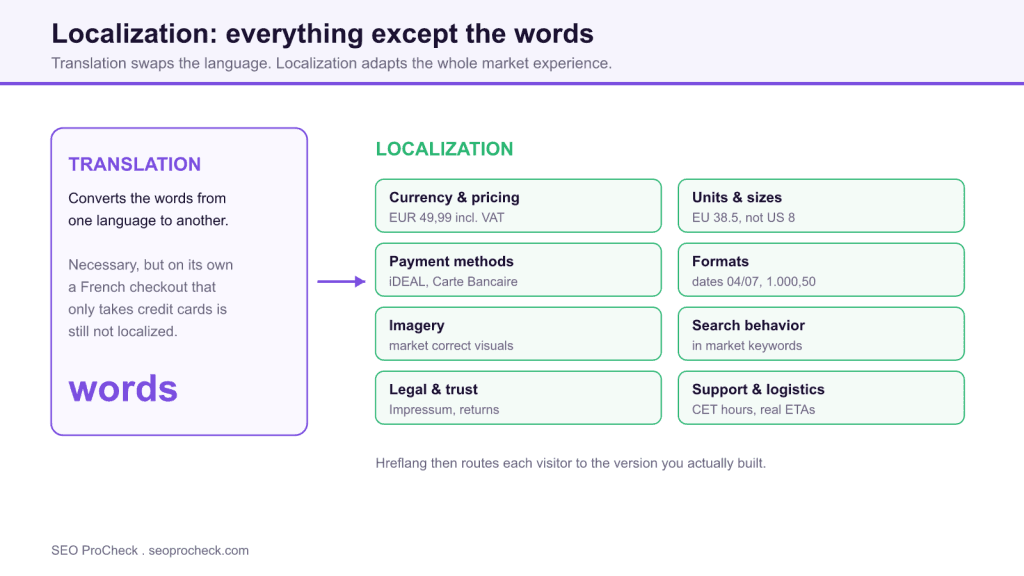
Localization is adapting a product or site to a specific market, language, yes, but also currency, units, payment methods, imagery, formats, and legal requirements. The stakes are commercial, not cosmetic: a German shopper who lands on a "German" page showing prices in dollars and shipping in ounces doesn't feel served, and doesn't convert.
Localization is everything except the words
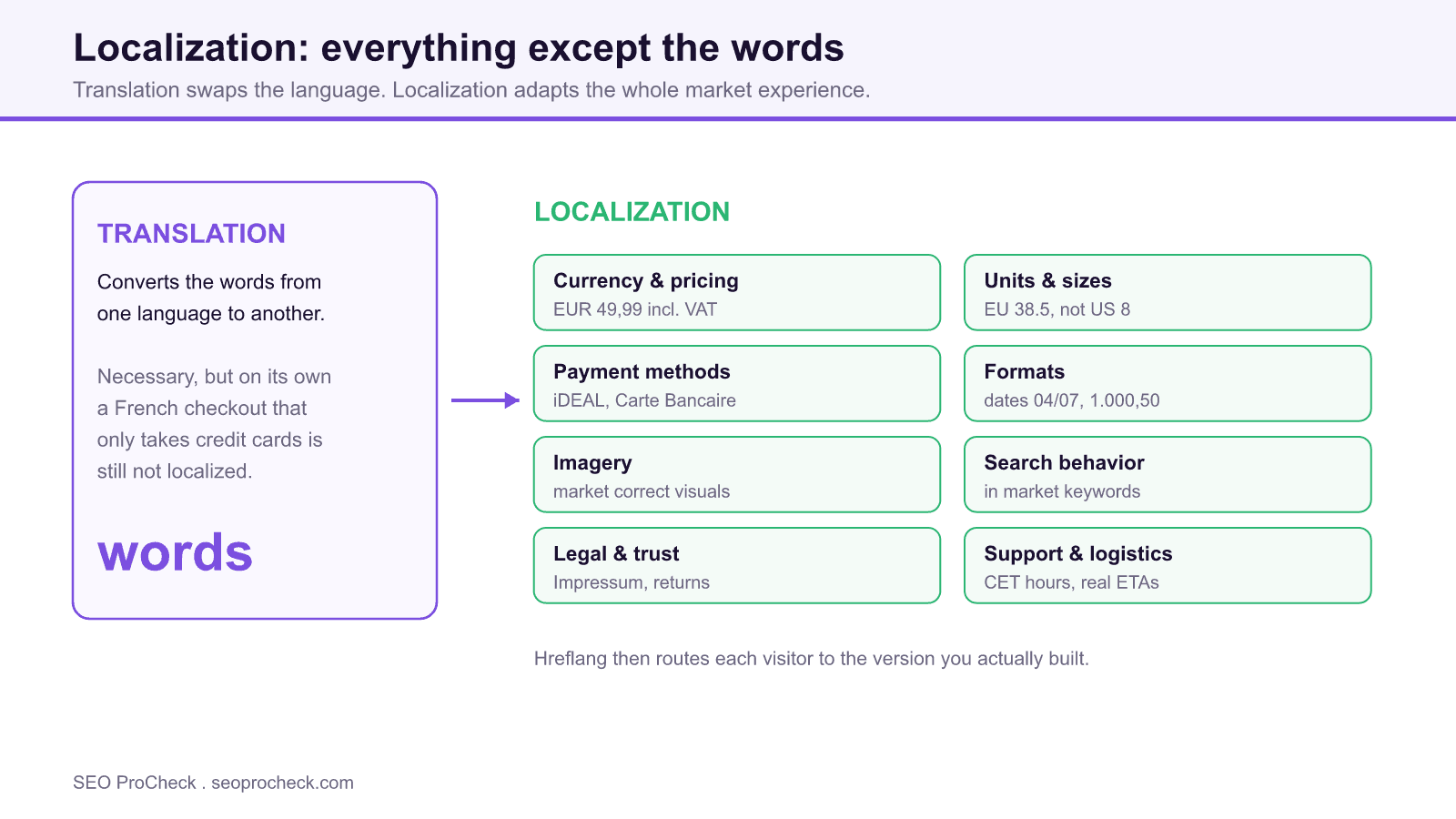
Translation converts text between languages. Localization is the rest of the job, the part that makes a market version feel native rather than imported. If you've translated your checkout into flawless French but it only accepts credit cards, you haven't localized for France, where many shoppers expect to pay by Carte Bancaire, and you definitely haven't localized for the Netherlands, where iDEAL dominates online payments. Same words, wrong market fit. The distinction gets its own treatment in the translation vs. localization glossary entry.
The layers of localization
Run down this table for any market launch. Each row is a place where "we translated it" quietly fails:
| Layer | What changes | Concrete example |
|---|---|---|
| Currency & pricing | Display currency, price points, tax presentation | €49,99 with VAT included for Germany, not $49.99 plus tax |
| Units & sizes | Measurements, clothing and shoe sizes | A US women's 8 shoe is a 38.5 to 39 in EU sizing; ounces mean nothing in metric markets |
| Payment methods | Locally expected payment rails | iDEAL in the Netherlands, Carte Bancaire in France, Klarna in the DACH region |
| Formats | Dates, decimals, phone numbers, addresses | 04/07/2026 is April 7 in Paris and July 4 in New York; 1.000,50 vs 1,000.50 |
| Imagery & design | People, settings, cultural references, color connotations | Driving-side in car photos; holiday visuals that match the market's calendar |
| Search behavior | Keyword research per market, not translated keywords | The literal translation of a head term is often not what locals type into Google |
| Legal & trust | Required notices, consumer rights, trust signals | German Impressum requirement; EU 14-day withdrawal right; local returns address |
| Support & logistics | Service hours, channels, shipping expectations | Support hours quoted in CET, not EST; realistic in-country delivery times |
Notice how little of that table is about words. That's the point, and it's why machine translation alone gets flagged as a problem in its own right (see the machine translation only check).
Why search engines care
Google doesn't have a "localization score," but localization shows up in everything it does measure. Localized pages match what locals actually search for, because the keyword research was done in-market instead of translated. They satisfy the click, right currency, right sizes, buyable product, so engagement signals hold up. And they're genuinely distinct documents, which keeps large international sites out of near-duplicate trouble: thirty market pages that differ only by a translated headline are thin variants, while thirty properly localized pages are thirty pages with a reason to exist. Hreflang then clusters those versions so the right one surfaces per market, the plumbing is covered in the hreflang implementation guide, but hreflang can only route users to the version you built; it can't make a half-assed version good.
How to check it
- Crawl each market section in Screaming Frog and use the Hreflang tab to map which URLs claim to serve which market, that's your audit inventory.
- Pick five money pages per market and check the non-text layers against the table above: currency, sizes, payment logos, date formats, legal footer. Screenshot side by side with the origin version.
- Compare word counts and content structure between origin and localized versions. Near-identical structure with swapped words means translation happened, localization didn't.
- Verify localized keyword targeting: take the market page's title tag, search it in that market's Google (or check Search Console queries per folder). If the page ranks for nothing locals search, the keywords were translated instead of researched.
- Check headers for the basics:
curl -sI https://example.com/de/, confirm the page returns 200 and isn't geo-redirecting auditors (and Googlebot) away from the market version.
Common mistakes
- Translating keywords instead of researching them. The dictionary translation of your head term is frequently not the local search term. Fix: run keyword research in the target language from scratch, then write to it.
- Localizing the marketing pages but not the money flow. Translated homepage, English checkout, dollar pricing. Fix: audit the full conversion path per market, not just landing pages.
- One "Spanish" version for 20 countries. Spain and Mexico differ in vocabulary, currency, sizes, and payment rails. One
esversion is a compromise, fine to start, but know what it costs. Fix: prioritize per-country versions for your biggest Spanish-speaking markets first. - Forgetting formats. Decimal commas, DD/MM dates, address fields that reject local postal codes. Fix: locale-aware formatting libraries, and test checkout with real local addresses.
- Stock imagery that contradicts the market. Left-hand-drive cars on a UK page, US power outlets on a German product shot. Fix: per-market image review as a launch gate, not an afterthought.
FAQ
What's the difference between localization and internationalization?
Internationalization (i18n) is the engineering that makes localization possible, Unicode, externalized strings, locale-aware date and currency handling. Localization (l10n) is doing the market adaptation itself. Full breakdown in localization vs internationalization vs translation vs transcreation.
Do I need to localize if my audience reads English?
Reading English and buying in English are different things. Plenty of Dutch and Scandinavian users browse comfortably in English but still expect local payment methods, EU sizing, and euro pricing. Localize the commerce layers even where you keep the language.
Is machine translation acceptable as a starting point?
As a starting point with human post-editing and real localization of the non-text layers, workable. Published raw at scale with nothing else changed, that's how international sections end up ignored. Content that adds no market-specific value gives Google no reason to rank it over the original.
How do I prioritize what to localize first?
Money pages first: pricing, checkout, top product or service pages, then the top organic entry pages per market. A perfectly localized blog on top of a dollar-only checkout is decoration.
Does localization help SEO or just conversions?
Both, and they reinforce each other. Localized pages match the words locals actually search, so they rank for real in market demand, and they satisfy the click with the right currency, sizes, and payment options, which protects the engagement signals search engines read. A page that ranks but cannot be bought by the visitor wastes the ranking.
How is transcreation different from localization?
Transcreation recreates the intent and emotional effect of marketing copy for a new market rather than adapting the existing message, so a slogan may be rewritten from scratch. Localization is the broader adaptation of the whole experience, with currency, formats, imagery, and legal detail included, and transcreation is one creative technique used inside it.
Take this with you
The assistant links open with a question about this page already written. Nothing is sent until you press enter.
Claude Vincent is a technical SEO consultant focused on crawlability, rendering, and AI-search visibility. He writes the field guides and case studies at SEO ProCheck, with a bias toward the durable, unglamorous work that decides whether search engines and AI answer engines can actually read and cite a site.
About SEO ProCheck
Technical SEO consulting and GEO strategy with 20 years of enterprise experience. Case studies, resources, and tools for search and AI visibility.
Work With Me
Technical SEO audits, GEO strategy, site migrations, and international SEO. Hourly consulting for teams who need hands-on support, not just reports.
Subscribe to our newsletter!








Recent Posts
- Most Top Sites Never Say Who They Are in Structured Data October 14, 2026
- Homepage Titles Are Mostly Too Short, Not Too Long October 8, 2026
- Who Actually Serves an llms.txt? 184 Top Sites Measured September 29, 2026