

Localization vs Internationalization vs Translation vs Transcreation: What Each Actually Means for SEO
- November 14, 2023
- International SEO
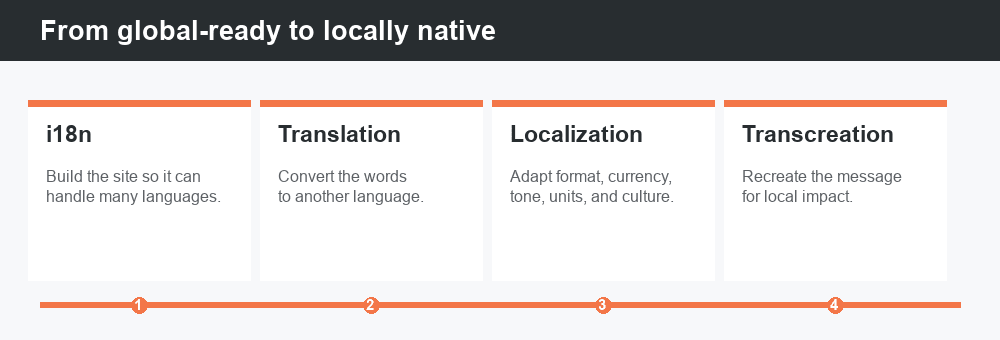
Internationalization (i18n) is the engineering work that makes locales possible, localization (l10n) is the full adaptation of your site for one specific market, translation converts the words and nothing else, and transcreation rebuilds the message from scratch so it lands the same way in a different culture. Each level has its own SEO failure mode, and most "international SEO problems" are really a mismatch between the level a business paid for and the level the market required.
Every international SEO post-mortem eventually arrives at the same sentence: "We translated the whole site. Why is there no traffic?" The honest answer is that the site was never internationalized, never localized, and never researched in the target market. It was run through a translation layer and pushed live, which is roughly the SEO equivalent of photocopying a restaurant menu and calling it a second location.
The four terms in this article get used interchangeably in meetings, and that sloppiness is expensive. They describe four different disciplines, executed by different people, with different budgets and different SEO consequences. Let us pull them apart properly, then look at what each one actually means for organic search.
The four terms, defined properly
Internationalization (i18n): engineering the possibility
The W3C defines internationalization as the design and development of a product or content that enables easy localization for audiences that vary in culture, region, or language. The abbreviation i18n comes from the 18 letters between the i and the n. The key word is "enables." Internationalization produces no visible market-facing content at all. It is the plumbing: a URL structure that can hold locale variants (subdirectories like /fr-fr/, subdomains, or ccTLDs), UTF-8 encoding everywhere, templates that do not hard-code date formats, currency symbols, or string lengths, a CMS that can store one piece of content in many language versions, and the technical signals such as hreflang annotations that tell search engines which version belongs to which audience.
Concrete example: a checkout template that renders prices as a variable with locale-aware formatting (1.299,00 € for Germany, $1,299.00 for the US) is internationalized. A checkout with "$" typed into the HTML is not, and no amount of translation will fix it.
Localization (l10n): adapting for one real market
Localization, per the same W3C definition, is the adaptation of a product or content to meet the language, cultural, and other requirements of a specific target market, a locale. It sits on top of i18n and includes translation, but goes much further: local currency and payment methods, metric versus imperial units, imagery that does not look imported, legal pages that reflect local consumer law, local phone numbers and support hours, and, critically for SEO, content built around what people in that market actually search for. A properly localized German store does not just say "Warenkorb" instead of "Cart." It offers invoice payment, quotes prices with VAT included, and writes product copy around the comparison criteria German buyers use.
Translation: the words, only the words
Translation converts text from one language to another while preserving meaning. That is the entire scope. It does not touch URL structure, currency, imagery, legal compliance, or search behavior. Translation is a necessary component of localization, but it is the smallest one, and treating it as the whole job is the single most common mistake in international expansion. A perfectly translated page can still show dollar prices to French users, link to English support docs, and target keywords nobody in France types.
Transcreation: rebuilding the message
Transcreation starts from the intent of a message rather than its words, and recreates it so it produces the same emotional effect in the target culture, even if the final copy shares almost nothing with the original. Slogans, campaign headlines, humor, wordplay, and brand voice usually require it, because those things rarely survive literal translation. A tagline built on an English pun has no translation; it has a French replacement, written by a French copywriter, briefed on what the line is supposed to make people feel. Transcreation is creative work priced like creative work, which is exactly why it is reserved for the content where resonance matters most.
Side by side
What it is: engineering so locales can exist
Who does it: developers, architects
SEO risk if skipped: broken hreflang, mixed signals, wrong pages ranking in wrong countries
What it is: full adaptation for one market
Who does it: in-market teams, SEO, legal, design
SEO risk if skipped: content misses local intent, weak engagement, no local entities
What it is: converting the words
Who does it: translators, MT plus human review
SEO risk if alone: translated keywords are not searched keywords; raw MT at scale risks spam policies
What it is: rebuilding the message for the culture
Who does it: in-market copywriters
SEO risk if skipped: brand and campaign pages that earn no links, no clicks, no recall
What each level means for SEO
i18n failures are technical failures
When internationalization goes wrong, the symptoms show up in crawl data, not copy. Wrong or non-reciprocal hreflang annotations, language codes that do not exist (the classic en-UK instead of en-GB), canonical tags pointing at the wrong locale, and auto-redirects that bounce users and Googlebot to a version chosen by IP address. Google's documentation on managing multi-regional and multilingual sites is explicit on the big ones: use locale-specific URLs, tell Google about localized versions with hreflang, do not rely on IP-based content adaptation, and avoid automatically redirecting users between language versions. Google also notes that Googlebot crawls from non-US IP addresses too, so locale-adaptive trickery is both unreliable and unnecessary. If you are building this layer, start with our hreflang implementation guide, and see where to declare hreflang for the HTML-head versus sitemap versus HTTP-header decision.
Translation-only sites rank poorly for a structural reason
Here is the part the "we translated the site" crowd misses: search demand does not translate. The query a German user types is not the German translation of the query an American types; it is whatever phrasing, brand vocabulary, and intent structure exists in that market. Translating your keyword list produces grammatically correct terms with the wrong search volume, the wrong intent, or both. Keyword research has to be redone natively per market: new seed terms, local SERP analysis, local competitors, local question phrasing. A translated page optimized for a translated keyword is optimized for a query that may barely exist.
Machine translation without review is now a stated policy risk
Google's spam policies deserve an honest reading here, because the situation is nuanced. Machine-translated content is not automatically spam. But Google's scaled content abuse policy explicitly lists creating many pages through automated transformations, and it names translation alongside synonymizing as an example, when the result provides little value to users. So the risk is real and specific: pumping out thousands of unreviewed machine-translated pages to multiply your URL count is squarely the pattern the policy describes. Machine translation with competent human review, local keyword adjustment, and genuine usefulness is a legitimate workflow. The difference is not the tool, it is whether anyone who speaks the language looked at the output before it shipped. Given how aggressively scaled content has been suppressed in recent updates, "nobody reviewed it" is not a position you want to defend with your traffic.
Localization is what actually wins local SERPs
Ranking in a market means matching that market's SERP, and local SERPs are shaped by local intent and local entities. A localized page references the institutions, regulations, brands, units, and price anchors that local searchers expect, which is also what local pages that already rank are doing. That alignment shows up everywhere Google evaluates relevance and usefulness: the entities on the page, the questions answered, the internal links to locally relevant resources, and the engagement of users who land there and find something built for them rather than shipped to them. Localization is, in effect, doing international SEO as content strategy instead of as a checkbox.
Transcreation earns what translation cannot
For SEO purposes, transcreation matters on the pages that need to persuade or get talked about: homepages, campaign landing pages, brand messaging. These are the pages that attract links, branded searches, and direct traffic in a new market, and a literal translation of a culturally specific message attracts none of those. You do not transcreate your help docs. You absolutely transcreate the line at the top of your homepage.
Which level do you actually need?
Documentation, support content, UGC at scale: high-quality machine translation with human review is usually proportionate. The intent is informational, the phrasing matters less, and users prefer an imperfect answer in their language to a perfect one in yours. Review remains non-negotiable for the policy reasons above.
Commercial pages: product, category, pricing, service pages: full localization. These pages compete on local SERPs against natively built competitors, so they need native keyword research, local currency and compliance, and local proof points. Translation alone here is where the "why no traffic" meetings come from.
Brand, campaigns, top-of-funnel creative: transcreation. Small page count, outsized impact, genuinely different skill set.
Everything, before any of the above: internationalization. If the architecture cannot signal locale cleanly, every euro spent on content lands on a foundation that leaks. i18n is the cheapest layer to get right at the start and the most expensive to retrofit.
Scenario: a US SaaS expands to France and Quebec
Picture a US project-management SaaS targeting France and French-speaking Canada. The tempting shortcut is one French translation serving both, since it is "the same language." It is not the same locale, and the four layers each have something to say about it.
i18n: the architecture needs two locale variants, fr-fr and fr-ca, with hreflang connecting them to each other and to en-us, plus an x-default for unmatched users. Pointing both hreflang values at one shared French URL is technically valid, but the moment the content diverges, and it will, you want separate URLs ready. Pricing infrastructure must handle EUR for France and CAD for Quebec from day one.
Translation versus localization: the French of France and Quebec French differ in vocabulary exactly where software lives. A France-flavored "email" is courriel in Quebec usage; weekend versus fin de semaine is the textbook example. Quebec also brings a legal dimension France does not: the Charter of the French Language imposes French-language requirements on businesses operating in Quebec, which makes the French version a compliance matter, not a nice-to-have. Meanwhile keyword research must run separately per market, because feature names, competitor sets, and query phrasing differ between French and Quebecois searchers even when the words overlap.
Transcreation: the US homepage tagline, presumably something punchy about crushing deadlines, needs two rewrites, not one, because the cultural register that works in Paris reads differently in Montreal. One French copywriter and one Quebecois copywriter, same brief, different output. That is the whole discipline in one sentence.
FAQ
A: Not by itself. Google's scaled content abuse policy targets large volumes of automatically transformed content, and it names translation as one such transformation, when the result adds little value for users. Machine translation that is human-reviewed, locally adjusted, and genuinely useful is a normal workflow. Unreviewed MT published at scale to multiply pages is the pattern the policy exists to catch.
A: If you serve one language to one market, no. If you serve the same language to multiple regions, for example en-us and en-gb with different pricing, hreflang is exactly what prevents the wrong regional version from ranking in each country. See our hreflang implementation guide for setup details.
A: Translate them as research seeds, never as targets. Run native keyword research in the target market and let local volume, intent, and SERP makeup decide what each page targets. The literal translation of your top US keyword is frequently not what anyone in the target market searches.
🌍 The International SEO series
- Hreflang and International SEO: The Complete Implementation Guide
- Where to Declare Hreflang: HTML, XML Sitemap, or HTTP Header
- Hreflang Best Practices: 7 Real-World Scenarios
- Hreflang Implementation Without the Errors: Return Tags and x-default
- Hreflang and International SEO FAQ
- Hreflang issue fix-guides (audit library)
Expanding into new markets?
SEO ProCheck audits international setups end to end, from architecture to hreflang.
Take this with you
The assistant links open with a question about this page already written. Nothing is sent until you press enter.
Claude Vincent is a technical SEO consultant focused on crawlability, rendering, and AI-search visibility. He writes the field guides and case studies at SEO ProCheck, with a bias toward the durable, unglamorous work that decides whether search engines and AI answer engines can actually read and cite a site.
About SEO ProCheck
Technical SEO consulting and GEO strategy with 20 years of enterprise experience. Case studies, resources, and tools for search and AI visibility.
Work With Me
Technical SEO audits, GEO strategy, site migrations, and international SEO. Hourly consulting for teams who need hands-on support, not just reports.
Subscribe to our newsletter!








Recent Posts
- Most Top Sites Never Say Who They Are in Structured Data October 14, 2026
- Homepage Titles Are Mostly Too Short, Not Too Long October 8, 2026
- Who Actually Serves an llms.txt? 184 Top Sites Measured September 29, 2026