

AI Summary
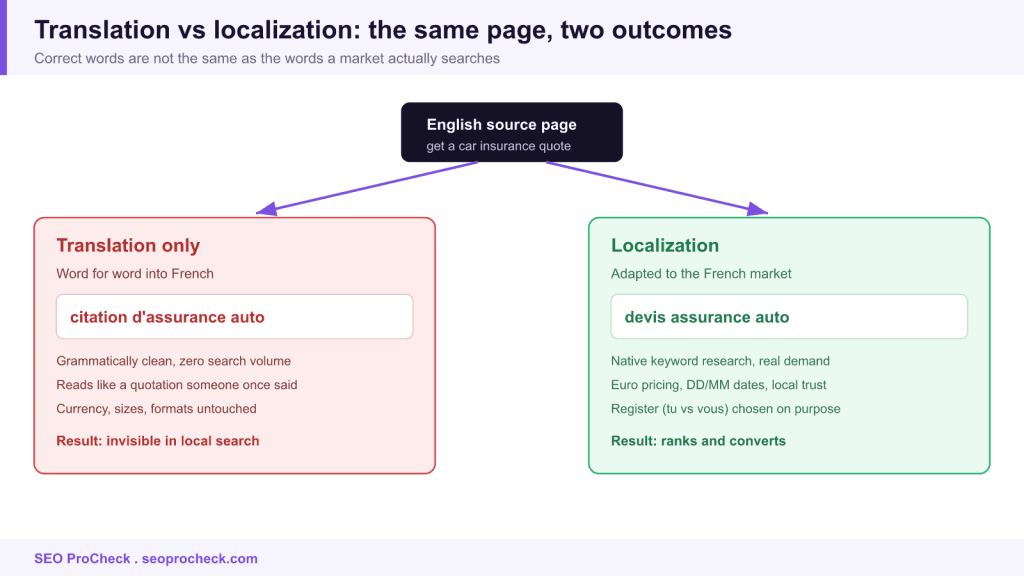
Translation converts your words into another language, while localization adapts the whole page, terminology, search behavior, currency, formats, and cultural context, to another market. Pages that are translated but not localized often read perfectly and still rank for nothing, because they target phrases no one in the market actually searches.
- A French shopper searches devis assurance auto, not the literal citation d'assurance.
- Localization includes native keyword research, currency, formats, and local trust signals.
- Translated only pages target phantom keywords with clean phrasing and zero volume.
- Use machine translation as the text layer inside localization, never as the whole process.
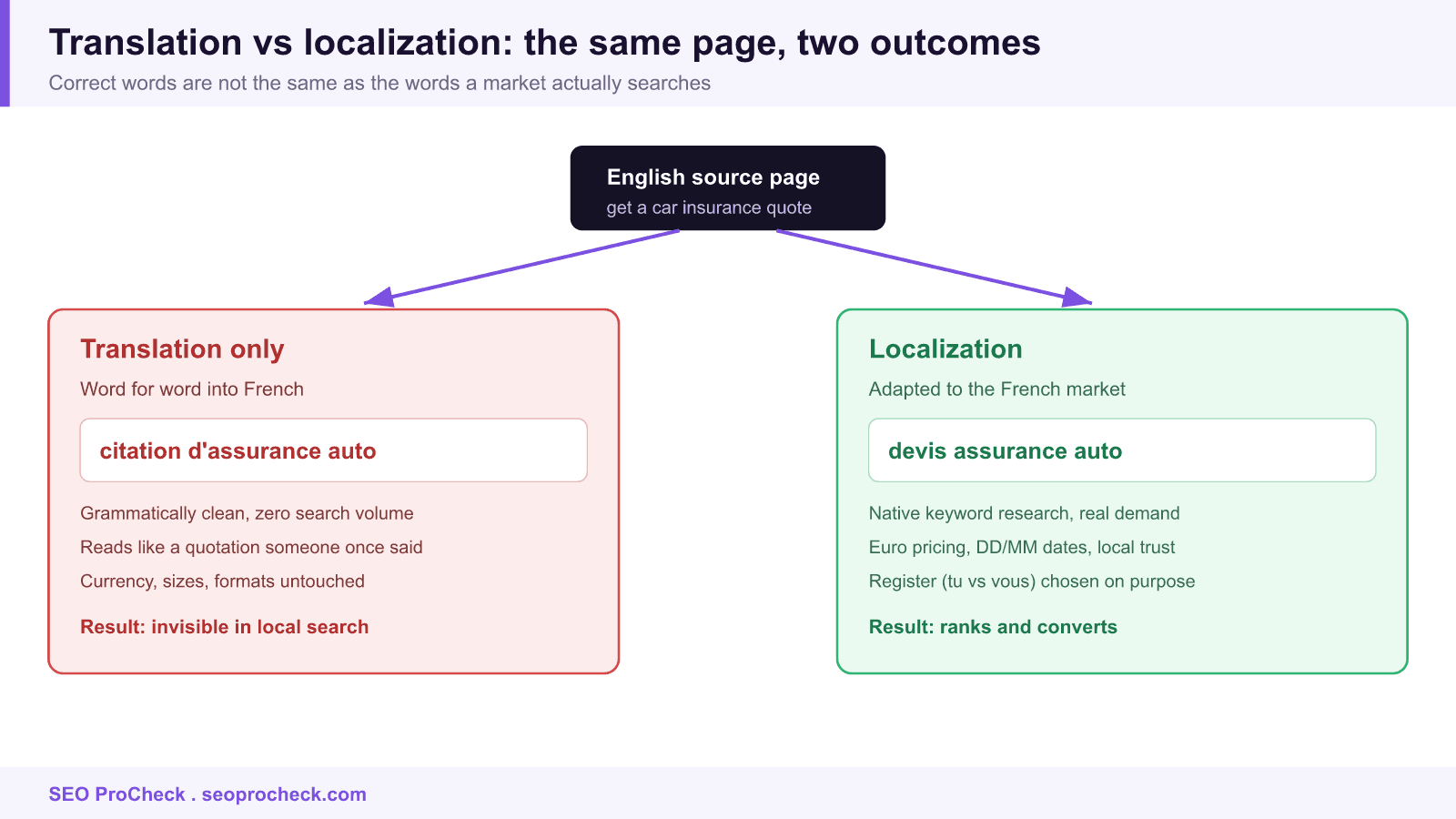
Translation converts your words into another language; localization adapts the whole page, terminology, search behavior, currency, formats, cultural context, to another market. Confuse the two and you ship pages that read fine, rank for nothing, and convert nobody.
Why word-for-word fails: a French example
Take an English insurance page built around "get a car insurance quote." A word-for-word translator, human or machine, can easily render "quote" as citation, because that's what the word means in the literary sense. But a French user shopping for insurance searches for a devis assurance auto. Citation d'assurance means roughly "insurance quotation" as in something an author once said about insurance. Oh merde. The page is grammatically clean, professionally translated, and invisible, because nobody in France types the words it targets.
This pattern is everywhere once you look for it. English "sneakers" translates literally, but the French search baskets. An English "resume" page for France should target CV. And running an EN+FR site teaches you the reverse lesson too: French copy translated flatly into English keeps its long sentences and formal register and reads like a notarized letter. Both directions fail the same way, correct words, wrong market.
What each discipline actually covers
| Dimension | Translation delivers | Localization delivers |
|---|---|---|
| Text | Accurate meaning in the target language | The terminology the market actually uses and searches |
| Keywords | Translated keywords (often wrong) | Keyword research done natively in the target market |
| Tone & register | Mirrors the source (tu/vous decided by accident) | Register chosen deliberately for the audience |
| Currency, units, sizes | Untouched | Converted and displayed in local conventions |
| Dates, decimals, formats | Untouched | DD/MM dates, decimal commas, local phone formats |
| Payment & trust signals | Untouched | Local payment methods, legal notices, local support info |
| Imagery & examples | Untouched | Swapped for culturally accurate visuals and references |
| Idioms & wordplay | Translated literally, usually dying on impact | Rewritten (transcreated) to land natively |
Read the left column as "what you paid for" and the right as "what the market needed." The gap between them is why translated pages so often fail in local search, a failure mode dissected in translation vs localization: why translated pages often fail in local search.
The SEO consequences of stopping at translation
Three things happen to translated-but-not-localized pages. First, they target phantom keywords, grammatically valid phrases with no search volume, like our citation d'assurance. Second, they underperform on satisfaction: users who do arrive find foreign currency, wrong sizes, and examples about a country they don't live in, and bounce back to the results. Third, at scale they read as low-effort near-duplicates of the origin site, pure machine translation with no added value is exactly what the machine translation only check exists to flag. Everything beyond the words that needs adapting is catalogued in the localization glossary entry.
How to check which one you have
- Take your top five money pages in the target language and extract their title tags and H1s.
- Check real search volume for those exact phrases with any keyword tool set to the target country and language. Phantom keywords (clean phrasing, zero volume) are the signature of translated targeting.
- Crawl the market section in Screaming Frog and compare it structurally against the origin: identical page count, identical layout, near-identical word counts per page usually means translate-and-forget.
- Scan five pages for non-text layers: currency symbols, date formats, payment logos, local contact details. All still origin-market? Translation, not localization.
- Have a native speaker read three pages cold and answer one question: "Does this read like it was written for you?" You'll get your answer in the first paragraph.
Common mistakes
- Briefing translators without keyword data. Translators optimize for fidelity, not findability, that's their job. Fix: hand them the target keyword per page and let them write toward it.
- Assuming one language means one market. French for France, Belgium, Switzerland, and Quebec differs in vocabulary, pricing expectations, and law. Fix: language versions get you started; market versions win. Cluster them properly with hreflang.
- Translating idioms literally. Wordplay, puns, and cultural references die in transit. Fix: transcreate, brief a native writer on intent and let them rebuild the line.
- Letting the source language decide formality. English has one "you"; French forces a tu/vous choice, German a du/Sie choice. Defaulting to whatever the translator picked is a brand decision made by accident. Fix: define register per market in the style guide.
- Measuring translation projects by word count delivered. Fix: measure by market-language rankings and conversions per market, the only numbers that reveal whether localization actually happened.
FAQ
Is localization always better than translation?
Localization includes translation, it's translation plus market adaptation. The real question is where translation alone is acceptable: internal docs, support macros, low-stakes long-tail content. For pages that need to rank and convert, translation alone is half the job.
What is transcreation and when do I need it?
Transcreation is rebuilding a message in the target language from intent rather than wording, nearest to copywriting. You need it for taglines, ads, humor, and anything where the literal version lands wrong. See localization vs internationalization vs translation vs transcreation for where each fits.
Can AI translation replace localization?
Modern machine translation handles meaning well and keeps getting better at register. What it doesn't do is keyword research, currency, payment methods, legal requirements, or knowing that the French search devis and not citation. Use it as the text layer inside a localization process, not as the process.
How much more does localization cost than translation?
Meaningfully more per page, native keyword research, format and commerce adaptation, native review. But compare it against the cost of the alternative: a full market rollout that generates no rankings and no revenue. Cheap translation that earns nothing is the most expensive option on the menu.
How do I know if my pages are translated but not localized?
Pull the title tags and H1s of your top money pages in the target language and check their real search volume in a keyword tool set to that country and language. Clean phrasing with zero volume is the signature of translated targeting rather than native keyword research.
Does one language cover every market that speaks it?
No. French for France, Belgium, Switzerland, and Quebec differs in vocabulary, pricing expectations, and law, so a single language version rarely wins every market. Cluster the market versions properly with hreflang and adapt terminology per country.
Take this with you
The assistant links open with a question about this page already written. Nothing is sent until you press enter.
Claude Vincent is a technical SEO consultant focused on crawlability, rendering, and AI-search visibility. He writes the field guides and case studies at SEO ProCheck, with a bias toward the durable, unglamorous work that decides whether search engines and AI answer engines can actually read and cite a site.
About SEO ProCheck
Technical SEO consulting and GEO strategy with 20 years of enterprise experience. Case studies, resources, and tools for search and AI visibility.
Work With Me
Technical SEO audits, GEO strategy, site migrations, and international SEO. Hourly consulting for teams who need hands-on support, not just reports.
Subscribe to our newsletter!








Recent Posts
- Most Top Sites Never Say Who They Are in Structured Data October 14, 2026
- Homepage Titles Are Mostly Too Short, Not Too Long October 8, 2026
- Who Actually Serves an llms.txt? 184 Top Sites Measured September 29, 2026