

AI Summary
Semantic search means a query is resolved to a concept before any page is scored, so relevance is judged by how completely and credibly a page covers that concept rather than by how often it repeats a phrase. The practical consequence is that keyword research becomes concept mapping, and the winning page is the one that answers the questions a knowledgeable reader would actually have.
- Search engines resolve queries to entities, so synonyms and variants are understood without explicit repetition.
- Pages covering related concepts and questions comprehensively outperform narrow, phrase focused pages.
- Natural writing aimed at a reader aligns better with semantic evaluation than writing aimed at a density target.
- The real work shifts from keyword research to mapping the entities, attributes and questions a topic contains.
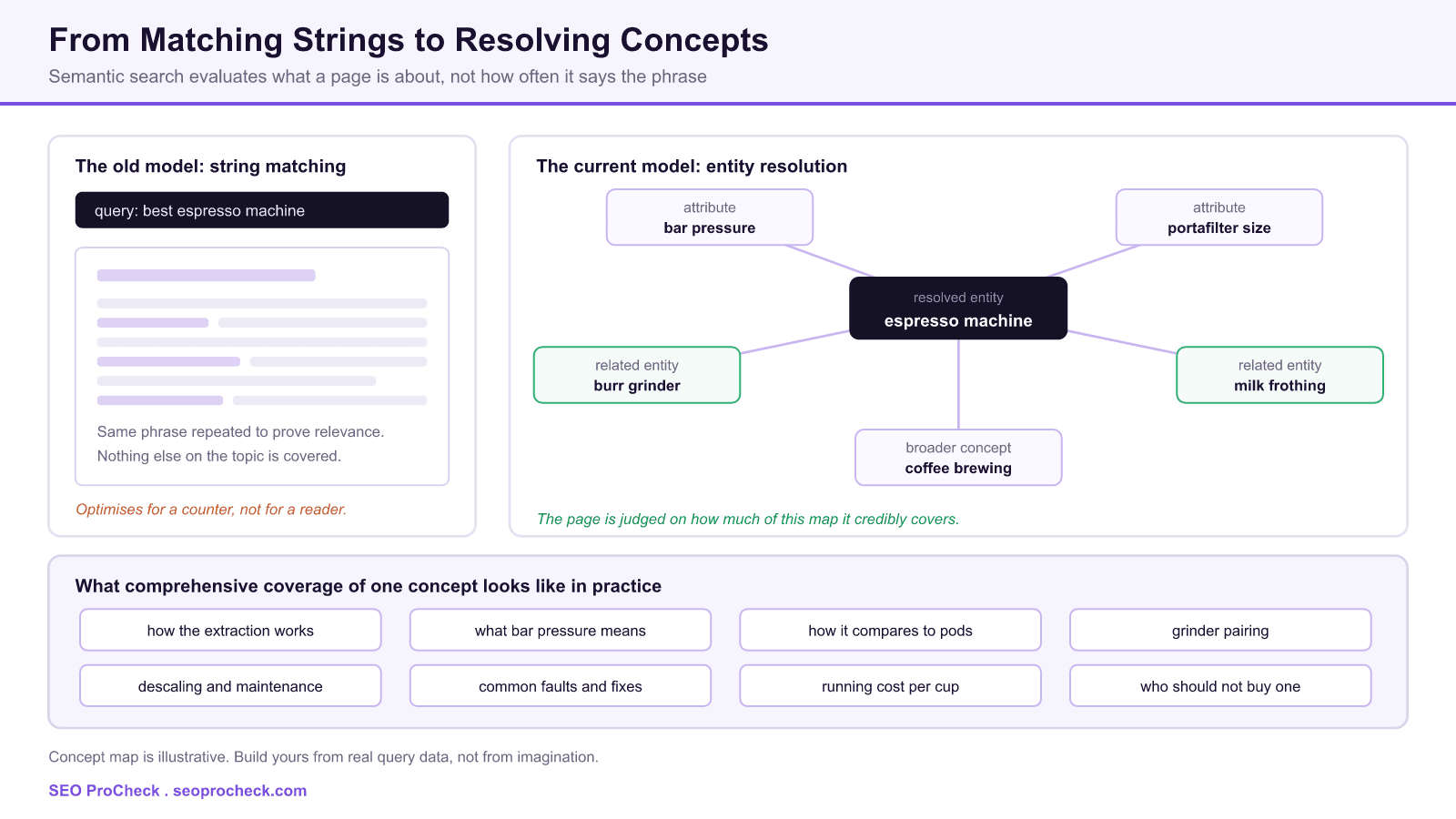
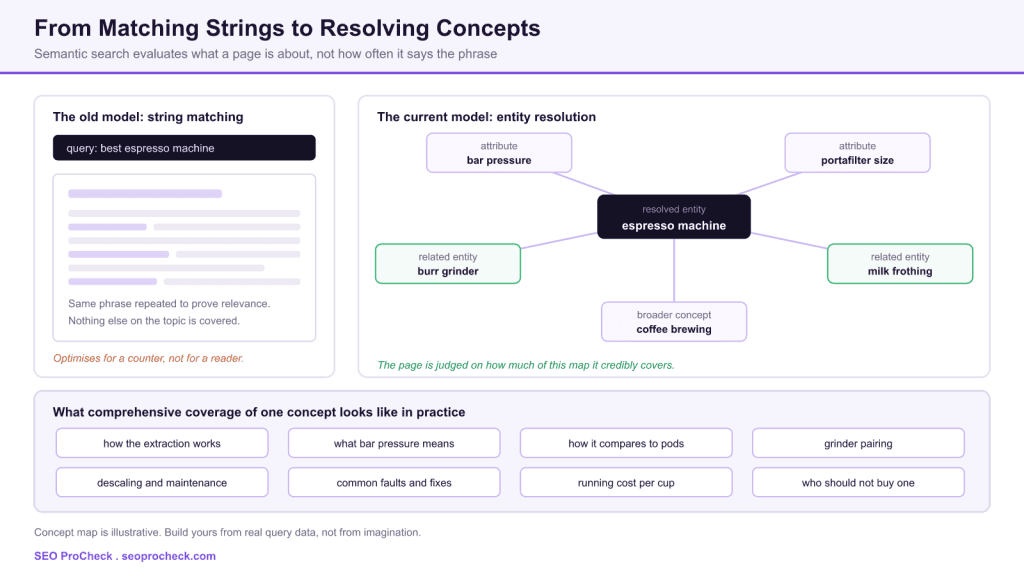
Stop asking how many times to use the keyword and start asking what a person who actually knows this topic would expect to find on the page. Search engines resolve your query to a concept before they score a single document, which means they already know that a page about espresso machines should have something to say about pressure, grinders and descaling. Repeating the phrase does not demonstrate expertise. Covering the concept does. The whole discipline reduces to one workflow: map the concept from real query data, write for a reader, then check the map for gaps.
Semantic SEO is often presented as a new technique. It is more accurate to describe it as the end of a technique. For roughly fifteen years, on page optimisation meant manipulating the relationship between a string in a query and the same string in a document. Once search engines could resolve both to underlying concepts, that relationship stopped being the thing being measured, and a large body of tactics built on it quietly stopped working.
Entity understanding
Knowledge Graph connections influence rankings well beyond keyword presence. Content that correctly identifies and describes the entities it discusses produces clearer relevance signals, and semantic clarity about what, or who, a page is about helps a search engine categorise and rank it properly.
The failure mode worth understanding is ambiguity. A page about "Mercury" is about a planet, a chemical element, a Roman god or a car marque, and a system that cannot tell which will hedge. Disambiguation is not achieved by repeating the name; it is achieved by the company the name keeps. Mention the atomic number and you have resolved to the element. Mention the orbital period and you have resolved to the planet. Those co-occurring signals are doing the work.
You can make this explicit rather than leaving it to inference. Structured data that names the entity and links it to an authoritative identifier removes the guesswork entirely:
{
  "@context": "https://schema.org",
  "@type": "Article",
  "about": {
    "@type": "Thing",
    "name": "Espresso machine",
    "sameAs": "https://en.wikipedia.org/wiki/Espresso_machine"
  },
  "mentions": [
    {"@type": "Thing", "name": "Burr grinder"},
    {"@type": "Thing", "name": "Portafilter"}
  ]
}
Note the distinction between about and mentions. A page has one primary subject and many secondary references, and collapsing that distinction by listing twenty things as about tells a parser that the page has no focus at all. Our guides to entity SEO and machine readable brand markup cover the same principle applied to your own organisation.
Topic comprehensiveness
Content covering related concepts and questions comprehensively consistently outperforms narrow, keyword focused pages. Semantic analysis that identifies topic gaps helps expand relevance, and natural language addressing the full scope of an intent performs well.
The dangerous misreading of this is that longer is better. Comprehensiveness is about coverage of the questions a topic raises, not about word count, and padding a page with restated material makes it worse on every dimension. The distinction is easy to operationalise if you keep the unit of coverage as a question rather than a term.
| Signal you are optimising | Phrase focused approach | Concept focused approach | How to verify |
|---|---|---|---|
| Relevance | Target phrase appears in title, headings and body at intervals | Page addresses the primary entity and its principal attributes | Ask a subject expert whether anything obvious is missing |
| Coverage | Secondary keywords sprinkled through the text | Each distinct question a searcher has gets a real answer | List the questions from People Also Ask and check each is answered |
| Vocabulary | Synonyms inserted deliberately to catch variants | Terminology used naturally as a practitioner would | Read it aloud; forced synonyms are audible |
| Structure | Headings built from keyword variations | Headings that state the question the section answers | Check the heading outline reads as a sensible table of contents |
| Scope | One page per keyword variant | One page per distinct intent, supported by linked depth pages | If two pages answer the same question, you have a duplication problem |
The right hand column is not merely nicer writing, it is a closer match to what is actually being evaluated.
Synonym and variant usage
Because search engines understand synonyms and variants, the need for explicit keyword repetition has largely disappeared. Natural writing that incorporates topically relevant variation ranks as well as, or better than, keyword stuffed alternatives, and writing for readers rather than for a density figure aligns with how semantic systems evaluate a page.
There is one important exception worth stating, because the general advice is sometimes taken too far. Understanding a synonym is not the same as treating two phrases as identical intents. "Cheap laptops" and "budget laptops" are close synonyms; "laptop repair" and "laptop repairs" are the same intent; but "espresso machine" and "coffee machine" are related concepts with meaningfully different result sets, because the searchers want different things. Check the actual results before assuming two phrases collapse into one page, and see our note on duplicate content for what happens when you build two pages for one intent.
Practical implementation
Semantic SEO means researching topics deeply enough to understand the concepts around them. Content should answer the questions users have across their journey on a topic, and keyword research expands to include conceptual mapping and related entity identification. Here is that process as an actual workflow.
Step one, resolve the entity. Search the primary term and read what the results assume. The knowledge panel, if one appears, tells you which entity the engine has resolved to and what attributes it associates. If the results are split across two meanings, your page needs to declare which one it serves in the first sentence.
Step two, harvest real questions. Collect from People Also Ask, related searches, the subheadings of the pages currently ranking, and your own Search Console queries for the URL. Do not invent questions. The value of this step is that it is evidence of demand rather than a guess about it.
Step three, cluster and decide scope. Group the questions. Questions that share the searcher's intent belong on one page; questions that represent a different job belong on their own page linked from this one. This is the decision that determines whether you end up with a coherent hub or a single unreadable megapage, and it is covered in depth in our guide to topic cluster architecture.
Step four, write to the outline, not to the terms. Turn each retained question into a heading that states the question, then answer it directly in the first two sentences beneath. This is also the format that makes a passage extractable for featured snippets and for AI generated answers, so the structural discipline pays twice.
Step five, audit for gaps rather than for density. After drafting, put the question list beside the draft and mark each as answered, partially answered or missing. That checklist is the semantic equivalent of the old density check, and unlike the old check it correlates with something a reader cares about.
Where this goes wrong
- Term lists treated as checklists. Tools that output terms found on ranking pages are diagnostic aids. Inserting every term to satisfy a score reinvents keyword stuffing one abstraction layer up.
- Comprehensiveness confused with length. A page that answers nine questions well beats a page that circles four questions for three thousand words.
- Entity markup that contradicts the page. Declaring the page is about something it barely discusses is a mismatch a parser can detect and a reader can certainly detect.
- Collapsing distinct intents. Merging pages because two phrases look like synonyms, without checking whether the results actually overlap, loses rankings on both.
- Ignoring who the reader is. The right subtopic set for a beginner guide differs from the right set for a specification page. Comprehensive means complete for that reader, not exhaustive.
FAQ
No, and it has not been a useful target for many years. Modern retrieval resolves a query to a concept and evaluates whether a page covers that concept credibly, so repeating a phrase adds no relevance once the topic is established. What repetition does reliably is make the writing worse, which harms the engagement signals that do matter.
An entity is a distinct, identifiable thing: a person, an organisation, a product, a place, a concept. It exists independently of the words used to name it, which is why a search engine can treat a nickname, an abbreviation and a formal name as references to the same thing. Semantic optimisation means making it unambiguous which entities your page is about.
It is a shift in what you optimise. Traditional on page work targets a phrase and checks it appears in the right places. Semantic work targets a concept and checks the page addresses the questions, attributes and related concepts a knowledgeable reader would expect. In practice this changes your research step far more than your writing step.
Yes, at least once and naturally, usually in the title and an early paragraph. Not because a counter is checking, but because the words a page uses are still the primary evidence of what it is about, and matching a searcher's language reassures them they landed in the right place. The difference is that once is sufficient where you previously felt obliged to repeat it.
Use sources of real demand rather than intuition. The people also ask box, related searches, your own Search Console query list filtered to the page, and the subheadings used by the pages currently ranking will between them produce a fuller map than any brainstorm. Cluster the result into subtopics and check your page against the list.
Tools can generate a list of terms that co-occur across ranking pages, which is a useful starting point for spotting genuine gaps. What they cannot do is judge whether covering a subtopic is appropriate for your page's purpose. Treating a term list as a checklist to satisfy reproduces keyword stuffing at the concept level, which is exactly what the shift was supposed to end.
Is your content covering the concept or just the keyword?
A content audit maps the questions your topic actually contains and shows which of them your pages leave unanswered.
Source: Semantic SEO research compiled
Take this with you
The assistant links open with a question about this page already written. Nothing is sent until you press enter.
Claude Vincent is a technical SEO consultant focused on crawlability, rendering, and AI-search visibility. He writes the field guides and case studies at SEO ProCheck, with a bias toward the durable, unglamorous work that decides whether search engines and AI answer engines can actually read and cite a site.
About SEO ProCheck
Technical SEO consulting and GEO strategy with 20 years of enterprise experience. Case studies, resources, and tools for search and AI visibility.
Work With Me
Technical SEO audits, GEO strategy, site migrations, and international SEO. Hourly consulting for teams who need hands-on support, not just reports.
Subscribe to our newsletter!








Recent Posts
- Most Top Sites Never Say Who They Are in Structured Data October 14, 2026
- Homepage Titles Are Mostly Too Short, Not Too Long October 8, 2026
- Who Actually Serves an llms.txt? 184 Top Sites Measured September 29, 2026