

Scaling Content with AI: What Actually Works (and What Gets You Penalized)
- August 2, 2023
- Cross-Industry
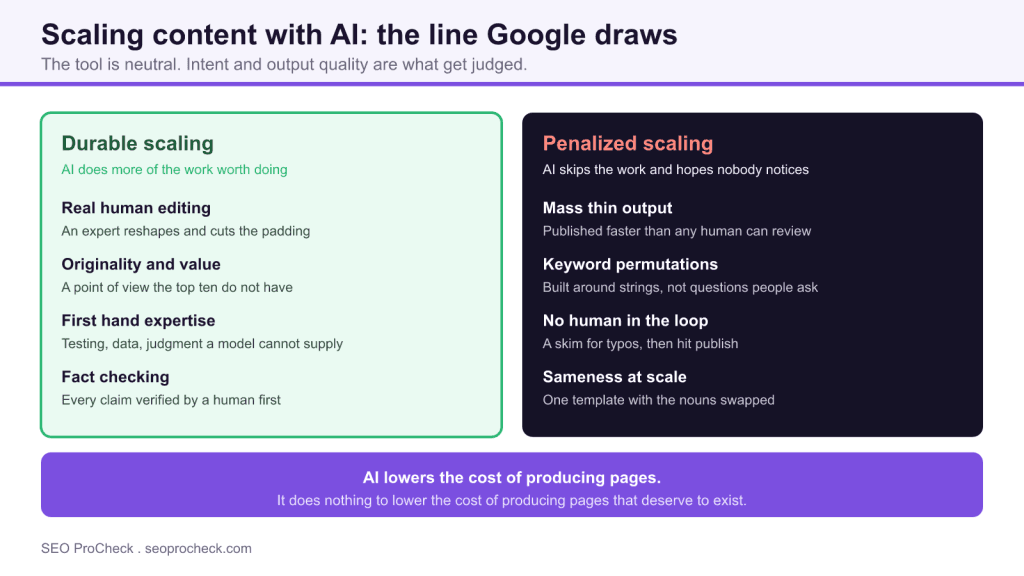
Google does not penalize content for being made with AI, it penalizes content produced mainly to game rankings, however it was written. The difference between AI scaling that works and scaling that gets a site flattened is whether a human with real expertise edited, verified, and added something only a person could add.
- Google's spam policy targets scaled content abuse, where the word primarily makes intent the deciding factor.
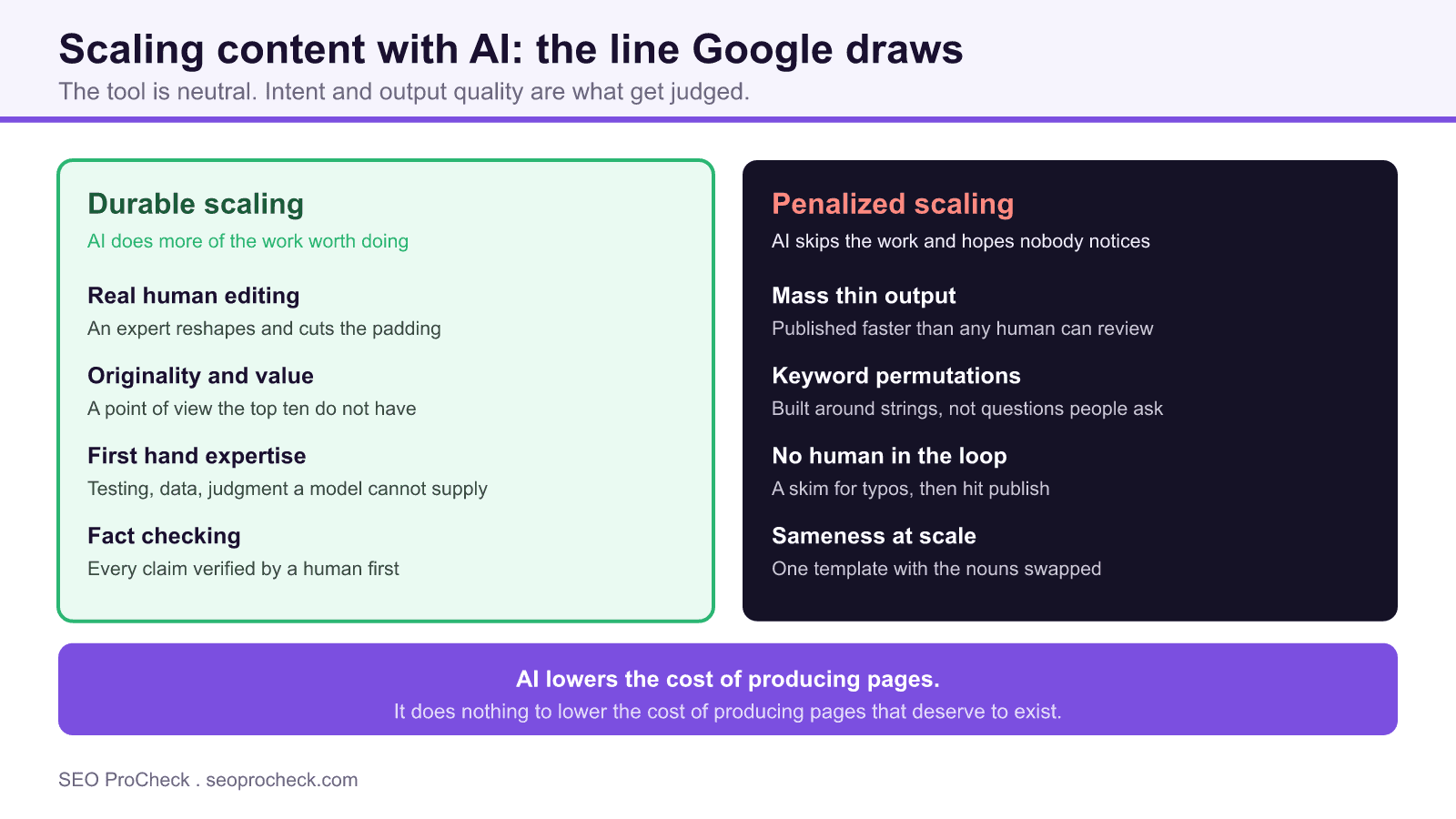
- Durable scaling keeps real human editing, originality, first hand expertise, and fact checking on every page.
- Penalized scaling ships mass thin pages built on keyword permutations with no meaningful human review.
- AI lowers the cost of producing pages but not the cost of producing pages that deserve to exist.
Google's actual position on AI content
There is a persistent myth that Google bans AI-written content. It does not. Google's guidance is consistent and public: using automation, including AI, to produce content is not against the rules when that content is helpful, original, and made for people first. How content is produced matters far less than whether it demonstrates expertise, experience, and genuine usefulness.
What Google does target is scaled content abuse. Its spam policies single out generating large amounts of content primarily to manipulate rankings rather than to help readers. Note the word "primarily." That is the whole game. The same policy applied to spun articles and outsourced filler long before generative tools existed. AI simply made the bad version cheaper to produce, which is why the policy language was sharpened to make intent the deciding factor.
So the honest read is this: AI is allowed. Mass-producing thin pages to flood the index is not. The tool is neutral. Intent and output quality are what get judged.
What separates safe scaling from penalized scaling
After watching several sites scale aggressively with AI, including our own, a clear pattern emerges. The ones that survived and the ones that collapsed were not separated by which model they used, but by a few decisions that are easy to name and hard to fake.
What the durable approach has
- Real human editing. A person who knows the subject reshapes the draft, cuts the padding, and rewrites the parts that are merely plausible into parts that are true and useful.
- Originality and genuine value. The page says something a reader cannot get from the first ten near-identical results. It has a point of view, a recommendation, or a synthesis that did not exist before.
- Expertise and first-hand input. Lived experience, testing, original data, or professional judgment is layered in. This is the one ingredient a model cannot supply on its own.
- Fact-checking. Every claim, figure, and citation is verified by a human before publication, because confident-sounding errors are the default failure mode of generated text.
What the penalized approach has
- Mass thin output published at a pace no human could meaningfully review.
- Pages built around keyword permutations rather than around questions real people ask.
- No human in the loop, or a human who only skims for typos and hits publish.
- Sameness at scale, where a hundred pages are visibly variations of one template with the nouns swapped.
The line is not subtle once you see it. One approach uses AI to do more of the work that was always worth doing. The other uses AI to skip the work entirely and hopes nobody notices. Search engines, and increasingly readers, notice.
For how to make AI-assisted pages legible to both readers and machines, see our guidance on content structure for AI.
A responsible AI content workflow
Here is a workflow that uses AI for genuine leverage without drifting into the territory that gets sites suppressed. It is deliberately ordered so the quality gate comes last and stays non-negotiable.
- Research and drafting assist. Use AI to gather angles, outline structure, and produce a first draft quickly. This is where the speed gain is real and harmless.
- Mandatory human expertise and editing. A subject-matter author rewrites with first-hand knowledge, adds what only they can add, and removes everything that is filler. This step is not optional and cannot be delegated back to the model.
- Verification. Check every fact, statistic, name, and link against a primary source. Treat the draft as a confident intern: useful, fast, and occasionally wrong with a straight face.
- Quality gate. Before publishing, ask one question: would this page genuinely help the person who searched for it, more than what already ranks? If the answer is no, it does not ship, no matter how cheap it was to make.
Durable scaling vs penalized scaling
| Decision | Durable approach | Penalized approach |
|---|---|---|
| Human involvement | An expert rewrites and verifies every draft | A skim for typos, then publish |
| Output pace | Only as fast as review capacity allows | Faster than any human can meaningfully check |
| Page purpose | Answers a real question better than the top results | Targets keyword permutations to flood the index |
| Added value | First hand testing, data, and judgment | Sameness at scale with the nouns swapped |
| Likely outcome | Compounding visibility that survives reassessment | Early gains, then broad suppression |
The honest lesson
We are not writing this from the sidelines. This site once leaned into scaled content and learned the consequences first-hand: visibility eroded, impressions thinned, and a large share of pages never earned their place in search. The recovery did not come from a clever trick. It came from accepting that volume without value is a liability, not an asset, and then doing the unglamorous work of pruning, rewriting, and verifying.
The trap is seductive because the first stretch feels like winning. Output goes up, costs go down, and for a while the charts cooperate. Then the same engines that rewarded the early pages reassess the whole site and conclude that most of it was never meant for humans. The cleanup costs far more than the restraint would have. If there is one sentence to keep, it is this: AI lowers the cost of producing pages, but it does nothing to lower the cost of producing pages that deserve to exist. That cost is still paid in human expertise.
For a related look at how lower-quality pages get quietly dropped, see how to find lower-quality content excluded from indexing.
FAQ
No. Google penalizes content created primarily to manipulate rankings, whether a human or a machine wrote it. Helpful, original, expert content made with AI assistance is allowed under its guidelines.
Scale only as fast as you can apply real human editing, expertise, and fact-checking to every page. The safe ceiling is set by your review capacity, not by the model's output speed.
Google does not require an AI disclosure. What it cares about is quality and intent. Focus on demonstrating expertise and accuracy, and disclose where it serves your readers' trust.
Google has said it does not target content simply for being AI generated, and reliable universal AI detection does not exist. What its systems and quality raters assess is whether a page is helpful, original, and accurate, regardless of how it was produced.
Yes, if a knowledgeable human edits, fact checks, and adds real expertise to each page. Sites that fail do so because they publish thin, unreviewed pages at volume, not because they used a model in the drafting step.
Audit which pages earn traffic and which never did, then prune, consolidate, or rewrite the weakest with genuine expertise and verification. Recovery comes from raising average page quality, not from a single technical fix.
We have lived through a scaled-content recovery on this very site. An audit will tell you which pages are earning their place and which are quietly dragging the rest down.
Claude Vincent is a technical SEO consultant focused on crawlability, rendering, and AI-search visibility. He writes the field guides and case studies at SEO ProCheck, with a bias toward the durable, unglamorous work that decides whether search engines and AI answer engines can actually read and cite a site.
About SEO ProCheck
Technical SEO consulting and GEO strategy with 20 years of enterprise experience. Case studies, resources, and tools for search and AI visibility.
Work With Me
Technical SEO audits, GEO strategy, site migrations, and international SEO. Hourly consulting for teams who need hands-on support, not just reports.
Subscribe to our newsletter!







Recent Posts
- Can AI Crawlers Actually Read Your Site? I Measured 400 of the Biggest September 5, 2026
- The Pre-Publish Quality Gate for AI-Assisted Content August 6, 2026
- AGENTS.md vs llms.txt vs llms-full.txt: Which Agent File Does What July 18, 2026