

AI Summary
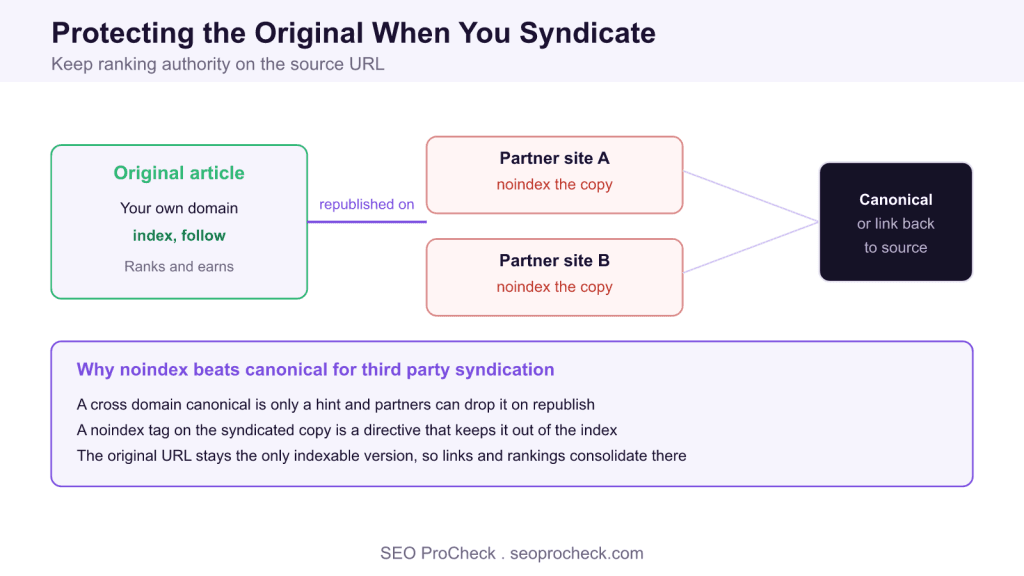
When you syndicate content to other sites, the most reliable way to protect your rankings is to have those copies carry a noindex tag. A noindex is a directive that keeps the duplicate out of search, so the original URL stays the only indexable version and keeps the ranking authority.
- Syndication republishes your content on other domains, creating duplicates.
- A cross domain canonical is only a hint that partners can drop or ignore.
- A noindex tag on the syndicated copy is a directive, so it is more reliable.
- The goal is to keep the original URL as the single indexable, ranking version.

Syndication is a legitimate way to reach new audiences by republishing your work on partner sites. The risk is that a stronger partner domain outranks your original for your own content. The case study referenced below argues that noindexing the syndicated copies is the most dependable protection, and its source is preserved at the foot of this page. Around it we explain why a directive beats a hint, and how to implement it cleanly.
What syndication does to your rankings
When a partner republishes your article, search engines see two or more near identical pages across different domains and try to pick one to rank. If the partner has more authority, it can win, and your original loses the visibility you created the content for. This is a specific case of the broader duplicate content problem, where multiple copies compete and dilute each other.
Why a canonical alone is not enough
The intuitive fix is to ask partners to add a cross domain canonical pointing back to your original. That helps, but a canonical is only a hint. Search engines can ignore it, and partners frequently drop the tag when their CMS republishes, strip it during editing, or never add it correctly. Relying on a hint you do not control is fragile. If you want the full picture of how canonicals behave, the canonical tags reference lays out exactly where they hold and where they fail.
Why noindex is the dependable choice
A noindex directive on the syndicated copy is stronger than a canonical hint because it is an instruction rather than a suggestion. When the partner page carries a robots meta noindex, search engines keep that copy out of the index entirely, which removes it as a competitor to your original. That leaves your URL as the only indexable version, so links pointing at either copy consolidate toward the page you actually rank. The mechanics of the robots meta tag are covered in depth in the meta robots and x robots tag reference.
How to implement it with partners
Make noindex a condition of the syndication agreement, not an afterthought. Ask the partner to add a robots meta noindex to the republished page, or to serve an x robots tag noindex header if they cannot edit the template. Where they are willing, pair the noindex with a link back to your original so readers and crawlers both find the source. Verify the tag on the live partner URL after publication, because a promised tag that never shipped offers no protection. Letting uncontrolled duplicates stay indexed also feeds index bloat, which works against you on both domains.
When you cannot get a noindex
If a partner will not noindex, negotiate the next best protections: a cross domain canonical, a delay before the copy is published so your original is indexed first, and a prominent link back to the source. These are weaker, but stacking them reduces the chance that a partner copy displaces your original. The safest partnerships are the ones where noindex is agreed upfront.
| Method | Strength | Why |
|---|---|---|
| Noindex on the copy | Strongest | A directive that keeps the copy out of the index |
| Cross domain canonical | Moderate | Only a hint, can be ignored or dropped |
| Publish delay | Supporting | Lets the original get indexed first |
| Link back to source | Supporting | Passes signals and readers to the original |
| Nothing | Risky | Partner may outrank your original |
Frequently asked questions
Why should syndicated content be noindexed?
Because a noindex tag keeps the republished copy out of search entirely, leaving your original as the only indexable version. That prevents a stronger partner domain from outranking you for your own content.
Is a canonical tag enough for syndication?
Often not. A cross domain canonical is only a hint that search engines can ignore, and partners frequently drop it during republishing. A noindex is a directive, so it is more dependable.
How do I add noindex to a partner site I do not control?
Make it a term of the syndication agreement. Ask the partner to add a robots meta noindex to the page, or to serve an x robots tag noindex header if they cannot edit the template, then verify it on the live URL.
Will noindexing the copy hurt my original?
No. The point is to protect the original by removing its duplicate competitor from the index. Your indexable original keeps its rankings and consolidates the signals.
What if the partner refuses to noindex?
Fall back to a cross domain canonical, a publishing delay so your original is indexed first, and a prominent link back to your source. These are weaker but stack to reduce the risk of being outranked.
Does syndication cause duplicate content penalties?
There is no specific penalty, but duplicates compete and can suppress your original. Noindexing the copies removes that competition and is the cleanest way to avoid the problem.
Source: https://www.gsqi.com/marketing-blog/news-syndication-seo-case-study/
Take this with you
The assistant links open with a question about this page already written. Nothing is sent until you press enter.
Claude Vincent is a technical SEO consultant focused on crawlability, rendering, and AI-search visibility. He writes the field guides and case studies at SEO ProCheck, with a bias toward the durable, unglamorous work that decides whether search engines and AI answer engines can actually read and cite a site.
About SEO ProCheck
Technical SEO consulting and GEO strategy with 20 years of enterprise experience. Case studies, resources, and tools for search and AI visibility.
Work With Me
Technical SEO audits, GEO strategy, site migrations, and international SEO. Hourly consulting for teams who need hands-on support, not just reports.
Subscribe to our newsletter!








Recent Posts
- Most Top Sites Never Say Who They Are in Structured Data October 14, 2026
- Homepage Titles Are Mostly Too Short, Not Too Long October 8, 2026
- Who Actually Serves an llms.txt? 184 Top Sites Measured September 29, 2026