

AI Summary
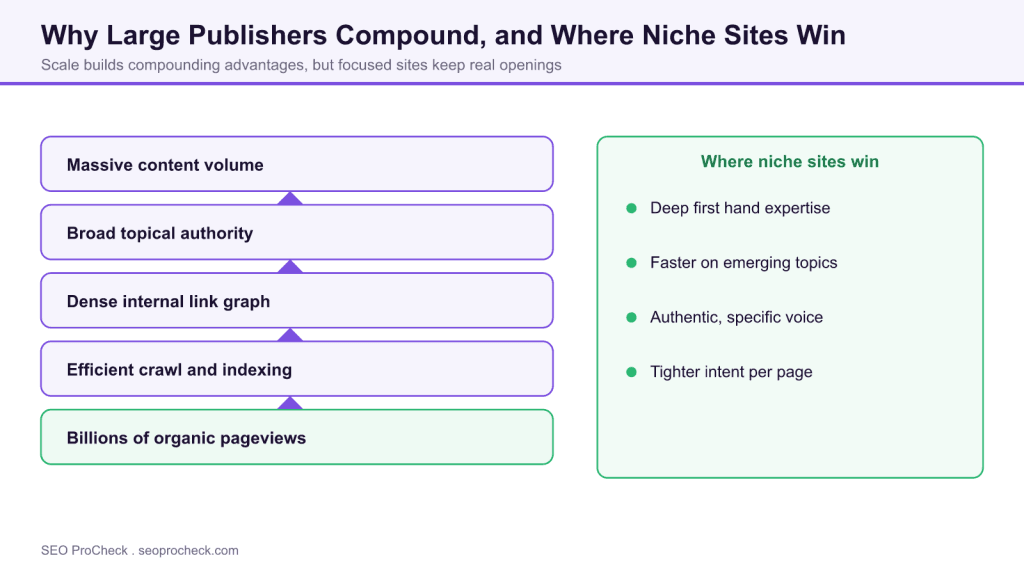
The largest publishers dominate organic search through scale: massive content volume, dense internal linking, and technical infrastructure that compounds topical authority. Smaller sites cannot match that volume, but they can win by going deeper on a niche, moving faster on new topics, and speaking with a specific, credible voice.
- Scale advantages: content portfolio thinking, automated internal linking, and crawl efficiency across millions of URLs.
- These are structural moats that take years and real budget to build.
- Niche openings: first hand expertise, speed on emerging queries, and an authentic, credible voice.
- Compete on depth and trust per page, not on raw output.
Detailed.com's ongoing Q series provides quarterly analysis of how the largest digital publishers execute their SEO strategies. The research examines traffic patterns, content strategies, and technical approaches used by sites generating billions of monthly pageviews from organic search.
Scale of Operations
The Q analysis documents the massive content production operations behind top publishers. Sites like Fandom, Dotdash Meredith properties, and major news organizations publish thousands of articles monthly. This scale creates compounding advantages in topical coverage and internal linking that smaller competitors cannot easily replicate.
Technical Infrastructure
Large publishers invest heavily in technical SEO infrastructure. Custom CMS platforms, automated internal linking systems, and sophisticated crawl management enable efficient scaling. These technical capabilities represent significant barriers to entry that take years and substantial investment to develop.
Content Strategy Patterns
The research identifies common content approaches: comprehensive topic coverage through pillar and cluster models, aggressive expansion into adjacent topics, and systematic content refresh programs. Successful large publishers treat content as a portfolio, understanding that individual page performance matters less than aggregate topic authority.
Lessons for Smaller Publishers
While scale advantages are real, the Q analysis also identifies where smaller publishers compete successfully. Deep niche expertise, faster response to emerging topics, and more authentic voice can offset scale disadvantages in specific contexts. Understanding what large publishers do well helps identify where they're vulnerable.
Source: Detailed.com
What the Q analysis tracks
Detailed.com's Q series periodically maps how the biggest publishers earn organic traffic: which sites are growing, which topics they expand into, and which technical patterns recur. The through line is that sites generating billions of pageviews treat content as a portfolio. No single article carries the business, and the aggregate topical authority of thousands of pages is the real asset.
The four compounding advantages
- Content volume: publishing thousands of articles a month blankets a topic and its adjacencies faster than any small team can.
- Topical authority: broad, deep coverage signals expertise across a subject, lifting new pages more easily.
- Internal link graph: automated linking systems connect related pages the moment they publish, distributing equity instantly.
- Crawl and index efficiency: custom platforms, clean architecture, and disciplined sitemaps keep millions of URLs discoverable.
The templated page engine behind Trello and Asana is a focused version of the same playbook, applied to a product catalogue instead of an editorial operation.
Where niche sites beat the goliaths
Scale is a moat, not a guarantee. Google's emphasis on experience and trust, the E-E-A-T framework, rewards signals that large content mills struggle to fake:
- First hand experience: genuine testing, original photography, and real results that a templated article cannot manufacture.
- Speed on emerging topics: a focused site can publish a credible take on a new development while a large newsroom is still assigning it.
- Authentic voice: a named, credible author with a point of view builds trust that anonymous scale content lacks.
- Tighter intent: one page that fully answers one need often beats a broad page that half answers several.
A niche playbook against scale
Do not try to out publish a goliath. Instead, pick a tight topic you can genuinely own, demonstrate experience on every page, and build your own dense internal cluster so your handful of pages reinforce each other. Then compete on the things scale erodes: clarity, credibility, and freshness. Winning the featured snippet for a specific question is often easier for a focused page than for a sprawling one.
Advantage and counter move
| Publisher advantage | Why it compounds | Niche counter move |
|---|---|---|
| Content volume | Blankets topics and adjacencies | Own one tight topic completely |
| Topical authority | New pages inherit trust | Prove first hand experience per page |
| Internal link graph | Equity spreads instantly | Build a small, dense cluster |
| Crawl efficiency | Millions of URLs stay indexed | Keep a lean, fast, clean site |
What has changed since this analysis
Since 2023, Google's helpful content work and the 2024 site reputation abuse policy have pushed back on some large publishers that scaled thin or borrowed authority through parasite arrangements. The field is not level, but the premium on genuine helpfulness and demonstrated experience has grown, which is exactly where a focused site has the advantage.
Frequently Asked Questions
How do large publishers get so much organic traffic?
They treat content as a portfolio: thousands of pages that together build deep topical authority, connected by automated internal linking and served from technical infrastructure that keeps millions of URLs crawlable. Aggregate authority, not any single article, drives the traffic.
Can a small site compete with large publishers?
Yes, but not by matching volume. Small sites win on first hand experience, speed on emerging topics, an authentic voice, and tightly focused pages that fully answer one intent, all signals that scaled content struggles to replicate.
What is E-E-A-T and why does it help niche sites?
E-E-A-T stands for experience, expertise, authoritativeness, and trust. It rewards genuine first hand experience and credible authorship, which a focused site can demonstrate more convincingly than an anonymous content mill.
What is the Detailed Q series?
It is Detailed.com's periodic analysis of how the largest publishers earn organic traffic, including which sites grow, which topics they expand into, and which technical patterns recur. It is a useful window into scale strategies.
Should a small site publish as much content as possible?
No. Out publishing a large operation is a losing race. A small site is better off publishing fewer, deeper, experience led pages and building a dense internal cluster around a topic it can genuinely own.
Have algorithm updates hurt large publishers?
Some. Since 2023 the helpful content work and the 2024 site reputation abuse policy have penalized large sites that scaled thin content or borrowed authority, raising the premium on genuine helpfulness where niche sites compete best.
Claude Vincent is a technical SEO consultant focused on crawlability, rendering, and AI-search visibility. He writes the field guides and case studies at SEO ProCheck, with a bias toward the durable, unglamorous work that decides whether search engines and AI answer engines can actually read and cite a site.
About SEO ProCheck
Technical SEO consulting and GEO strategy with 20 years of enterprise experience. Case studies, resources, and tools for search and AI visibility.
Work With Me
Technical SEO audits, GEO strategy, site migrations, and international SEO. Hourly consulting for teams who need hands-on support, not just reports.
Subscribe to our newsletter!







Recent Posts
- Can AI Crawlers Actually Read Your Site? I Measured 400 of the Biggest September 5, 2026
- The Pre-Publish Quality Gate for AI-Assisted Content August 6, 2026
- AGENTS.md vs llms.txt vs llms-full.txt: Which Agent File Does What July 18, 2026