


AI Summary
Trello and Asana rank for enormous volumes of software and productivity queries because they run a templated page engine, not a blog. They turn every use-case, integration, and template into its own indexable landing page, then bind those pages together with topical internal links so authority compounds.
- The repeatable pattern: seed real use-cases and integrations, publish templated landing pages at scale, cluster them with internal links, and convert on organic sessions.
- Programmatic pages win the long tail: thousands of low competition queries that one blog post could never target on its own.
- Guardrails decide the outcome: thin, near duplicate templates get filtered, so every page needs a genuine reason to exist.
- You can borrow the model at any size by starting with one high intent template and expanding only where real demand exists.
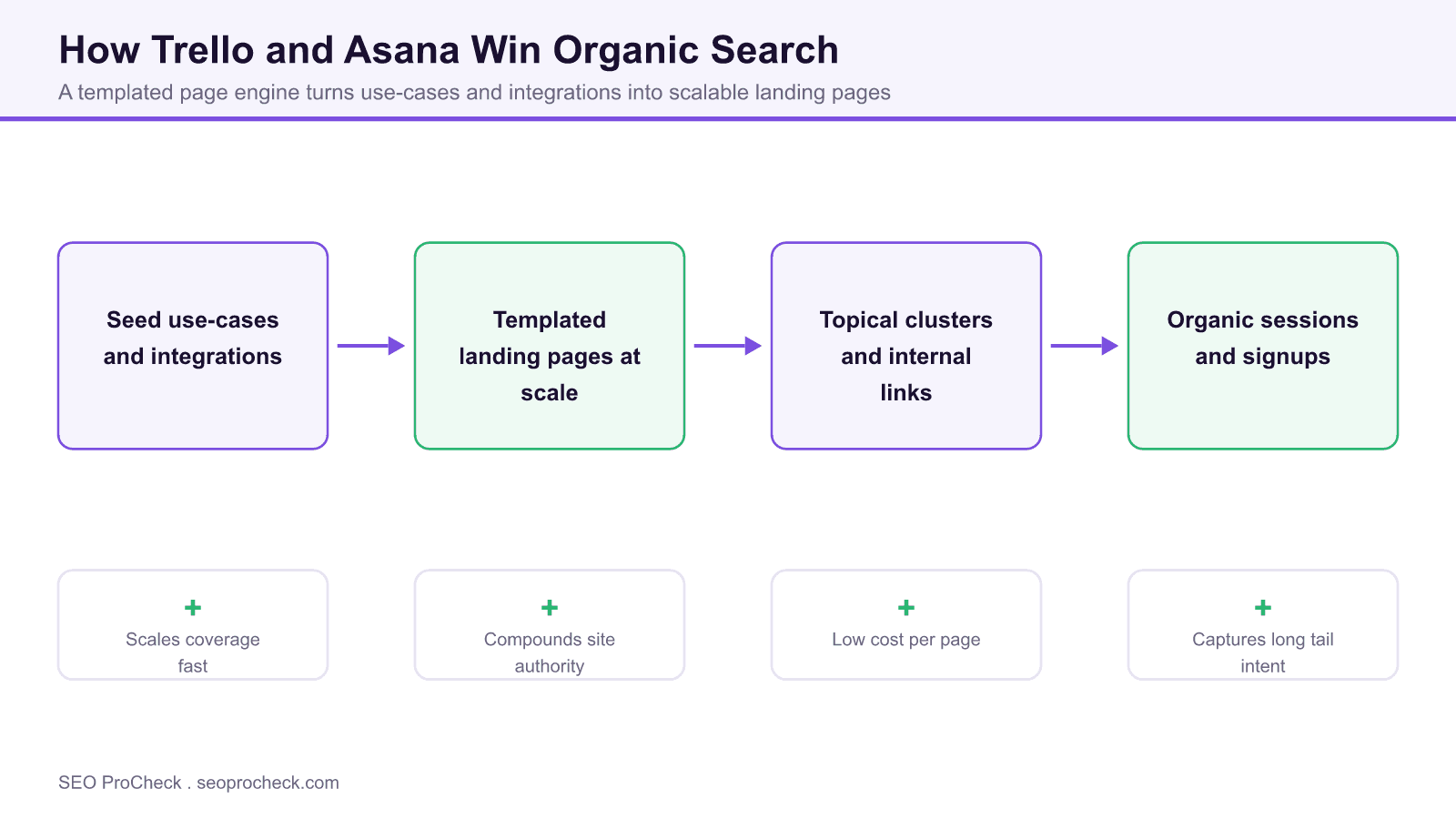
This case study documents a successful organic growth strategy, demonstrating how strategic SEO implementation drives measurable business results. The approach provides actionable insights for practitioners facing similar challenges.
Challenge and Context
Every successful SEO initiative begins with understanding the starting position and objectives. This case study reveals the initial challenges, competitive landscape, and business goals that shaped the strategy. Understanding context helps practitioners assess applicability to their own situations.
Strategic Approach
The methodology employed combined technical optimization, content strategy, and authority building in a coordinated approach. Key decisions around prioritization, resource allocation, and tactical execution provide a template for similar initiatives. The strategy balanced quick wins with sustainable long-term growth.
Implementation Details
Moving from strategy to execution required specific technical implementations, content creation processes, and measurement frameworks. This case study documents the practical steps taken, tools used, and workflows developed. These implementation details help practitioners translate strategy into action.
Results and Analysis
The outcomes demonstrate the effectiveness of the approach through measurable metrics: traffic growth, ranking improvements, and business impact. Analysis of what worked best and what could have been done differently provides learning value beyond the raw results.
This case study contributes to the evidence base for effective SEO strategy, helping practitioners learn from documented successes.
Source: https://www.youtube.com/watch?v=gdk57i9w0xs
What Trello and Asana actually built
Both products treat their marketing site as a library of indexable landing pages rather than a stream of posts. Trello publishes a large template gallery at trello.com/templates/, with a dedicated URL for each board template and each category. Asana runs use-case pages under asana.com/uses/, an integrations directory at asana.com/apps/, and comparison and resource hubs. Each page targets a specific query family: a Kanban template, a marketing calendar, a Slack integration, or a "project management for agencies" use case.
This is the same lesson the SEO playbook of the largest publishers teaches, applied to a SaaS catalogue: individual page performance matters less than the aggregate authority the whole cluster earns.
The programmatic SEO pattern, step by step
- Mine demand. Pull query data from Google Search Console, then expand it with a keyword tool. Group queries into repeatable page types: templates, integrations, use cases, comparisons.
- Design one template per intent. A template page and an integration page answer different questions, so they need different layouts, headings, and calls to action.
- Give every page a unique element. A real screenshot, a downloadable board, specific setup steps, or genuine data. Without it the page is a near duplicate.
- Build the internal link graph. Category hubs link to every child page, children link back to the hub and to close siblings, and breadcrumbs expose the hierarchy.
- Manage indexation. Keep money pages indexable, submit segmented XML sitemaps per template type, and keep faceted or filter URLs out of the index.
Internal linking that compounds
The quiet engine behind both sites is a dense, predictable internal link graph. A visitor and a crawler can reach any template from its category hub in one click, and every child page passes context back up. That structure concentrates relevance signals on the hubs while spreading crawl equity to the long tail. If you serve any pages behind a login or with restricted crawling, confirm your directives with the meta robots and X-Robots-Tag reference so you never accidentally noindex a page that should rank.
Where thin programmatic pages fail
Scale cuts both ways. When templates are stamped out with no unique value, they read as doorway or scaled content and get filtered or demoted. The fix is not fewer pages, it is more substance per page: original media, specific instructions, and data a competitor cannot copy in an afternoon. Ask of every template: would this page still deserve to exist if only ten people a month searched for it?
What has changed since this case study
In March 2024 Google rolled out a core update alongside a scaled content abuse policy that specifically targets mass produced pages created mainly to rank, including AI generated pages at scale. Programmatic SEO still works, but the bar for uniqueness is higher than it was. The winning version of the Trello and Asana model in 2026 pairs template scale with real, page level value and clear internal structure, not automation for its own sake.
Template type to intent map
| Page template | Query intent | Unique element that justifies the page |
|---|---|---|
| Board or project template | "kanban template", "content calendar template" | A usable, copyable template plus setup steps |
| Integration page | "asana slack integration" | Real configuration steps and screenshots |
| Use-case page | "project management for agencies" | Role specific workflow and examples |
| Comparison page | "trello vs asana" | Honest feature table and decision guidance |
Frequently Asked Questions
What is programmatic SEO?
Programmatic SEO is the practice of publishing many landing pages from a single template, each targeting a specific long tail query. Trello and Asana use it for templates, integrations, and use cases. The template stays constant while the data on each page changes.
Why do Trello and Asana rank for so many keywords?
They give each use-case, integration, and template its own indexable URL, then link those pages together into topical clusters. That captures thousands of long tail queries a single blog post could never target and compounds authority across the cluster.
Can a small site copy this strategy?
Yes. Start with one high intent template type where you can prove real demand, give each page a genuinely unique element, and expand only where searches exist. Depth per page matters more than raw volume at small scale.
Will Google penalize templated pages?
Not for being templated. Google demotes scaled content that exists only to rank and adds no unique value. Pages with original media, specific steps, and real data are safe, which is why unique per page substance is the deciding factor.
How do internal links help programmatic pages?
Category hubs link to every child page and children link back, so crawlers reach the long tail quickly and relevance signals concentrate on the hubs. A predictable link graph is what turns a pile of pages into a compounding topical cluster.
How do I measure if the strategy works?
Track indexed page counts, impressions and clicks by page template in Search Console, and assisted conversions from organic landing pages. Rising impressions across a whole template type, not just one page, is the signal that the cluster is compounding.
Take this with you
The assistant links open with a question about this page already written. Nothing is sent until you press enter.
Claude Vincent is a technical SEO consultant focused on crawlability, rendering, and AI-search visibility. He writes the field guides and case studies at SEO ProCheck, with a bias toward the durable, unglamorous work that decides whether search engines and AI answer engines can actually read and cite a site.
About SEO ProCheck
Technical SEO consulting and GEO strategy with 20 years of enterprise experience. Case studies, resources, and tools for search and AI visibility.
Work With Me
Technical SEO audits, GEO strategy, site migrations, and international SEO. Hourly consulting for teams who need hands-on support, not just reports.
Subscribe to our newsletter!








Recent Posts
- Most Top Sites Never Say Who They Are in Structured Data October 14, 2026
- Homepage Titles Are Mostly Too Short, Not Too Long October 8, 2026
- Who Actually Serves an llms.txt? 184 Top Sites Measured September 29, 2026