

AI Summary
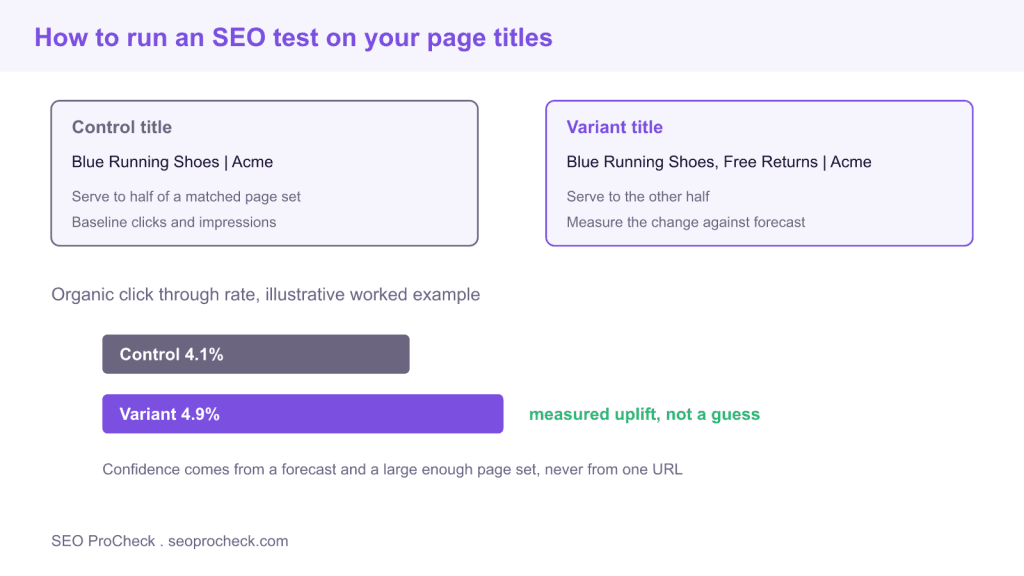
You SEO test a page title by serving a control version and a variant version to two statistically similar groups of pages, then comparing real clicks and impressions from Search Console against a forecast of what would have happened with no change. That turns title writing from opinion into a measured decision that survives an algorithm update and a change of manager.
- Test on a group of similar pages, never a single URL, because one page cannot separate your change from normal noise.
- The core metrics come from Search Console: clicks, impressions, click through rate, and average position for the tested queries.
- Build a forecast first, so the result is the gap between predicted and actual, not a raw before and after.
- Guard against seasonality, ranking swings, and cannibalisation, which are the usual reasons a title test lies to you.
Everyone has an opinion about title tags. The point of an SEO test is to replace the loudest opinion in the room with evidence. A title test measures whether a specific rewrite actually moves clicks, impressions, or rankings, and by how much, so you can ship the winners and quietly retire the ideas that sounded good but did nothing. This guide walks through the test designs that work, the exact metrics to read, and the traps that produce false wins.
Why you test titles instead of guessing
The title tag is one of the few ranking and click factors you can change on thousands of pages in an afternoon, which is exactly why an untested change is dangerous. A rewrite that lifts click through rate by a fraction of a point across a large template can be worth a lot of traffic, and a rewrite that quietly suppresses it can cost just as much. Testing gives you three things at once: a defensible number to report, protection against a change that looks clever but loses clicks, and a growing library of patterns that work for your specific audience rather than for a generic best practice list.
Three ways to run a title test
There is no single correct method. Pick the design that matches how many similar pages you have and how much traffic they get.
| Test design | How it works | Best when | Main risk |
|---|---|---|---|
| Split test on matched groups | Half of a template gets the variant, half stays as control, compared over the same window | Hundreds of similar pages, such as product or category templates | Groups not truly comparable at the start |
| Time based before and after | Change all pages on one date, forecast the baseline, measure the gap | One important page or a small set | Seasonality and algorithm updates confound the result |
| Staggered rollout | Apply the variant in waves and watch each wave move in turn | Medium page counts where a clean split is hard | Slower to read, needs steady traffic |
Whichever you choose, the unit of analysis is the group, not the page. A single URL swings on its own ranking luck, so its numbers cannot tell you whether the title or the algorithm caused the change.
The metrics that decide the test
Search Console is the source of truth for a title test because titles influence what a searcher sees in the result, which is the click decision. Read four numbers for the tested query set:
- Impressions tell you the test had enough exposure to mean anything. A tiny sample is not a result, it is noise.
- Clicks are the outcome you usually care about most, since a better title earns more of the same demand.
- Click through rate normalises clicks against impressions, so a real title win shows up here even when demand moves.
- Average position is the control variable. If the variant group also happened to rank higher, some of the click gain is ranking, not the title, and you must separate the two.
Export the query and page report, segment into control and variant, and compare click through rate at matched positions. If you can, model the expected clicks with a simple forecast from the pre test period, then report the difference between forecast and actual. That difference, not a raw before and after, is the honest measure of the title.
Common ways a title test lies to you
Most false wins come from a handful of avoidable mistakes. Seasonality is the biggest: a test that runs across a demand spike will credit the title for traffic the calendar delivered. Ranking drift is next, since a group that drifts up in position gains clicks regardless of wording. Cannibalisation hides a third: if two of your pages compete for the same query, a title change can move clicks between them rather than growing the total. Finally, watch for Google rewriting your title in the result. Google now replaces titles it dislikes, so verify that the variant you wrote is the title actually shown before you trust the numbers.
A worked example
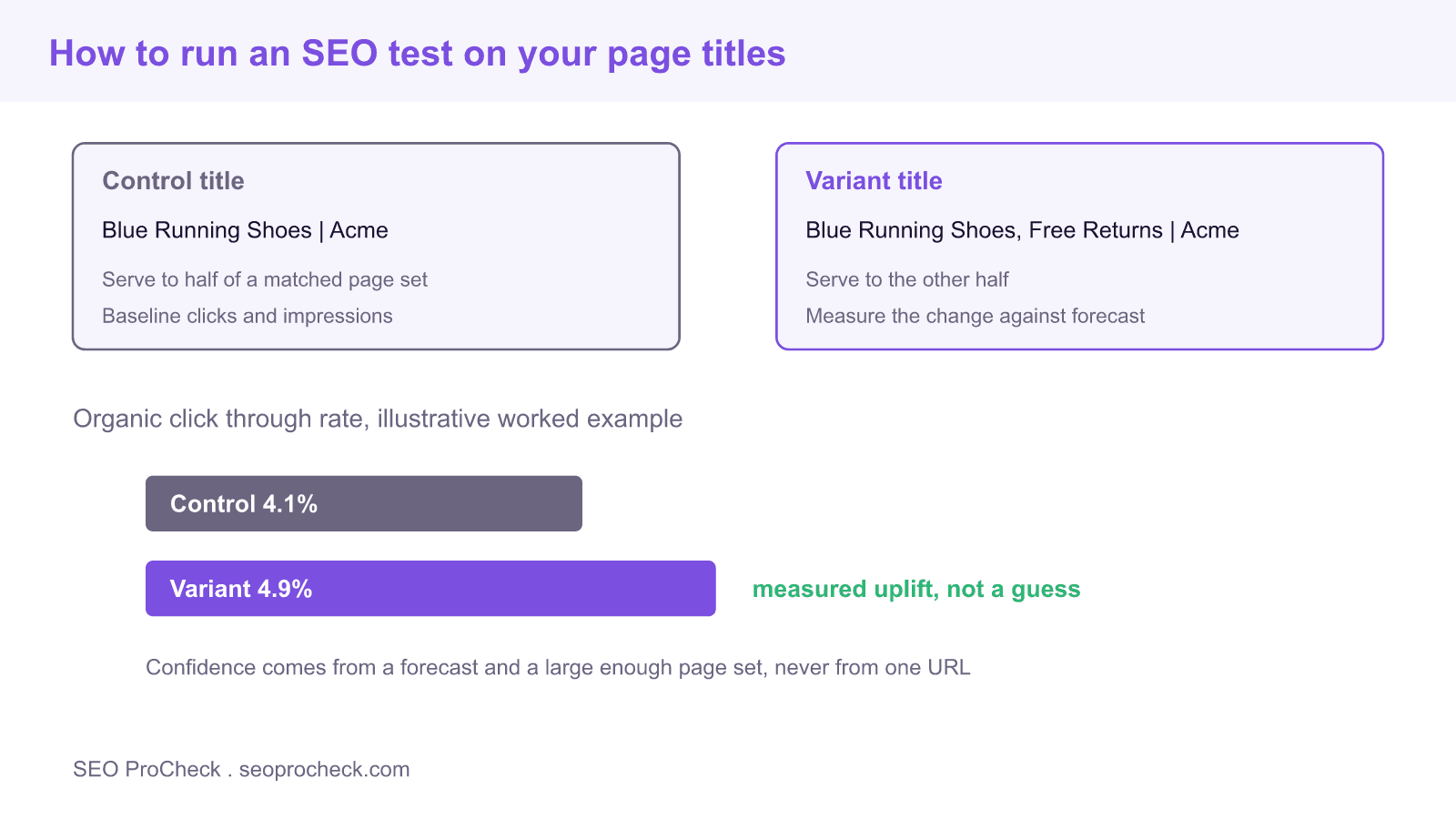
Say you manage 800 category pages. You split them into two matched groups of 400 by traffic and position, keep group A on the current pattern, and give group B a pattern that adds a benefit phrase such as Free Returns. Over four clean weeks group A holds a 4.1 percent click through rate while group B reaches 4.9 percent at the same average position. Because position held steady and both groups saw the same seasonality, the gap is attributable to the title. You roll the winning pattern out to the full template and log it in your test library. These numbers are illustrative and stand in for whatever your own data shows, but the shape of the decision is exactly this.
FAQ
You can, but you should not trust it. A single URL moves with its own ranking luck, so you cannot tell the title effect apart from normal fluctuation. Test on a group of similar pages, or use a time based design with a forecast if the page is genuinely one of a kind.
Long enough to gather a stable sample of impressions and to average out weekly patterns, which usually means at least three to four weeks. Extend it if your traffic is seasonal or low, and always compare like periods rather than a busy week against a quiet one.
Click through rate is the cleaner signal because it normalises for how much demand and how many impressions each group received. Clicks are the business outcome, so report both, and always check average position so a ranking move is not misread as a title win.
Google frequently replaces titles it considers a poor fit, which can neutralise your test. Before you trust a result, search the target queries and confirm the variant you wrote is the title actually displayed. If Google overrides it, adjust the wording so your intended title is the one users see.
Yes, at least in spirit. With enough pages and impressions you can apply a significance test or a forecasting model to judge whether the gap is real. Without that volume, treat the result as directional and confirm it with a second run before rolling out widely.
A title edit does not wipe rankings, but Google has to recrawl and reassess relevance, so expect a short settling period. Keep the primary keyword and intent intact, test the persuasive framing around it, and give the change time to bed in before you read the outcome.
Tools and further reading
- Preview how a title looks in the result before you test it with the SERP preview tool.
- Draft and length check the tag itself using the meta tags generator.
- Keep titles inside their pixel budget with the word and character counter.
- See more metadata and title case studies.
Reference: original case note
This SEO case study documents a successful optimization initiative, providing actionable insights for practitioners. The documented approach demonstrates how strategic SEO implementation drives measurable results.
Initial Situation
Understanding the starting point is essential context for evaluating any case study. This documentation covers the initial challenges, competitive position, and business objectives that shaped the SEO strategy.
Strategy and Approach
The strategic approach combined multiple SEO disciplines to address identified opportunities. Key decisions around prioritization and resource allocation provide a template for similar initiatives.
Implementation
Moving from strategy to execution required specific technical implementations, content development, and process changes. This case study documents the practical steps that translated strategy into action.
Results and Learnings
The outcomes demonstrate effectiveness through measurable improvements in rankings, traffic, and business metrics. Analysis of successes and challenges provides learning value for practitioners.
Case studies like this contribute to the SEO knowledge base, helping practitioners learn from documented real-world experiences.
Source: https://seotesting.com/blog/seo-test-page-titles/
Take this with you
The assistant links open with a question about this page already written. Nothing is sent until you press enter.
Claude Vincent is a technical SEO consultant focused on crawlability, rendering, and AI-search visibility. He writes the field guides and case studies at SEO ProCheck, with a bias toward the durable, unglamorous work that decides whether search engines and AI answer engines can actually read and cite a site.
About SEO ProCheck
Technical SEO consulting and GEO strategy with 20 years of enterprise experience. Case studies, resources, and tools for search and AI visibility.
Work With Me
Technical SEO audits, GEO strategy, site migrations, and international SEO. Hourly consulting for teams who need hands-on support, not just reports.
Subscribe to our newsletter!
Recent Posts
- Most Top Sites Never Say Who They Are in Structured Data October 14, 2026
- Homepage Titles Are Mostly Too Short, Not Too Long October 8, 2026
- Who Actually Serves an llms.txt? 184 Top Sites Measured September 29, 2026