

AI Summary
For large sites, XML sitemaps are a discovery and prioritization tool, not a ranking lever. The winning setup segments URLs into child sitemaps under an index file, respects the hard size limits, and uses honest lastmod dates so Google recrawls what actually changed.
- Each sitemap file is capped at 50,000 URLs and 50 MB uncompressed; use a sitemap index to group them.
- Include only indexable, canonical, HTTP 200 URLs; leave out redirects, noindex and duplicates.
- Google largely ignores priority and changefreq; accurate lastmod is the signal that matters.
- Sitemap inclusion aids discovery but does not guarantee indexation.
Research into XML sitemap implementation examined best practices for large sites managing thousands or millions of URLs. Proper sitemap management significantly affects crawl efficiency and indexation.
Sitemap Organization
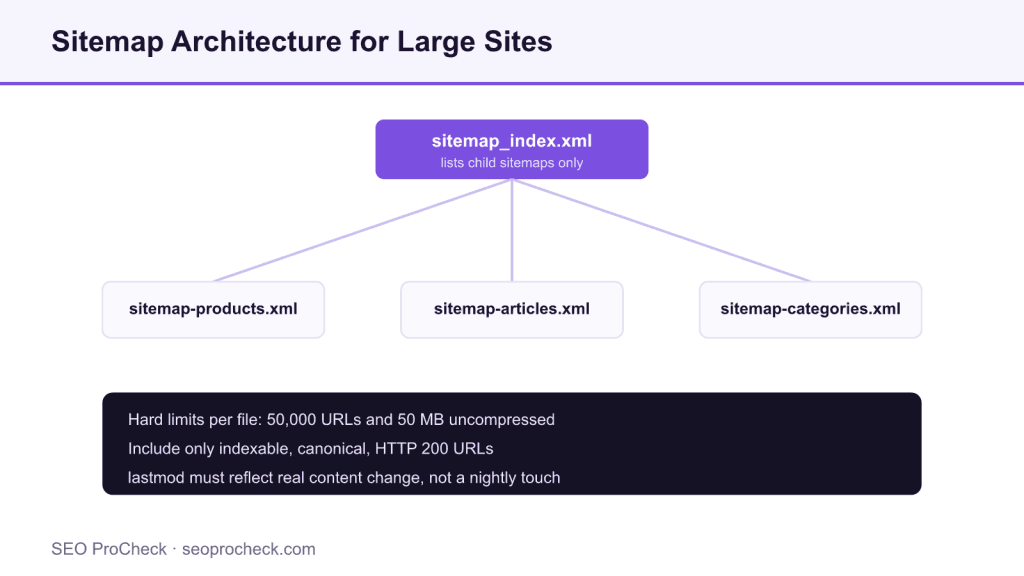
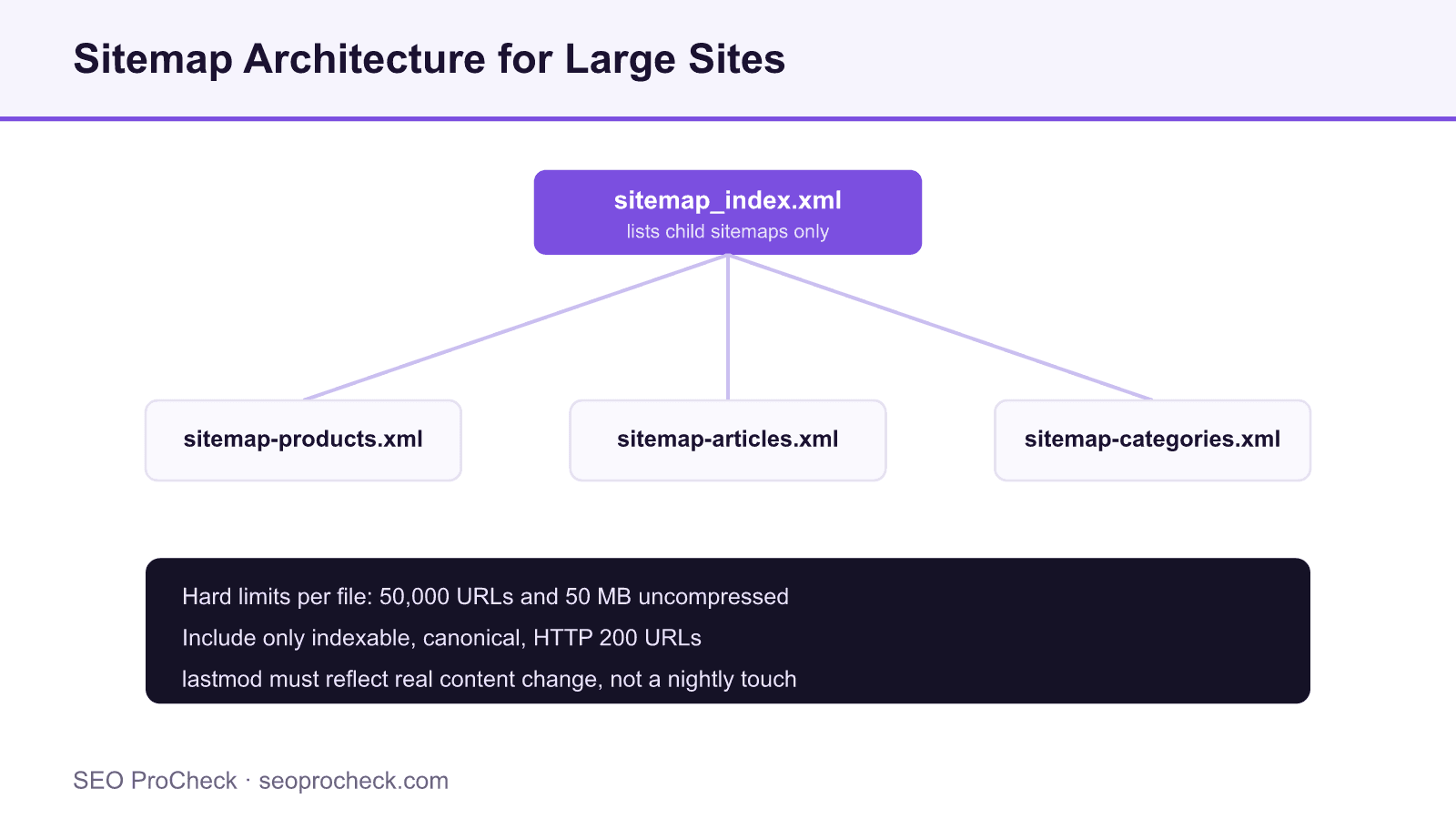
Segmenting sitemaps by content type (products, articles, categories) improved management and analysis. Sitemap index files organized large URL sets effectively. Keeping individual sitemaps under 50,000 URLs or 50MB ensured reliable processing.
Priority and Changefreq
Google largely ignores priority and changefreq signals in practice. Lastmod dates showing actual modification times provided the most useful signal. Automated lastmod updates on every minor change reduced signal value; lastmod should reflect meaningful content changes.
Sitemap and Indexation
Sitemap inclusion does not guarantee indexation. Sitemaps helped with discovery but didn't override quality or relevance decisions. Including only indexable, canonical URLs improved sitemap signal quality. Bloated sitemaps with non-indexable URLs wasted crawl resources.
Monitoring and Maintenance
Regular sitemap audits identified issues before they impacted crawling. GSC sitemap reports revealed processing errors and indexation ratios. Automated sitemap generation from CMS required validation to prevent technical errors from propagating.
Architect the sitemap index first
On a site with many thousands of URLs, a single flat sitemap is hard to manage and impossible to diagnose. The pattern that scales is a sitemap index file that points to child sitemaps split by content type, as shown in the diagram: one for products, one for articles, one for categories, and so on. This segmentation does double duty. It keeps each file within limits, and it turns Search Console into a diagnostic dashboard, because you can see indexation ratios per section and immediately spot which content type is struggling. Our XML sitemaps reference details the index format and namespaces.
| Sitemap | What to include | Hard limit | Common mistake |
|---|---|---|---|
| Index file | Links to child sitemaps only | 50,000 child sitemaps | Listing URLs directly in the index |
| Products | Canonical, in stock, indexable product URLs | 50,000 URLs, 50 MB | Including out of stock or variant duplicates |
| Articles | Published, canonical article URLs | 50,000 URLs, 50 MB | Leaving tag and author archives in |
| Categories | Indexable category and hub URLs | 50,000 URLs, 50 MB | Including paginated or filtered variants |
Respect the limits, and only list URLs you stand behind
Each sitemap file may contain at most 50,000 URLs and must not exceed 50 MB uncompressed. Cross either and Google may reject or truncate it. Just as important is what you leave out. A sitemap should be a clean list of URLs you want indexed: canonical, HTTP 200, not blocked by robots and not marked noindex. Every redirected, duplicate or noindex URL you include dilutes the signal and, on large sites, wastes crawl attention. That connects sitemaps directly to crawl budget: a lean sitemap of canonical URLs points Googlebot at exactly the pages that matter.
lastmod done right, priority and changefreq ignored
In practice Google has said it disregards the priority and changefreq elements, so do not spend engineering time tuning them. The lastmod date is different: Google does use it, but only if it is trustworthy. lastmod should reflect a meaningful content change, not a nightly database touch or a template tweak. If every URL reports today as its last modified date on every crawl, the signal is worthless and Google learns to ignore it. Set lastmod when the visible content actually changes, and pair each canonical entry with a matching self referencing canonical tag on the page.
Sitemaps do not equal indexation, so monitor
Submitting a URL in a sitemap gets it discovered, not indexed. Google still applies quality, duplication and relevance judgments before indexing. The place to watch this is the Search Console page indexing report, filtered by sitemap, where the indexed to submitted ratio per content type tells you where the problem sits. What has changed since the early sitemap era is that this per sitemap reporting makes segmentation more valuable than ever: if your products sitemap indexes at 40 percent while articles index at 95 percent, you know exactly where to investigate. Automated sitemap generation from a CMS should always be validated, because a templating error can silently propagate thousands of bad URLs.
Frequently Asked Questions
How many URLs can one XML sitemap contain?
A single sitemap file can hold up to 50,000 URLs and must stay under 50 MB uncompressed. For larger sites, split URLs across multiple sitemaps and reference them from a sitemap index file.
Should I use priority and changefreq in my sitemap?
There is little point. Google has said it largely ignores the priority and changefreq values. Focus instead on an accurate lastmod date that reflects genuine content changes.
Do sitemaps guarantee my pages get indexed?
No. Sitemaps help Google discover URLs, but indexation still depends on quality, uniqueness and relevance. A URL can be submitted and discovered yet remain unindexed.
What URLs should I exclude from a sitemap?
Exclude anything you do not want indexed: redirects, noindex pages, non canonical duplicates, parameter variants and pages that return errors. List only canonical, indexable, HTTP 200 URLs.
How should I structure sitemaps for a large site?
Use a sitemap index that points to child sitemaps segmented by content type, such as products, articles and categories. This keeps files within limits and lets you diagnose indexation per section in Search Console.
What is the right way to set lastmod?
Update lastmod only when the page content meaningfully changes. Touching it on every minor or automated change makes the signal unreliable and Google will discount it.
Source: XML sitemap research compiled
Take this with you
The assistant links open with a question about this page already written. Nothing is sent until you press enter.
Claude Vincent is a technical SEO consultant focused on crawlability, rendering, and AI-search visibility. He writes the field guides and case studies at SEO ProCheck, with a bias toward the durable, unglamorous work that decides whether search engines and AI answer engines can actually read and cite a site.
About SEO ProCheck
Technical SEO consulting and GEO strategy with 20 years of enterprise experience. Case studies, resources, and tools for search and AI visibility.
Work With Me
Technical SEO audits, GEO strategy, site migrations, and international SEO. Hourly consulting for teams who need hands-on support, not just reports.
Subscribe to our newsletter!








Recent Posts
- Most Top Sites Never Say Who They Are in Structured Data October 14, 2026
- Homepage Titles Are Mostly Too Short, Not Too Long October 8, 2026
- Who Actually Serves an llms.txt? 184 Top Sites Measured September 29, 2026