

AI Summary
The AI content quality score (element CO-003) flags pages that fall short of the accuracy, depth and authority thresholds AI systems prefer when choosing sources. Raise it by verifying facts, deepening coverage, showing named expertise, and keeping content current, then re audit against a repeatable rubric.
- AI systems favour content that demonstrates experience, expertise, authoritativeness and trust.
- Low quality pages are less likely to be selected for AI generated answers, reducing citation and visibility.
- A repeatable scoring rubric turns a vague quality goal into a checklist you can audit page by page.
- The strongest fixes are named authors, primary source citations, original data, and a real update cadence.
Quick Reference
Element Code: CO-003
Issue: Content does not meet quality thresholds for AI system preference
Impact: Lower likelihood of AI citation and visibility
Fix: Improve factual accuracy, depth, and authoritative signals
Detection: Content quality analysis, E-E-A-T evaluation
What Is This Issue?
AI systems prioritize high-quality, authoritative content for their responses. Content quality for AI includes factual accuracy, depth of coverage, clear attribution, and expertise signals.
Why This Matters for Your Website
AI systems are trained to prefer reliable, authoritative sources. Low-quality content is less likely to be selected for AI-generated responses.
How to Fix This Issue
- Verify facts: Ensure all claims are accurate
- Add depth: Comprehensive coverage of topics
- Show expertise: Author credentials and citations
- Update regularly: Keep content current
Tools for Detection
- Content analysis tools: Evaluate quality metrics
AI Search and GEO Considerations
AI systems use quality signals to determine which sources to cite. Improving content quality increases citation likelihood.
TL;DR (The Simple Version)
AI systems prefer high-quality content. Ensure your content is factually accurate, comprehensive, and shows expertise through author credentials and proper citations.
What quality means to an AI system
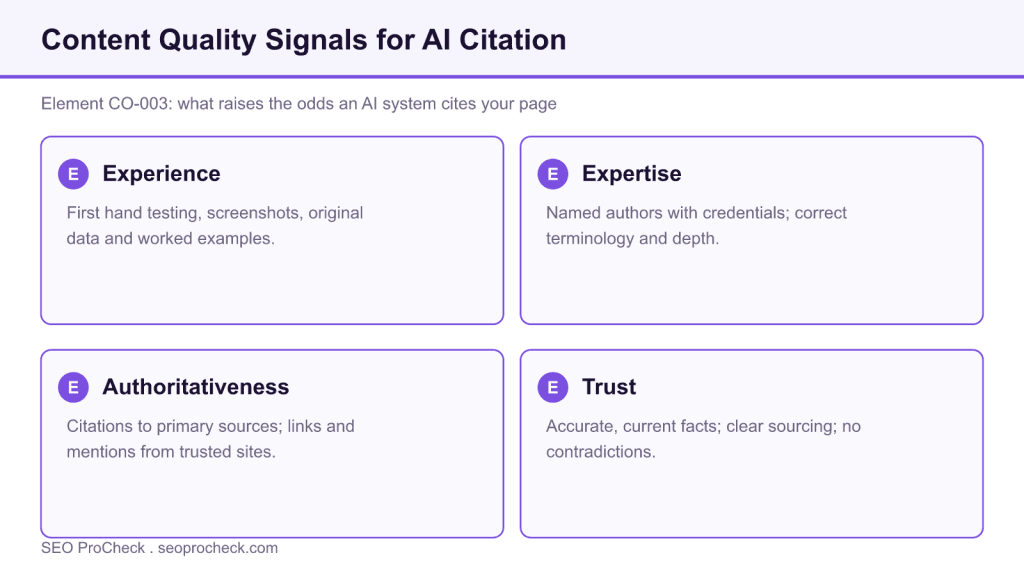
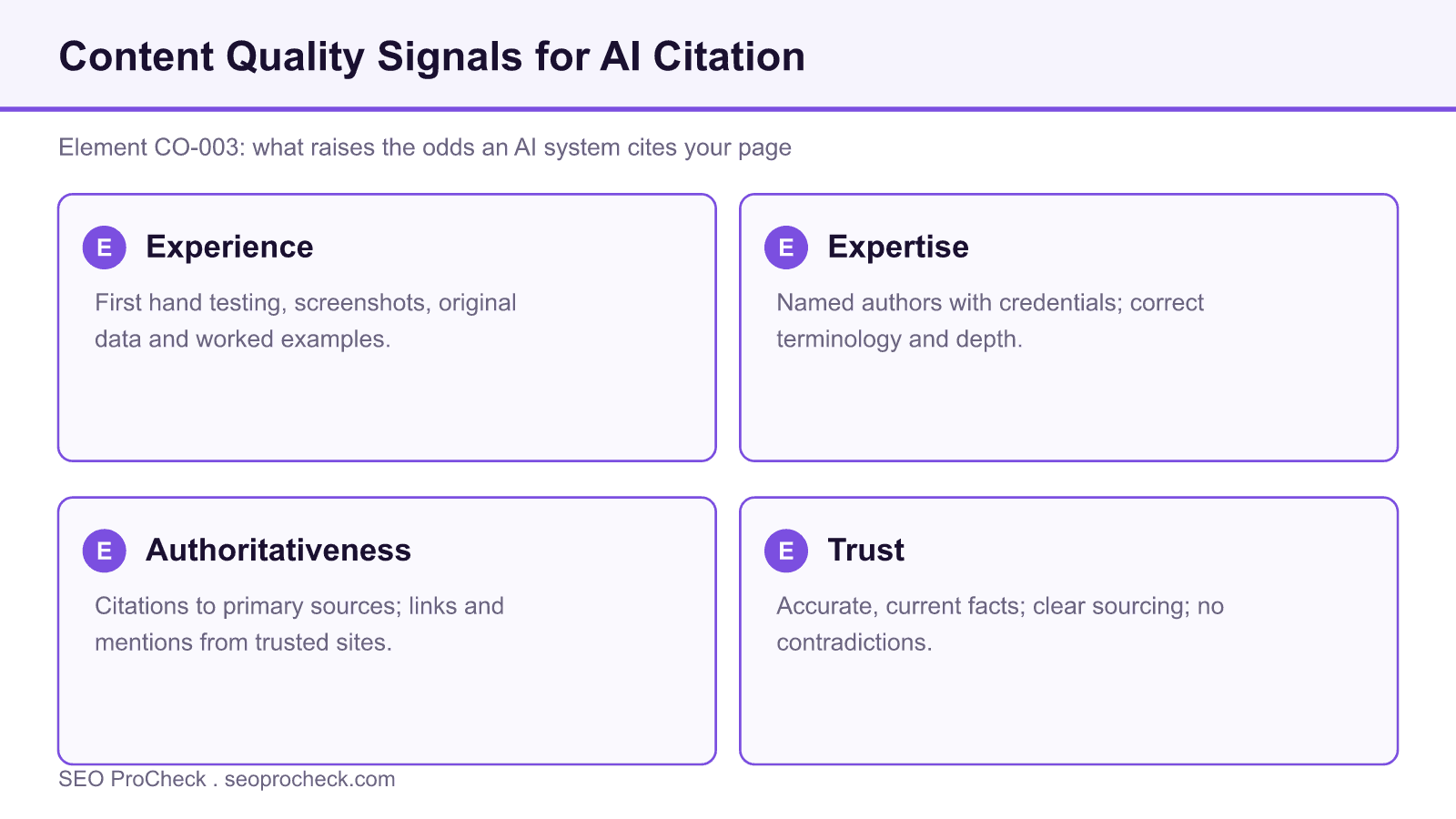
When an AI system decides which pages to ground an answer in, it is looking for signals that a source is reliable. Those signals map closely to the familiar E-E-A-T framework: experience (first hand knowledge), expertise (demonstrated skill), authoritativeness (recognition by others), and trust (accuracy and transparency). Element CO-003 fires when a page does not carry enough of these signals to be a comfortable citation.
The practical takeaway is that quality here is not about word count or polish. It is about whether a machine can tell that a real, credible person or organisation produced accurate, well sourced information.
A repeatable scoring rubric
Score each page from zero to two on five dimensions, then total it. Anything below seven out of ten is a rewrite candidate.
- Accuracy. Zero: unsourced claims. One: some citations. Two: every claim traceable to a primary source.
- Depth. Zero: surface summary. One: covers the main question. Two: covers the question plus edge cases and next steps.
- Experience. Zero: generic. One: some specifics. Two: original data, screenshots or worked examples.
- Authorship. Zero: anonymous. One: a byline. Two: a named author with credentials and Person schema.
- Freshness. Zero: undated. One: a publish date. Two: a visible last reviewed date with real updates.
Running this rubric turns the CO-003 flag into a concrete work list instead of an abstract worry. The companion fact verification score drills into the accuracy dimension, and you can find related material in the content and GEO checks hub or the AI search research library.
Concrete fixes that move the score
- Add a real author. Give the page a named author with a short credential line and mark it up with Person schema so the entity is machine readable.
- Cite primary sources. Replace assertions with linked references to studies, documentation and original data. Pages that cite well get cited well.
- Add first hand material. Original screenshots, a small dataset, or a worked example signal experience that generic text cannot fake.
- Structure for extraction. Lead with a direct answer, use question shaped headings, and add lists and tables so systems can lift a clean span.
- Set an update cadence. Review priority pages on a schedule and show a genuine last reviewed date, not a cosmetic one.
Weak versus strong quality signals
| Dimension | Weak signal | Strong signal |
|---|---|---|
| Accuracy | Unsourced claims and round numbers | Every claim linked to a primary source |
| Depth | Restates the question | Answers the question plus edge cases |
| Experience | Generic, interchangeable prose | Original data, screenshots, worked examples |
| Authorship | Anonymous or brand only byline | Named expert with Person schema |
| Freshness | No date or a stale one | Visible last reviewed date with real edits |
Frequently asked questions
What is the AI content quality score?
It is element CO-003, a check that flags pages which do not meet the accuracy, depth and authority thresholds AI systems prefer. A low score means the page is less likely to be selected for AI generated answers.
How do AI systems judge content quality?
They look for signals of experience, expertise, authoritativeness and trust, such as named authors, primary source citations, original data and accurate, current information. These map to the E-E-A-T framework used in quality evaluation.
How can I improve my content quality score quickly?
Start with the highest leverage fixes: add a named author with credentials, cite primary sources for every claim, include original screenshots or data, and show a genuine last reviewed date. Then re audit against a simple rubric.
Does content length affect AI citation likelihood?
Length itself is not the point. A short, accurate, well sourced page can outperform a long, vague one. Depth matters, but only in the sense of covering the question thoroughly and correctly, not padding word count.
What role does author information play?
A named author with visible credentials and Person schema helps AI systems attribute expertise to a real entity. Anonymous or brand only content is harder to trust and therefore less likely to be cited.
How often should I update content for AI systems?
Review your priority pages on a set cadence and update them when facts change, then show a real last reviewed date. Freshness is especially important on topics like tools, pricing and platform behaviour that shift over time.
Take this with you
The assistant links open with a question about this page already written. Nothing is sent until you press enter.
Claude Vincent is a technical SEO consultant focused on crawlability, rendering, and AI-search visibility. He writes the field guides and case studies at SEO ProCheck, with a bias toward the durable, unglamorous work that decides whether search engines and AI answer engines can actually read and cite a site.
About SEO ProCheck
Technical SEO consulting and GEO strategy with 20 years of enterprise experience. Case studies, resources, and tools for search and AI visibility.
Work With Me
Technical SEO audits, GEO strategy, site migrations, and international SEO. Hourly consulting for teams who need hands-on support, not just reports.
Subscribe to our newsletter!








Recent Posts
- Most Top Sites Never Say Who They Are in Structured Data October 14, 2026
- Homepage Titles Are Mostly Too Short, Not Too Long October 8, 2026
- Who Actually Serves an llms.txt? 184 Top Sites Measured September 29, 2026