

AI Summary
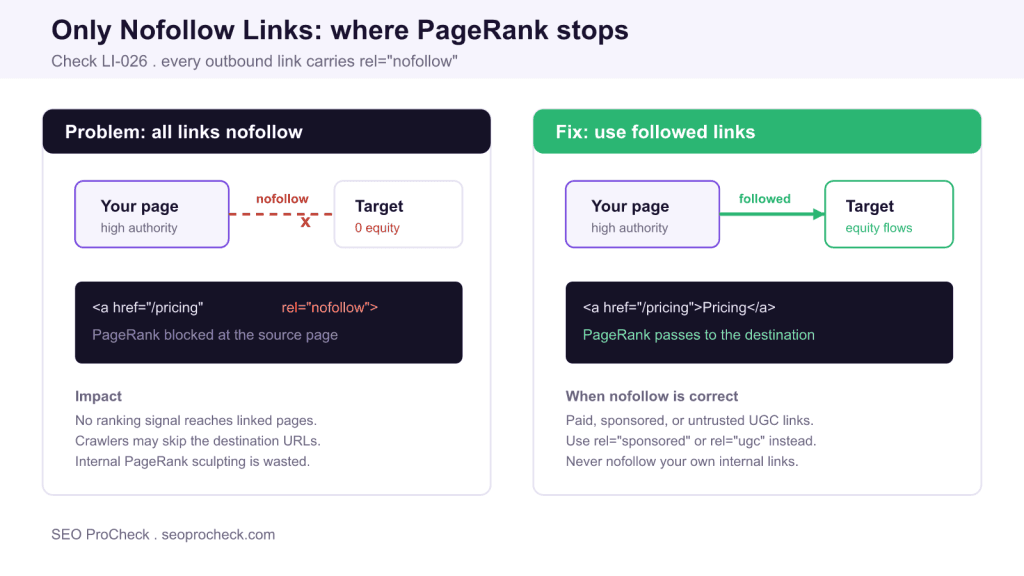
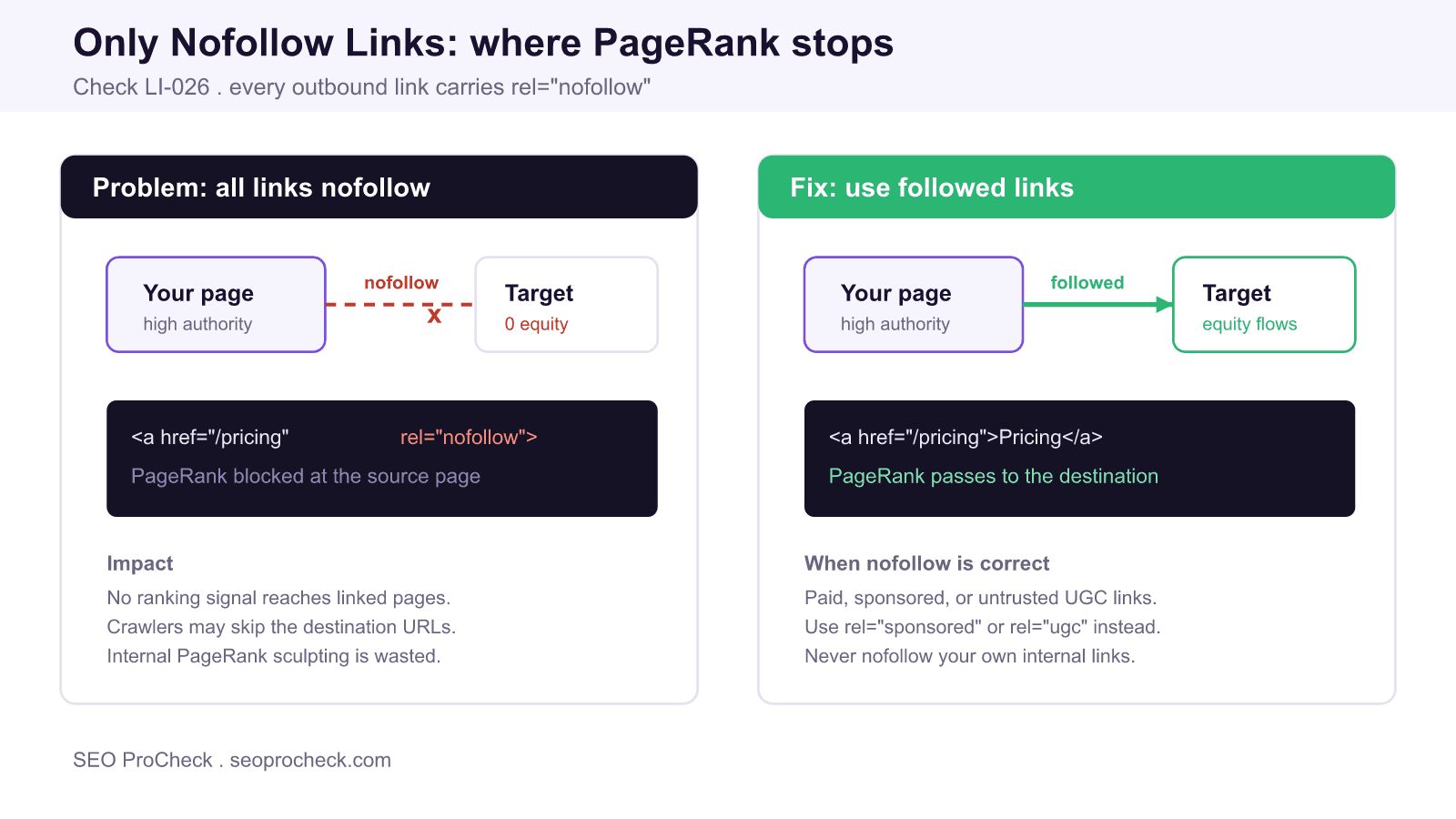
The "only nofollow links" check (LI-026) flags a page whose outbound links all carry rel="nofollow", so none of them pass PageRank or crawl signals to the pages they point at. On your own site this quietly wastes internal link equity and can leave destination URLs under-crawled.
- Nofollow tells search engines not to pass ranking credit through that link.
- Followed links are the default and should be used for your own internal navigation.
- Reserve nofollow for paid, sponsored, or untrusted user-generated links.
- Since 2019 Google treats rel="nofollow", rel="sponsored", and rel="ugc" as hints, not strict rules.
Quick Reference
Element Code: LI-026
Issue: Only nofollow links
Impact: No link equity flows to the destination pages
Fix: Use followed links for internal navigation
Detection: Screaming Frog, link type report
What Is This Issue?
This check fires when every outbound link on a page carries the rel="nofollow" attribute. Nofollow is a signal to search engines that you do not vouch for the destination and do not want ranking credit, sometimes called link equity or PageRank, to flow through that link. When a page links out only through nofollowed links, it passes no authority to anything it references. On an internal page that links to your own pricing, product, or category URLs, that is almost always a mistake: you are throttling the ranking signals your own site relies on.
The attribute itself is valid HTML and has legitimate uses. The problem the check surfaces is scope. A single nofollow on a paid placement is correct. A whole page where the navigation, body links, and footer are all nofollow means the page becomes a dead end for authority, and often a crawl dead end too.
Why This Matters for Rankings
Search engines discover and score pages partly through the links between them. Internal links spread authority from strong pages, such as your homepage or a popular guide, to deeper pages that need help ranking. When those internal links are nofollowed, three things happen. First, the destination pages receive no share of the linking page's authority. Second, crawlers that lean on links for discovery may reach those URLs later or less often. Third, any deliberate internal linking strategy, moving equity toward money pages, is silently cancelled.
External nofollow is less damaging but still worth reviewing. If you nofollow a genuinely useful, authoritative resource you cite, you lose the small trust signal that outbound relevance can provide, and you gain nothing in return unless the link is paid or untrusted.
The rel Attribute Values You Should Know
Google split the old single nofollow into a small family of link relationships. Using the right one keeps you compliant and preserves equity where you want it.
| rel value | Meaning | Passes equity? | Use for |
|---|---|---|---|
(none) | Default followed link | Yes | Your internal links and trusted citations |
nofollow | Do not vouch, do not pass credit | No (treated as a hint) | Untrusted or unvetted destinations |
sponsored | Paid or affiliate placement | No | Ads, affiliate, sponsorships |
ugc | User generated content | No | Comments, forum posts, profile links |
You can combine values, for example rel="sponsored nofollow", when a link is both paid and untrusted. What you should not do is blanket every link on a template with nofollow.
How to Detect Nofollow-Only Pages
Crawl the site with Screaming Frog, then open the Outlinks tab or export All Outlinks. Filter the Link Position and Follow columns: any internal target where every inbound internal link shows Follow = False is a candidate. In the Inlinks report, sort by follow status to find URLs that receive only nofollowed internal links. You can also spot-check in the browser by viewing source and searching for rel="nofollow" across the navigation and body.
- Run a full crawl and export All Outlinks to a spreadsheet.
- Filter for internal links where
Followequals False. - Group by destination URL and flag any that never receive a followed internal link.
- Confirm in the page source that the nofollow is intentional, not a template default.
How to Fix
- Remove
rel="nofollow"from all internal links that point to your own indexable pages. - Audit templates, navigation menus, and plugins that may inject nofollow globally.
- Switch paid or affiliate links to
rel="sponsored"and user submitted links torel="ugc". - Leave genuine external links followed unless there is a specific trust or payment reason not to.
- Recrawl to confirm destination pages now receive at least one followed internal link.
When Nofollow Is the Right Choice
Nofollow is not something to eliminate, only to apply precisely. Use it for links you were paid to place, links inside user generated areas you cannot moderate, and links to pages you do not trust or do not want associated with your site. In those cases the correct modern attributes are sponsored and ugc, which tell search engines exactly why the link is qualified. The rule of thumb: nofollow protects you from vouching for something, so never point it at your own content.
What Has Changed Since 2019
For roughly fifteen years nofollow was a strict directive that blocked PageRank flow entirely. In September 2019 Google introduced rel="sponsored" and rel="ugc" and announced that all three values would be treated as hints for ranking purposes, with the change taking full effect through 2020. In practice Google may now choose to consider a nofollowed link for crawling and indexing signals, though it still will not be counted as an endorsement. This does not change the guidance for this check: keep your internal links followed so the intended equity flow is unambiguous.
Related reading on SEO ProCheck: the full link checks library, the nofollow definition in our glossary, and the accessibility guide to links that must have discernible text.
Frequently Asked Questions
Does nofollow stop Google from crawling the link?
Not necessarily. Since 2020 Google treats nofollow as a hint, so it may still crawl a nofollowed URL if it finds value in doing so. What nofollow reliably does is signal that you do not endorse the destination, so ranking credit is generally not passed through it.
Should I nofollow my own internal links?
No. Internal links to your own indexable pages should be followed so authority flows through your site as intended. Nofollowing internal links wastes the ranking signals your deeper pages depend on and is the exact problem this check flags.
What is the difference between nofollow, sponsored, and ugc?
All three qualify a link so it does not pass endorsement. Use sponsored for paid or affiliate links, ugc for user generated links such as comments, and nofollow as a general fallback when a link is simply untrusted. Sponsored and ugc give search engines more precise context than a bare nofollow.
Will removing nofollow from internal links improve rankings?
It can help destination pages by restoring the internal link equity they were being denied, especially pages that had no other followed internal links. Rankings depend on many factors, but making sure your own pages receive followed internal links removes a self-inflicted handicap.
How do I find pages that only have nofollow links?
Crawl the site with a tool like Screaming Frog and export the outlinks and inlinks reports. Filter for internal links where the follow status is false, then group by destination URL to find any page that never receives a followed internal link.
Is nofollow bad for SEO?
Nofollow itself is a legitimate tool. It is only harmful when misapplied, such as nofollowing your own internal navigation or every outbound link on a page. Used precisely for paid, untrusted, or user generated links, it protects your site without hurting your rankings.
TL;DR
Keep internal links followed so PageRank reaches your own pages. Reserve rel="nofollow", rel="sponsored", and rel="ugc" for paid, untrusted, or user generated destinations. A page where every link is nofollowed passes no equity and can leave its targets under-crawled.
Take this with you
The assistant links open with a question about this page already written. Nothing is sent until you press enter.
Claude Vincent is a technical SEO consultant focused on crawlability, rendering, and AI-search visibility. He writes the field guides and case studies at SEO ProCheck, with a bias toward the durable, unglamorous work that decides whether search engines and AI answer engines can actually read and cite a site.
About SEO ProCheck
Technical SEO consulting and GEO strategy with 20 years of enterprise experience. Case studies, resources, and tools for search and AI visibility.
Work With Me
Technical SEO audits, GEO strategy, site migrations, and international SEO. Hourly consulting for teams who need hands-on support, not just reports.
Subscribe to our newsletter!








Recent Posts
- Most Top Sites Never Say Who They Are in Structured Data October 14, 2026
- Homepage Titles Are Mostly Too Short, Not Too Long October 8, 2026
- Who Actually Serves an llms.txt? 184 Top Sites Measured September 29, 2026