

AI Summary
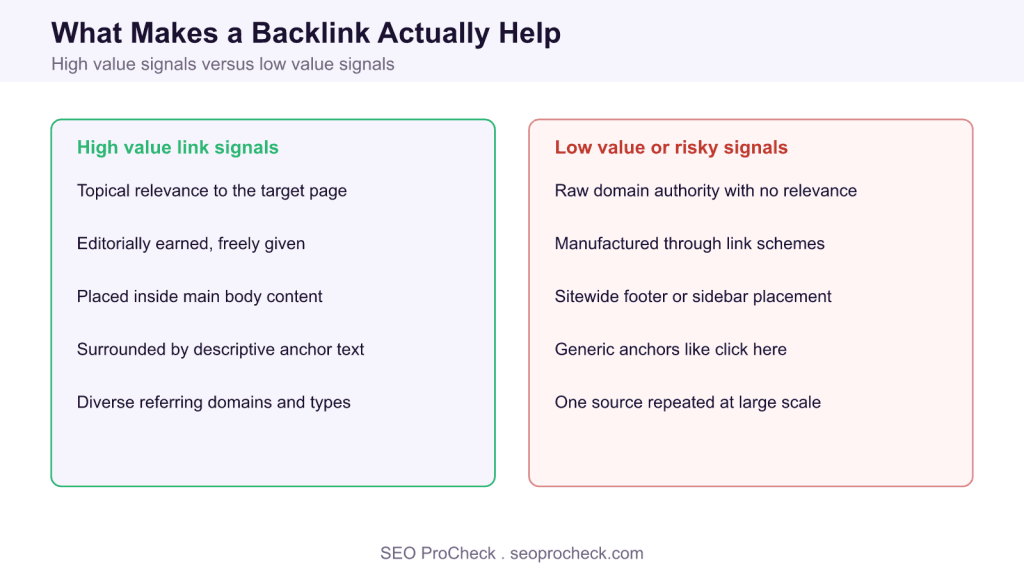
Not every link moves rankings. The links that reliably help are topically relevant, editorially earned, and placed inside the main content, while volume alone and manufactured links do little or actively hurt.
- Relevance and editorial intent predict link value better than a raw authority score.
- In content placement beats sidebar and footer links because it carries context.
- A diverse, naturally built referring domain profile outperforms one repeated source.
- Manufactured links from schemes tend to decay or trigger devaluation over time.
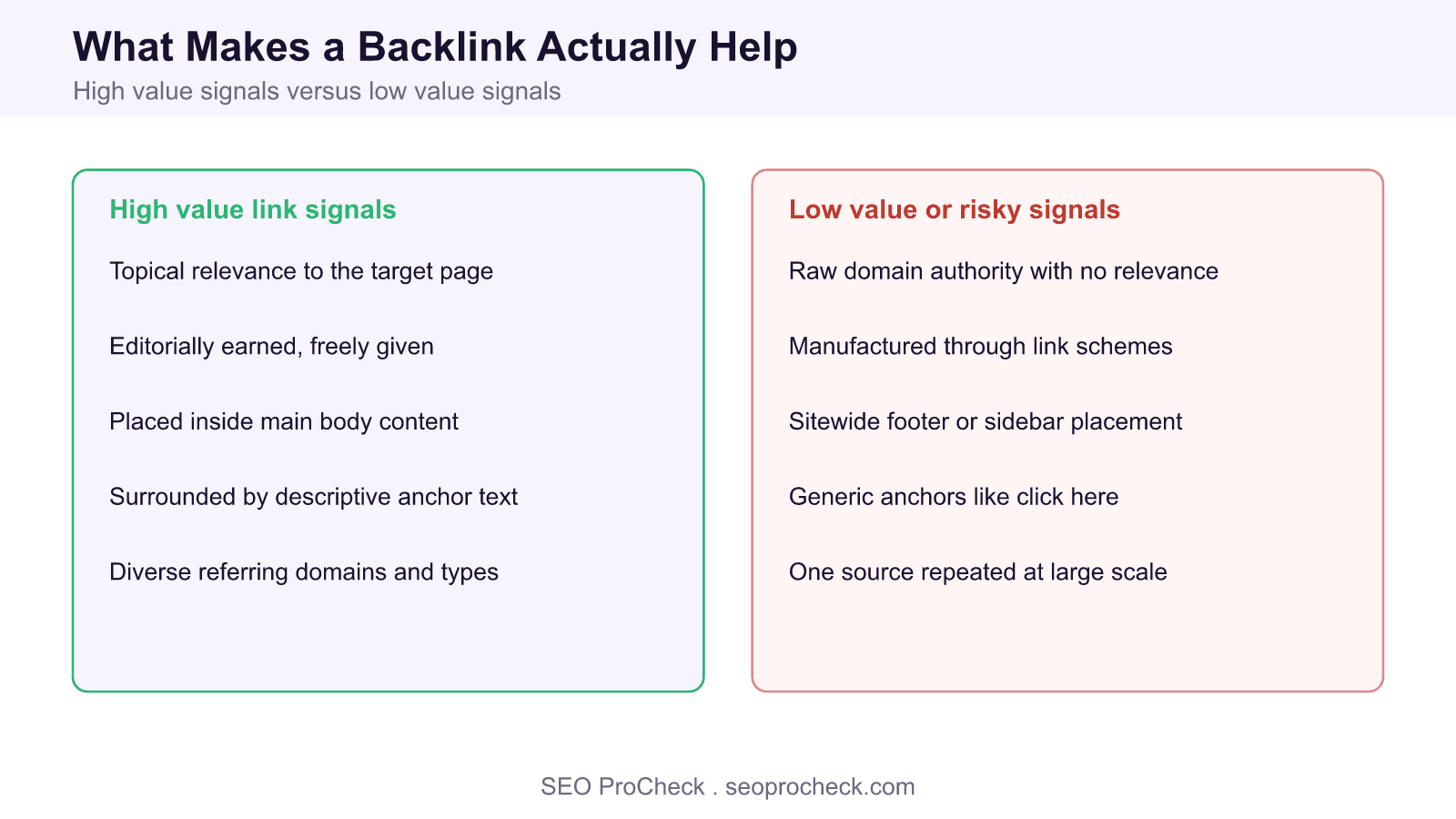
Link building advice often collapses into a single number: get more links, or chase a higher authority score. In practice the links that actually move rankings share a handful of qualitative traits, and understanding those traits is what separates outreach that compounds from outreach that wastes budget. This page keeps the original research summary below and adds a practitioner view of how to evaluate a link before you ever try to earn it, plus a scoring approach you can apply to your own prospect lists.
How to score a link before you chase it
Treat every prospective link as a small investment and score it on the same factors the research highlights. A quick internal rubric keeps a team honest and stops the reflex to celebrate any link that appears in a report. The five factors that carry the most weight are topical relevance, editorial intent, on page placement, anchor context, and how that link fits the wider profile you are building.
Relevance is the factor most teams underweight. A link from a site that already ranks for the topics you care about passes context that a generic high authority link cannot. When you audit your own gaps, pair this with a look at internal linking, because the same relevance logic that makes an external link valuable also decides whether your internal links pass useful signals between your own pages.
Editorial links versus manufactured links
An editorially earned link is one a writer or editor chose to include because it helped their reader. A manufactured link is one you placed through a paid slot, a private network, or a reciprocal deal. Search engines have spent years getting better at telling these apart, and the pattern in the research matches what practitioners see: editorial links hold their value, while manufactured links flatten out or reverse once a spam system or a broad quality pass catches up. If you want to understand how those broad passes work, the coverage of the latest core update is a useful companion, because link devaluation increasingly rides along with quality reassessment rather than arriving as a separate manual penalty.
Placement, anchor, and the context around a link
Two links from the same domain are not worth the same amount. A link inside the main body, wrapped in a sentence that describes what it points to, transfers more than a link parked in a sidebar widget or a footer that repeats site wide. When you evaluate a placement, read the paragraph around it: does the surrounding text share vocabulary with your target page, or is the link dropped into unrelated copy. That surrounding context is also how modern systems associate your brand with a topic, which is why building a clear entity around your brand compounds the value of every relevant mention you earn.
Building a profile that looks earned
Diversity is a proxy for how natural a profile looks. Links that arrive from a mix of blogs, news, resource pages, and community sites read as the byproduct of real work. A profile dominated by one template, one anchor, or one source type reads as engineered even when each link is individually fine. Aim to earn links as a side effect of assets people want to cite: original data, tools, and reference pages. That is slower than buying placements, but it is the only approach that survives repeated quality passes.
| Signal | What high value looks like | What to avoid |
|---|---|---|
| Relevance | Site already ranks for your topic cluster | Unrelated niche bought for authority |
| Intent | Editor chose to cite you | Paid slot or link exchange |
| Placement | Inside main body content | Sitewide footer or sidebar |
| Anchor | Descriptive, varied phrasing | Exact match repeated at scale |
| Profile fit | Adds a new referring domain type | One source repeated many times |
Frequently asked questions
Do more backlinks always improve rankings?
No. Volume without relevance or editorial intent adds little, and links from schemes can be devalued or become a liability. A smaller set of relevant, editorially earned links usually outperforms a large set of low quality ones.
Is domain authority a reliable way to judge a link?
Authority scores are third party estimates, not ranking factors. They are a rough filter at best. A moderately scored but highly relevant and editorially placed link often beats a high scoring link from an unrelated site.
Are footer and sidebar links worthless?
They are not worthless, but they carry far less weight than links inside the main content because they lack surrounding context and are usually repeated across every page of the linking site.
How important is anchor text?
Descriptive anchors that vary naturally help search engines understand what you are about. Exact match anchors repeated at scale look manipulated and can work against you.
How long does it take for good links to help?
Editorially earned links tend to show sustained benefit and hold up over time, while manufactured links often show a short lived bump followed by decay once quality systems catch up.
What is the safest way to build links?
Create assets worth citing, such as original research, free tools, and thorough reference pages, then earn links through genuine outreach. This produces the diverse, natural profile that holds value.
Original research notes
Research into backlink quality examined which link characteristics correlate with ranking improvements. The study moved beyond quantity metrics to analyze qualitative factors affecting link value.
Relevance Over Authority
Links from topically relevant sites showed stronger ranking correlation than raw domain authority scores. A moderately authoritative link from a relevant industry site outperformed higher-authority links from unrelated sources. Context and relevance provided amplification effects.
Editorial vs Manufactured
Editorially earned links (naturally given by content creators) showed sustained ranking benefits. Manufactured links through schemes showed diminishing or negative effects over time. Google's ability to identify link manipulation has improved, making natural link earning increasingly important.
Position and Context
Links within main content provided more value than sidebar or footer placements. Contextual links surrounded by relevant text showed stronger signals. The integration quality of links within the linking page affected value transfer.
Link Diversity Benefits
Links from diverse domain types (blogs, news, resources, forums) showed cumulative benefits. Over-concentration from single sources or types appeared less natural. Building diverse link profiles through varied content and outreach channels improved outcomes.
Source: Backlink quality research compiled
Claude Vincent is a technical SEO consultant focused on crawlability, rendering, and AI-search visibility. He writes the field guides and case studies at SEO ProCheck, with a bias toward the durable, unglamorous work that decides whether search engines and AI answer engines can actually read and cite a site.
About SEO ProCheck
Technical SEO consulting and GEO strategy with 20 years of enterprise experience. Case studies, resources, and tools for search and AI visibility.
Work With Me
Technical SEO audits, GEO strategy, site migrations, and international SEO. Hourly consulting for teams who need hands-on support, not just reports.
Subscribe to our newsletter!




Recent Posts
- Can AI Crawlers Actually Read Your Site? I Measured 400 of the Biggest September 5, 2026
- The Pre-Publish Quality Gate for AI-Assisted Content August 6, 2026
- AGENTS.md vs llms.txt vs llms-full.txt: Which Agent File Does What July 18, 2026