

Updated October 28, 2026 · Sources re-checked October 28, 2026 · 50 checks · What changed
TL;DR
An AI readiness checklist is the list of things a site must get right so AI search engines and AI agents can reach, index, read, understand and use its pages, and so you can see what they do with it. This one has 50 checks, and every check carries its source and an evidence level, because a lot of AI readiness advice mixes documented rules with guesses.
- Start with access: in my test of 184 top sites, GPTBot was not served real content on 40 of them, and robots.txt rarely told me why.
- There is no AI index, no AI sitemap and no AI schema. Google, Bing and the AI crawlers use their ordinary indexes and ordinary markup.
- Most AI crawlers do not run JavaScript, so anything that appears only after scripts run is invisible to them.
- llms.txt and similar files are optional: Google says to ignore them for Search, and no answer engine has been shown to read them.
Most AI readiness checklists mix three kinds of advice without saying which is which: rules the engines document, patterns someone measured, and guesses that sound technical. This one keeps them apart. Each check below says what passing looks like, which engines it applies to, where the rule comes from and how strong the evidence is.
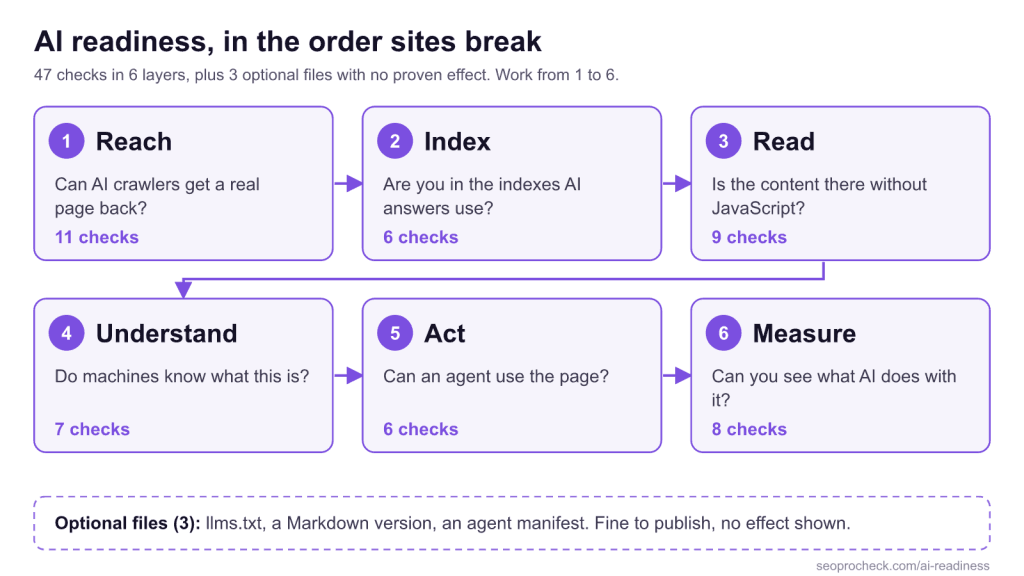
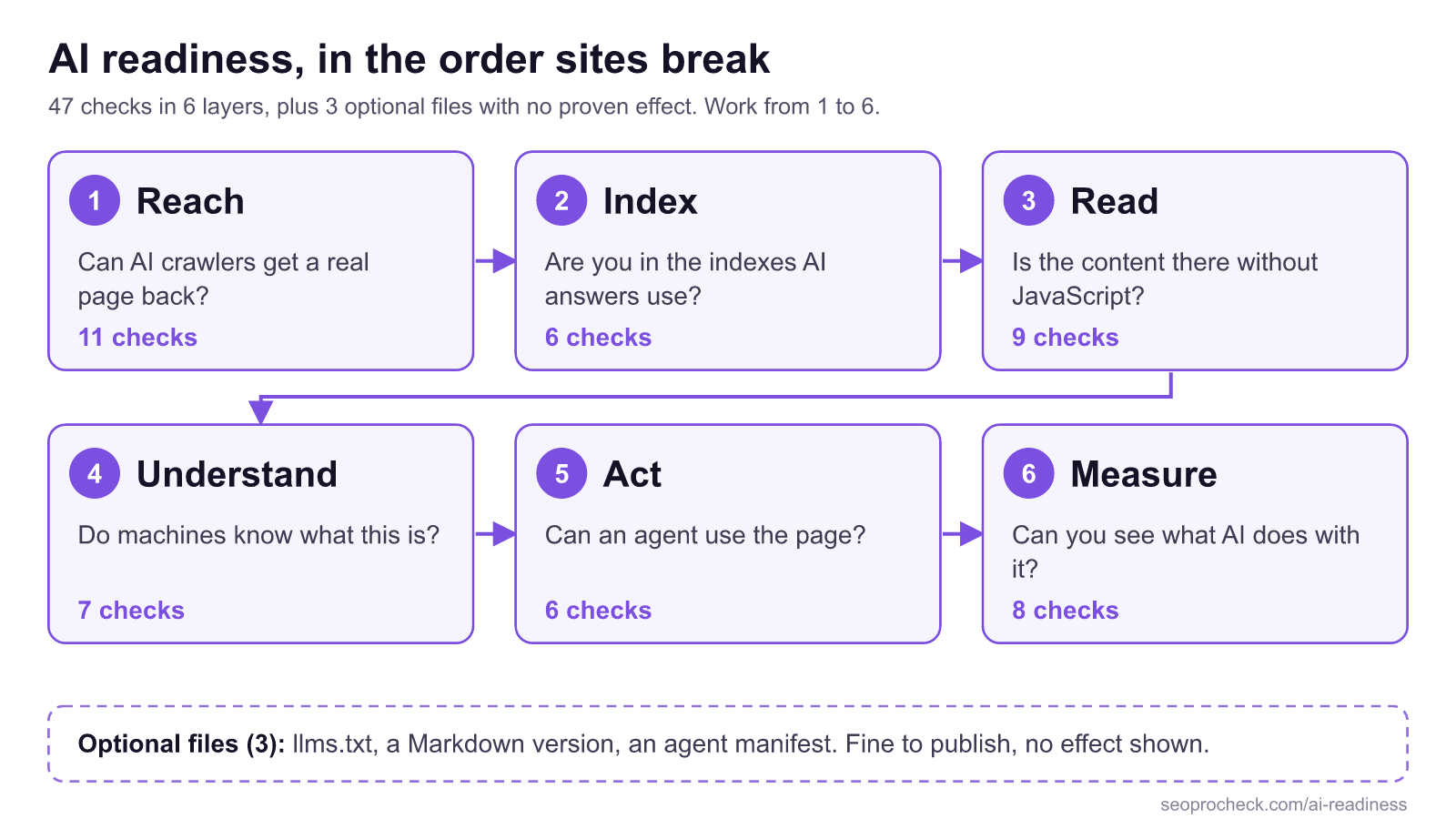
It is ordered the way sites actually fail. A page an AI crawler cannot fetch cannot be indexed, a page that is not indexed cannot be read into an answer, and so on down to measurement, so work from the top. The checks come from the 684 checks in the SEO ProCheck library: the ones that decide whether AI search engines and agents can use a site.
This page is kept current on purpose. A script re-reads every source behind it each night. When a source changes, the checks that cite it are marked under review until the change has been read, and every edit is logged under What changed with its date. Tick the boxes as you go: your progress is saved in this browser only. 0 of 50 done
The checklist at a glance
| Group | The question | Checks | Start with |
|---|---|---|---|
| Reach | Can AI systems get to your pages at all? | 11 | Search crawlers you want get a normal 200 on key pages |
| Index | Are your pages in the indexes AI answers draw from? | 6 | Key pages are eligible for AI features in each engine |
| Read | Can a crawler that does not run JavaScript read the page? | 9 | Main content and links are in the HTML the server sends |
| Understand | Do machines know what the page and the business are? | 7 | Business facts match everywhere AI answers read them |
| Act | Can an AI agent use the page, not just read it? | 6 | Links, buttons and form fields have accessible names |
| Measure | Can you see what AI systems do with the site? | 8 | AI impressions are tracked next to clicks |
| Optional files | What about llms.txt and the other new files? | 3 | llms.txt: optional, and no answer engine has been shown to read it |
How to read each check
Every check has an evidence level. It describes the rule, not how much the check matters: a Confirmed check can be minor, and a Reported one can be worth doing first.
| Evidence level | What it means | Checks |
|---|---|---|
| Confirmed | The rule is in the engine's or standard body's own documentation, or in my own measurement. | 38 |
| Reported | A practitioner or vendor study with a stated method backs it; no engine has confirmed it. | 7 |
| Disputed | Official sources disagree. Both sides are shown. | 1 |
| Unproven | A proposed standard or a claim with no consumer shown yet. | 2 |
| Optional, no effect shown | Fine to publish. No answer engine has been shown to read it. | 2 |
Each check also lists the engines it applies to. Google is one of them, not the only one: a rule Google ignores can still matter to Bing, Copilot, ChatGPT, Perplexity or Claude, and the reverse. Where official sources disagree, the check is marked Disputed and both sides are shown. The check ID next to the sources ties each item to the SEO ProCheck library.
1. Reach
Can AI systems get to your pages at all?
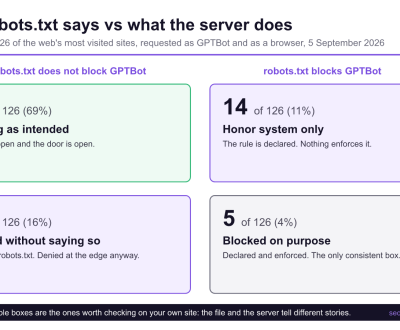
Everything else on this list depends on a crawler getting a real page back. In my test of 400 of the most visited sites, GPTBot was not served real content on 40 of the 184 sites that answered a browser normally (21.7%), and 58 of those 184 (31.5%) did not give GPTBot, ClaudeBot and PerplexityBot the same answer. On 34 of 126 sites, robots.txt and the server told different stories. So test what each bot receives, from outside, and treat robots.txt as a request rather than a control.
0 of 11 done
Confirmed
Passes when: Zero key URLs answer 403, 429 or a challenge page to a verified search crawler you intend to allow: Googlebot, Bingbot, OAI-SearchBot, PerplexityBot, Claude-SearchBot, Applebot.
Google's AI features page lists crawling allowed by your CDN and hosting, not only by robots.txt, among its basics, and OpenAI and Perplexity ask sites to allow their published IP ranges. A firewall rule written for scrapers often catches these crawlers too.
Applies to: Google, Gemini, Bing, Copilot, ChatGPT, Perplexity, Claude · Sources: Google: AI features and your website, OpenAI: crawlers and user agents, Perplexity: crawlers · Check TE-002 · Rule reviewed October 17, 2026
Confirmed
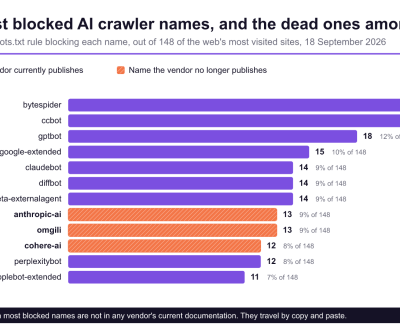
Passes when: Every AI token has a deliberate allow or disallow that matches a written policy, and no search crawler you want is disallowed. Search: OAI-SearchBot, PerplexityBot, Claude-SearchBot. Training: GPTBot, ClaudeBot, Google-Extended, Applebot-Extended. User-triggered: ChatGPT-User, Claude-User, Perplexity-User.
Each vendor splits its bots by purpose, so blocking model training does not have to mean leaving AI search. Google-Extended is a robots.txt token only: no crawler sends it, and Google says it does not affect inclusion in Google Search.
Applies to: Google, Gemini, Bing, ChatGPT, Perplexity, Claude · Sources: OpenAI: crawlers and user agents, Anthropic: how site owners control its crawlers, Google: common crawlers and tokens · Check TE-003B · Rule reviewed October 17, 2026
Confirmed
Passes when: No key public page answers 403, 429 or a challenge to a verified ChatGPT-User, Perplexity-User, Claude-User or Google user-triggered fetcher that you have not decided to block.
These fetch a page because a person asked an assistant about it, and most of them do not follow robots.txt, so the server layer makes the decision. For new domains since September 15, 2026, Cloudflare's defaults block bots it classes as Training or Agent on pages that display ads, so check even if you changed nothing yourself.
Applies to: ChatGPT, Perplexity, Claude, Google, Gemini · Sources: OpenAI: crawlers and user agents, Google: user-triggered fetchers, Cloudflare: block AI bots · Check TE-034 · Rule reviewed October 17, 2026
Confirmed
Passes when: robots.txt returns 200 (or 404, which means no restrictions) on every host, stays under 500 KiB, and never answers 5xx, 429 or a timeout.
Google stops crawling a site for 12 hours when robots.txt answers a 5xx, and treats 429 the same way. RFC 9309 tells other crawlers to assume everything is disallowed after a server error. One bad night on this file can take a site out of every crawler's queue at once.
Applies to: Google, Bing, ChatGPT, Perplexity, Claude, Gemini · Sources: Google: how Google reads robots.txt, RFC 9309: Robots Exclusion Protocol · Check RO-001 · Rule reviewed October 17, 2026
Confirmed
Passes when: The served file matches the intended file on every host, or every difference (a CDN-managed block, Content-signal lines) is written down and approved.
CDN features such as Cloudflare's managed robots.txt put their own lines in front of yours, and edge rules can change what each crawler gets. Read the live file from outside, as each bot, not the copy in your CMS.
Applies to: All engines · Sources: Cloudflare: managed robots.txt, Search Console Help: robots.txt report, Google: how Google reads robots.txt · Check TE-048 · Rule reviewed October 17, 2026
Confirmed
Passes when: Every allow rule, firewall exception or analytics segment pairs the user agent with the vendor's IP list, reverse DNS or signature, and the IP lists are refreshed on a schedule.
A user agent string is easy to fake. Google documents reverse DNS checks, and OpenAI and Perplexity publish IP lists. Without verification, a rule that lets GPTBot in also lets in anyone who types GPTBot.
Applies to: Google, Bing, ChatGPT, Perplexity, Claude, Gemini, Copilot · Sources: Google: verify Google's crawlers, OpenAI: crawlers and user agents, Perplexity: crawlers · Check TE-033 · Rule reviewed October 17, 2026
Confirmed
Passes when: For each verified bot and date range, you can say which URLs it requested and what share of its requests got 2xx, 3xx, 4xx and 5xx answers.
Most AI crawlers do not run JavaScript, so analytics page tags never see them. A fetch is not a citation, but a page that is never fetched has no chance of one.
Applies to: ChatGPT, Perplexity, Claude, Google, Bing, Gemini, Copilot · Sources: Google: fix JavaScript issues in Search, Cloudflare: AI Crawl Control · Check TE-035 · Rule reviewed October 17, 2026
Confirmed
Passes when: The settings on every host (GPTBot, ClaudeBot, Google-Extended and Applebot-Extended in robots.txt, NOARCHIVE or NOCACHE for Bing, optional licensing such as RSL) match a written policy.
No source says which choice is better. What costs sites is an accidental choice, such as a training block that also catches a search crawler. robots.txt is a request, not enforcement (RFC 9309).
Applies to: Google, Gemini, ChatGPT, Claude, Bing, Copilot · Sources: OpenAI: crawlers and user agents, Bing: controls for content use in AI answers (2023), RSL licensing standard · Check TE-009B · Rule reviewed October 17, 2026
Confirmed
Passes when: No Crawl-delay in the User-agent: * group without a recorded load reason, and no value that slows Bingbot below the rate the site changes.
Bingbot, Anthropic's bots and Common Crawl honor Crawl-delay; Googlebot and Applebot ignore it. Bing's own example: a delay of 5 seconds allows about 17,280 pages a day.
Applies to: Bing, Copilot, Claude · Sources: Bing: crawl-delay and Bingbot, Anthropic: how site owners control its crawlers, Google: how Google reads robots.txt · Check TE-036 · Rule reviewed October 17, 2026
Confirmed
Passes when: Applebot is not blocked from key pages, nosnippet appears only on purpose, and your business listings match the site.
Apple says Applebot data powers search in Siri, Spotlight and Safari, and that the nosnippet tag keeps content out of the broad world knowledge answers in Siri and Search. Voice assistants answer from documented sources like these, not from a voice ranking score.
Applies to: Siri, Bing, Copilot, Google · Sources: Apple: about Applebot, Bing: AI Performance in Webmaster Tools (February 2026) · Check TE-030 · Rule reviewed October 17, 2026
Reported
Passes when: Every gated template has a recorded decision, and any content crawlers see but visitors do not carries paywall structured data.
If crawlers get more than visitors without paywall markup, Google can treat it as cloaking. AI crawlers have no paywall markup of their own, so whatever they fetch may be quoted to people for free.
Applies to: Google, Bing, ChatGPT, Perplexity, Gemini, Copilot, Claude · Sources: Conductor Academy: AI crawlability, Google: paywalled content markup, Bing Webmaster Guidelines · Check TE-046 · Rule reviewed October 17, 2026
2. Index
Are your pages in the indexes AI answers draw from?
There is no AI index to submit to. Google's AI Overviews and AI Mode use the Google Search index, Copilot uses Bing's, and ChatGPT, Perplexity and Claude run their own search crawlers next to third-party indexes. Being indexed in each one is the entry ticket, and most of the work is ordinary indexing hygiene done for more than one engine.
0 of 6 done
Confirmed
Passes when: Key templates are indexed, carry no unintended nosnippet, max-snippet:0 or NOARCHIVE, the generative AI control in Search Console is set to Include, and no search crawler you want is disallowed.
Google shows pages in AI Overviews and AI Mode only if they are indexed and eligible for a snippet. For ChatGPT, Perplexity and Claude, eligibility starts with their search crawlers; for Copilot, with Bing.
Applies to: Google, Gemini, Bing, Copilot, ChatGPT, Perplexity, Claude · Sources: Google: AI features and your website, Search Console Help: generative AI control, OpenAI: crawlers and user agents · Check CO-001 · Rule reviewed October 17, 2026
Reported
Passes when: Key pages are indexed in Google and Bing, found in Brave for a sample, and fetched by each AI search crawler you want (check the logs).
Google's AI features use Google's index and Copilot uses Bing's. Bing says many LLMs ground on its index or other search indexes, OpenAI says ChatGPT search also uses third-party search providers, and Perplexity and Apple run their own crawlers. Checking Google alone checks one door of several.
Applies to: Google, Gemini, Bing, Copilot, ChatGPT, Claude, Perplexity · Sources: Bing: duplicate content and AI search (December 2025), OpenAI: crawlers and user agents, Apple: about Applebot · Check TE-014B · Rule reviewed October 17, 2026
Confirmed
Passes when: Every key page passes URL Inspection in Google and shows as indexed, or with impressions, in Bing Webmaster Tools.
No engine exposes the index its AI answers retrieve from, but Google and Bing both document that their AI answers draw on their search indexes. A key page missing from either is missing from that engine's answers.
Applies to: Google, Gemini, Bing, Copilot, Perplexity · Sources: Google: AI optimization guide, Bing: duplicate content and AI search (December 2025), Perplexity: its search API and index · Check TE-014 · Rule reviewed October 17, 2026
Confirmed
Passes when: Each sitemap file stays within 50,000 URLs or 50MB uncompressed, lists only 200, indexable, canonical URLs, and lastmod changes only when the content does.
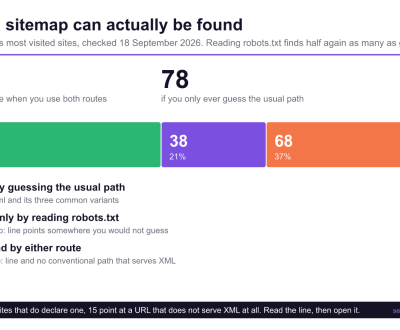
There is no AI sitemap. Bing says sitemaps plus IndexNow keep content fresh for Copilot answers, and Google ignores priority and changefreq.
Applies to: Google, Bing, Copilot · Sources: Bing: sitemaps in AI-powered search (July 2025), Google: build and submit a sitemap · Check TE-011B · Rule reviewed October 17, 2026
Confirmed
Passes when: The key file answers 200 at the root, submissions follow real changes, and no 400, 403, 422 or repeated 429 answers come back.
1 submission reaches every participating engine, Bing included, which is what Copilot reads. Google does not take part, so it changes nothing there.
Applies to: Bing, Copilot · Sources: IndexNow documentation, IndexNow: participating engines, Bing Webmaster Guidelines · Check TE-039 · Rule reviewed October 17, 2026
Confirmed
Passes when: No indexable older version competes with the current page without a 301, a canonical or a clear link to the current version.
Bing warns that when several versions of a page exist, search engines and LLMs may surface the outdated one. An AI answer quoting last year's price is worse than no citation at all.
Applies to: Bing, Copilot, Google · Sources: Bing: duplicate content and AI search (December 2025), Google: publication dates · Check TE-016B · Rule reviewed October 17, 2026
3. Read
Can a crawler that does not run JavaScript read the page?
Google renders JavaScript, usually later. Most AI crawlers do not render at all: they read the HTML your server sends. Anything that only appears after scripts run, from the main text to the title tag, is missing for them. This group also covers the parts of a page that only exist as pictures or video, because a crawler reads text.
0 of 9 done
Confirmed
Passes when: No key template has its main text or primary navigation links only after JavaScript runs.
A Vercel log study (December 2024) found GPTBot and ClaudeBot fetching JavaScript files without running them. Google renders, but calls dynamic rendering a workaround and recommends server-side or static rendering.
Applies to: ChatGPT, Claude, Perplexity, Google, Bing · Sources: Google: dynamic rendering as a workaround, Vercel: the rise of the AI crawler (December 2024) · Check TE-006B · Rule reviewed October 17, 2026
Confirmed
Passes when: On indexable pages, none of the four is missing from the response HTML and added only by JavaScript.
Google can read all four after rendering, though it may index a page before it renders it. Crawlers that do not render, such as those behind ChatGPT, Claude and Perplexity, never see them.
Applies to: Google, Bing, Copilot, ChatGPT, Claude, Perplexity · Sources: Google: JavaScript SEO basics, Vercel: the rise of the AI crawler (December 2024), Bing Webmaster Guidelines · Check ON-029 ON-010 ON-021 IN-013 · Rule reviewed October 17, 2026
Confirmed
Passes when: Each HTML document is under 2MB, and field data shows LCP of 2.5 seconds or less, INP of 200 ms or less and CLS of 0.1 or less.
Google Search uses only the first 2MB of an HTML file; the 15MB figure often quoted is the default for Google's crawlers in general, not Googlebot for Search. AI crawlers do not publish their limits, so a heavy page is a gamble with them too.
Applies to: Google, Users · Sources: Google: Googlebot, Google: Core Web Vitals · Check TE-017B · Rule reviewed October 17, 2026
Reported
Passes when: The page's main answer starts well inside the first 5,000 characters of body text, before mega menus and long link lists.
Peec AI logged ChatGPT Deep Research reading about 5,000 to 6,000 characters of body text in source order (June 2026, more than 10 accounts). One vendor study, and the window will move, but nothing is lost by answering first.
Applies to: ChatGPT · Sources: Peec AI: how ChatGPT Deep Research reads a site (June 2026), Anthropic: web fetch tool · Check TE-042 · Rule reviewed October 17, 2026
Disputed
Passes when: No key answer loads only after a click, swipe or typing; tabs and accordions hold secondary detail.
Google treats content in tabs that is in the HTML on load as main content. Microsoft warns that AI systems may skip answers hidden in tabs or expandable menus. Both agree that content loaded only on interaction is not read, which is the part to fix first.
Applies to: Google, Bing, Copilot · Sources: Google: mobile-first indexing, Microsoft: content for AI search answers (October 2025) · Check TE-021 · Rule reviewed October 17, 2026
Confirmed
Passes when: Key templates show no Level A failures of WCAG 1.3.1 (Info and Relationships).
Google says perfectly semantic HTML is not required for Search. Browser agents read the accessibility tree, though, and Lighthouse now checks accessibility for agents. HTML validator errors on their own are not a failure.
Applies to: Google, Bing, Copilot, AI agents, Accessibility · Sources: Google: AI optimization guide, W3C: WCAG 1.3.1 Info and Relationships, Chrome: Lighthouse accessibility for agents · Check TE-008B · Rule reviewed October 17, 2026
Confirmed
Passes when: Each chart that carries information has a short description and its key numbers in text or an HTML table next to it (WCAG 1.1.1, Level A).
Numbers inside an image or a JavaScript chart cannot be quoted by a crawler that reads text. Dataset markup does not fix this: Google uses it for Dataset Search only.
Applies to: Google, Bing, Copilot, Accessibility · Sources: W3C: WCAG 1.1.1 Non-text Content, W3C: complex images tutorial, Microsoft: content for AI search answers (October 2025) · Check TE-010 · Rule reviewed October 17, 2026
Confirmed
Passes when: Every prerecorded video with audio has reviewed captions, and important videos have a transcript or text summary on the page.
A crawler reads the text around a video, not the video. Automatic captions with errors do not meet WCAG until someone reviews them.
Applies to: Google, Bing, Accessibility · Sources: W3C: WCAG 1.2.2 Captions, Schema.org: transcript, Google: AI optimization guide · Check TE-019 · Rule reviewed October 17, 2026
Reported
Passes when: Long articles start with a short TL;DR or key points block that says the same thing as the body.
This is a reader aid first. Microsoft's guidance on concise, self-contained answers supports it, while Google says no special formatting is needed for its AI features. No engine documents a summary block as a ranking or citation factor.
Applies to: Users, Bing, Copilot · Sources: Microsoft: content for AI search answers (October 2025), Google: AI optimization guide · Check TE-026 · Rule reviewed October 17, 2026
4. Understand
Do machines know what the page and the business are?
Google says there is no special markup for AI features, and that is worth repeating because a lot of AI readiness advice sells exactly that. What engines do document is plainer: facts about the business that agree everywhere they appear, markup that matches the visible page, and feeds kept accurate where an engine accepts them. In my read of 180 of the most visited homepages, 109 (60.6%) published no JSON-LD on the homepage at all, so the basics are still where most of the gap is.
0 of 7 done
Confirmed
Passes when: Legal name, address, phone, hours and founding date agree across the site, Organization markup, Google Business Profile, Bing Places, Apple Business Connect and Wikidata.
Bing says Bing Places keeps business details current and eligible for AI-generated answers, and Google lists an up-to-date Business Profile and Merchant Center among its best practices for AI features.
Applies to: Google, Gemini, Bing, Copilot, ChatGPT · Sources: Bing: AI Performance in Webmaster Tools (February 2026), Google: AI features and your website, Google: Organization markup · Check TE-001 · Rule reviewed October 17, 2026
Confirmed
Passes when: Organization markup carries name, url and logo, sameAs lists the official profiles, and no sameAs URL is broken or points to another entity.
Google uses url and sameAs to tell organizations and authors apart. No engine documents a citation gain from it; it removes ambiguity, which is the job.
Applies to: Google, Users · Sources: Google: Organization markup, Google: Article markup, Schema.org: sameAs · Check TE-016 · Rule reviewed October 17, 2026
Confirmed
Passes when: No required-property errors for the feature the markup targets, and no value that differs from the visible text.
Google says there is no special schema for AI features. Valid markup that matches the page still helps every parser that reads it, and Microsoft says schema helps machines interpret content.
Applies to: Google, Bing, Copilot · Sources: Google: AI optimization guide, Google: AI features and your website, Microsoft: content for AI search answers (October 2025) · Check TE-004B · Rule reviewed October 17, 2026
Reported
Passes when: The Knowledge Graph Search API returns the entity with the right name, type and website, and the knowledge panel shows no wrong facts.
The tools are official, but no engine documents a ranking or citation gain from Knowledge Graph presence. Check it because wrong facts there tend to travel into answers.
Applies to: Google, Gemini · Sources: Google: Knowledge Graph Search API, Google: Organization markup, Schema.org: sameAs · Check TE-005B · Rule reviewed October 17, 2026
Confirmed
Passes when: No indexable page has a missing or duplicate title or H1, and the three describe the same topic.
Microsoft says title, description and H1 are signals AI systems use to interpret a page. Google sets no character limit; length warnings in crawling tools are display conventions.
Applies to: Google, Bing, Copilot, Users · Sources: Microsoft: content for AI search answers (October 2025), Google: helpful, people-first content · Check TE-018B · Rule reviewed October 17, 2026
Confirmed
Passes when: Instructions use ordered lists, and any HowTo markup matches the visible steps.
Google removed HowTo rich results in September 2023, so the markup earns nothing in Google. An ordered list is easy for any parser to lift as steps, and HowTo markup stays optional for others.
Applies to: Bing, Copilot, Users · Sources: Google: HowTo and FAQ changes (August 2023), Microsoft: content for AI search answers (October 2025), Schema.org: HowTo · Check TE-012 · Rule reviewed October 17, 2026
Confirmed
Passes when: Feed price, availability and title match the landing page, with no item-level errors for key products in Merchant Center or the OpenAI product feed.
Feeds and profiles are the machine channels engines actually document: Merchant Center, OpenAI's product feed for ChatGPT, Bing Places. This applies to stores and local businesses only.
Applies to: Google, ChatGPT, Bing, Copilot · Sources: Google: AI optimization guide, OpenAI: product feed spec, Bing: AI Performance in Webmaster Tools (February 2026) · Check TE-007B · Rule reviewed October 17, 2026
5. Act
Can an AI agent use the page, not just read it?
Browser agents click, type and buy. They work from the accessibility tree and from what is visible on screen, so most of this group is accessibility work that also serves people. Two items are proposed standards (WebMCP and agent checkout protocols) and are marked that way: worth a recorded decision, not a rush.
0 of 6 done
Confirmed
Passes when: Zero axe-core failures for link-name, label and aria-command-name on key templates (WCAG 2.2, Level A).
Chrome's Lighthouse documentation says agents review the accessibility tree to find interactive elements, the same structure screen readers use. An icon-only button with no name is a dead end for an agent and for a screen reader user alike.
Applies to: ChatGPT, AI agents, Accessibility, Users · Sources: Chrome: Lighthouse accessibility for agents, W3C: WCAG 4.1.2 Name, Role, Value, W3C: WCAG 2.4.4 Link Purpose · Check AC-001 AC-002 AC-004 · Rule reviewed October 17, 2026
Confirmed
Passes when: Every control needed to finish a task is the top element at its own center point.
Google's agent guidance says vision-based agents may discard covered elements, and people cannot click through them either.
Applies to: AI agents, Users, Google · Sources: web.dev: site UX for AI agents (April 2026), Google: AI optimization guide, Playwright: actionability checks · Check TE-049 · Rule reviewed October 17, 2026
Confirmed
Passes when: Controls use real button or a elements, are visible, are at least 24 by 24 CSS pixels for people (WCAG 2.5.8) and set cursor:pointer.
Chrome's guidance for agents (April 2026) sets a floor of 8 square pixels for a control an agent can use; the WCAG size for people already covers it.
Applies to: AI agents, Users, Accessibility · Sources: web.dev: site UX for AI agents (April 2026), W3C: WCAG 2.5.8 Target Size · Check TE-047 · Rule reviewed October 17, 2026
Confirmed
Passes when: Every declarative tool form has both a toolname and a tooldescription, every required field has a name, and optional fields have a description or label.
This is Lighthouse 13.5's rule. It applies only to sites that adopt WebMCP; for everyone else the audit is not applicable, not failed.
Applies to: AI agents · Sources: Chrome: Lighthouse WebMCP schema validity, Chrome: Lighthouse agentic browsing scoring, W3C community draft: WebMCP · Check TE-043 · Rule reviewed October 17, 2026
Unproven
Passes when: Optional. If you try it, keep under 40 registered tools (Lighthouse warns above that) and build it as a progressive enhancement.
WebMCP is a proposed standard in a Chrome origin trial. No agent has been shown to prefer sites that publish tools, so this is a test, not a requirement.
Applies to: AI agents · Sources: Chrome: WebMCP, Chrome: Lighthouse agentic browsing scoring · Check TE-037 · Rule reviewed October 17, 2026
Confirmed
Passes when: Each store has a recorded, dated decision on Google's Universal Commerce Protocol and OpenAI's Agentic Commerce Protocol.
Google calls UCP emerging and optional. The decision matters more than the answer: know whether agents can buy from you, and why.
Applies to: Google, Gemini, ChatGPT · Sources: Google: AI optimization guide, Google: Universal Commerce Protocol, OpenAI: Agentic Commerce Protocol · Check TE-044 · Rule reviewed October 17, 2026
6. Measure
Can you see what AI systems do with the site?
Only Google and Bing publish first-party AI visibility data, and both report impressions or citations, not causes. Everything outside those two reports is a sample, so freeze the prompt set, label it as a sample, and keep accuracy (what the answer says about you) separate from visibility (whether you appear).
0 of 8 done
Confirmed
Passes when: Each month, by template: Search Console's generative AI performance report (AI Overviews and AI Mode impressions) and Bing AI Performance citations, next to clicks.
AI features create visibility that often produces no click. Google's AI report shows impressions only; clicks from AI features are counted inside the Web search type of the main Performance report.
Applies to: Google, Bing, Copilot · Sources: Search Console Help: generative AI performance, Search Console Help: Performance report, Bing: AI Performance in Webmaster Tools (February 2026) · Check TE-031 · Rule reviewed October 17, 2026
Confirmed
Passes when: In Bing AI Performance, the grounding queries listed for each cited URL match that page's topic, and every mismatch gets a review.
It is the closest thing to a retrieval report any engine publishes. Microsoft says a consistent title, H1 and description improve confidence signals for AI systems.
Applies to: Bing, Copilot · Sources: Bing: AI Performance in Webmaster Tools (February 2026), Microsoft: content for AI search answers (October 2025) · Check TE-006 · Rule reviewed October 17, 2026
Confirmed
Passes when: Bing Citation Share is reported with its trend; for other engines, a share is estimated from a frozen prompt set and labeled as a sample.
Bing defines Citation Share per grounding query and calls it observational, not a ranking. Outside Bing there is no first-party number, so say how the sample was built.
Applies to: Bing, Copilot, ChatGPT, Perplexity, Google, Gemini · Sources: Bing: Citation Share and AI visibility insights (June 2026), Bing: Topics Portfolio beta (October 2026) · Check TE-017 · Rule reviewed October 17, 2026
Confirmed
Passes when: Each month: sessions, engagement rate and key events from chatgpt.com, perplexity.ai, copilot.microsoft.com, gemini.google.com and claude.ai, next to organic search.
Google says clicks from results pages with AI Overviews are higher quality and suggests tracking conversions and time on site. Referral sessions are the part of AI's effect you can count directly.
Applies to: ChatGPT, Perplexity, Copilot, Gemini, Claude · Sources: Google: AI features and your website, Google Analytics Help · Check TE-004 · Rule reviewed October 17, 2026
Confirmed
Passes when: Per landing page, the engagement rate and key events of AI-referred sessions are compared with organic sessions; you set the minimum sessions and the gap that triggers a review.
A page that does not deliver what the AI answer promised loses that visitor quickly. The comparison finds those pages; no engine sets a threshold.
Applies to: ChatGPT, Perplexity, Copilot, Gemini, Claude · Sources: Google: AI features and your website, Google Analytics Help · Check TE-028 · Rule reviewed October 17, 2026
Reported
Passes when: On a fixed schedule, a fixed list of prompts about products, prices, policies and people runs in the main assistants; every wrong fact is recorded with the source it cited, and that source is fixed or reported.
Answers vary by wording, account, place and model version, so one run proves little; keep the prompt set frozen. Being described wrongly can cost more than not being mentioned at all.
Applies to: Google, ChatGPT, Perplexity, Gemini, Copilot, Claude · Sources: Ahrefs: AI search checklist, Google Search Help: AI Overviews, Claude Help: incorrect or misleading answers · Check CO-041 · Rule reviewed October 17, 2026
Reported
Passes when: For a frozen prompt set, you know which third-party domains each engine cites for your topics and whether they mention you, tracked over time.
Google says its AI features show what is said about products across blogs, videos and forums, and that seeking inauthentic mentions does not help. Earn that coverage; never seed it.
Applies to: Google, Gemini, ChatGPT, Perplexity, Copilot, Claude · Sources: Google: AI optimization guide, Ahrefs: AI Overview brand correlation study · Check CO-027 · Rule reviewed October 17, 2026
Confirmed
Passes when: 404s that receive visits from AI assistants are reviewed; a clear match gets a 301 to the right page, and everything else keeps a useful 404.
Ahrefs found AI assistants sending visitors to URLs that never existed. The traffic is small (about 0.25% of site traffic in their data), and redirecting unrelated URLs to the home page can be treated as a soft 404.
Applies to: ChatGPT, Perplexity, Claude, Copilot, Gemini · Sources: Ahrefs: how often AI assistants invent links, Google: site moves with URL changes · Check TE-053 · Rule reviewed October 17, 2026
Optional files
What about llms.txt and the other new files?
These files are fine to publish and cheap to keep. None has been shown to change what an answer engine shows. They sit at the end, apart from everything above, so nobody mistakes them for a lever. If you publish one, keep it valid; if you do not, nothing on this page is missing.
0 of 3 done
Optional, no effect shown
Passes when: If you publish one, it answers as plain text with a # title line and never a server error. If you do not, nothing is missing.
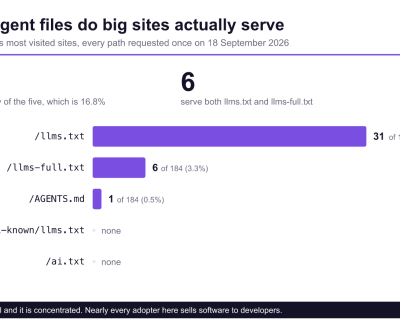
Google's AI optimization guide says that for Google Search you can ignore AI text files such as llms.txt, along with chunking. Server-log tests have found essentially no fetches of the file from answer engines. In my check of 184 top sites, 31 (16.8%) serve one, nearly all of them selling software to developers.
Applies to: AI agents · Sources: Google: AI optimization guide, Chrome: Lighthouse llms.txt audit, llmstxt.org proposal · Check TE-032 · Rule reviewed October 17, 2026
Optional, no effect shown
Passes when: If you return Markdown when a client sends Accept: text/markdown, it carries the same main content as the HTML and the response sends Vary: Accept.
Google Search does not use Markdown versions. Some agents request Markdown and Cloudflare can convert pages on the fly, but no search engine or AI search crawler documents asking for it.
Applies to: AI agents · Sources: Google: AI optimization guide, Cloudflare: Markdown for agents, RFC 9110: content negotiation · Check TE-015B · Rule reviewed October 17, 2026
Unproven
Passes when: If you publish /.well-known/ard.json (or the older ai-catalog.json), it answers 200 and parses; if you advertise one, it exists.
The Agentic Resource Discovery draft (v0.91, August 26, 2026) is a proposal, not a standard. Lighthouse 13.5 checks the older ai-catalog.json path.
Applies to: AI agents · Sources: Agentic Resource Discovery draft, Lighthouse 13.5 source: agent discovery check · Check TE-041 · Rule reviewed October 17, 2026
What is not on this list, and why
Some advice turns up in nearly every AI readiness list and is left out here on purpose. Each line says what the sources actually say.
| Advice you will see | What the sources say | Do this instead |
|---|---|---|
| Rewrite pages into small chunks for Google's AI | Google's AI optimization guide says that for Google Search you can ignore chunking. | Write for people and put the main answer early (Read group). |
| Add AI schema | Google says there is no special schema for its generative AI features. | Keep ordinary markup valid and matching the page (Understand group). |
| FAQ markup gets you a rich result | Google ended FAQ rich results for every site on May 7, 2026, and HowTo rich results in September 2023. | Keep FAQ markup for real FAQs, for Bing and assistants; expect nothing from Google. |
| Allow Google-Extended to appear in AI Overviews | Google-Extended is a robots.txt token for Gemini training and grounding. No crawler sends it, and Google says it does not affect inclusion in Google Search. | Decide training on its own (Reach group); AI Overviews follow Googlebot. |
| Submit an AI sitemap | No engine documents one. | Keep standard XML sitemaps accurate, and use IndexNow for Bing. |
| Add llms.txt to rank in AI answers | No answer engine has been shown to read it, and Google says to ignore it for Search. | Treat it as optional (last group). |
More on why FAQ markup still earns its place: FAQ schema after Google retired the rich result.
How to run it in an afternoon
- Pick 10 to 20 key URLs: the home page, one page of each template, and the pages that earn money.
- Request each as a browser and as Googlebot, Bingbot, OAI-SearchBot, GPTBot, ClaudeBot, PerplexityBot and ChatGPT-User, from 2 different networks, and write the date on the results. Bot management adapts: in my study, 2 of 8 sites that refused a crawler served it normally 2 hours later.
- Compare the HTML your server sends with the rendered page for the title, H1, canonical, meta description and main text.
- Read robots.txt as served on every host, and match each AI token to a written policy.
- Check the same URLs in Search Console URL Inspection and in Bing Webmaster Tools, then open Google's generative AI performance report and Bing AI Performance.
- Run axe or Lighthouse on one page per template for accessible names and covered controls, then fill in the Measure group once a month.
The access test in steps 1 and 2 is the method behind my 400-site AI crawler study, which also shows the traps: odd status codes such as LinkedIn's 999, and answers that change from one hour to the next.
Frequently asked questions
What is an AI readiness checklist?
It is a list of the technical and content conditions a site needs so AI search engines (Google AI Overviews and AI Mode, Copilot, ChatGPT search, Perplexity, Claude) and AI agents can reach, index, read, understand and use its pages. A useful one also covers measurement, because without it you cannot tell whether any of the work changed anything.
Do I need llms.txt to show up in ChatGPT or Google AI Overviews?
No. Google's AI optimization guide says you can ignore AI text files such as llms.txt for Google Search, and no answer engine has been shown to read the file. Publishing one does no harm; just do not expect it to change what any engine shows.
Should I block GPTBot and other AI crawlers?
That is a business decision, and the vendors make it possible to split it. GPTBot, ClaudeBot and Google-Extended relate to model training, while OAI-SearchBot, Claude-SearchBot and PerplexityBot feed AI search. You can block training and still allow search; what to avoid is a rule that blocks both by accident.
Is there special schema markup for AI search?
No. Google says structured data is not required for its generative AI features and there is no special schema for them. Keep ordinary markup valid and matching the visible page, because Bing and other parsers still read it.
How do I check whether AI crawlers can reach my pages?
Request your key pages as each crawler, from more than one network, and compare the answer with what a browser gets, then confirm with verified bot traffic in your server logs. robots.txt alone will not tell you: in my 400-site test, the file and the server disagreed on 34 of 126 sites.
How often is this checklist updated?
Its sources are re-read every night and the date at the top moves every week. When a source changes, the checks that cite it are marked under review, then updated, and every change is listed under What changed with its date.
What changed
- October 28, 2026: First version: 50 checks in 7 groups, each tied to its SEO ProCheck check ID, its sources and an evidence level.
Sources re-checked October 28, 2026. 82 sources are re-read every night; 0 checks are under review right now.
More in the AI Readiness hub
- The AI Readiness hub: every article, study and tool on the topic
- Can AI crawlers actually read your site? 400 sites measured
- Who actually serves an llms.txt? 184 top sites measured
- Most top sites never say who they are in structured data
- JavaScript SEO: how search engines and AI crawlers render pages
- Is your site agent-ready? The Lighthouse agentic browsing audit
Take this with you
The assistant links open with a question about this page already written. Nothing is sent until you press enter.
Claude Vincent is a technical SEO consultant focused on crawlability, rendering, and AI-search visibility. He writes the field guides and case studies at SEO ProCheck, with a bias toward the durable, unglamorous work that decides whether search engines and AI answer engines can actually read and cite a site.
About SEO ProCheck
Technical SEO consulting and GEO strategy with 20 years of enterprise experience. Case studies, resources, and tools for search and AI visibility.
Work With Me
Technical SEO audits, GEO strategy, site migrations, and international SEO. Hourly consulting for teams who need hands-on support, not just reports.
Subscribe to our newsletter!
Recent Posts
- AI Readiness Checklist (2026): 50 Checks, Each With Its Source October 28, 2026
- Most Top Sites Never Say Who They Are in Structured Data October 14, 2026
- Homepage Titles Are Mostly Too Short, Not Too Long October 8, 2026