

AI Summary
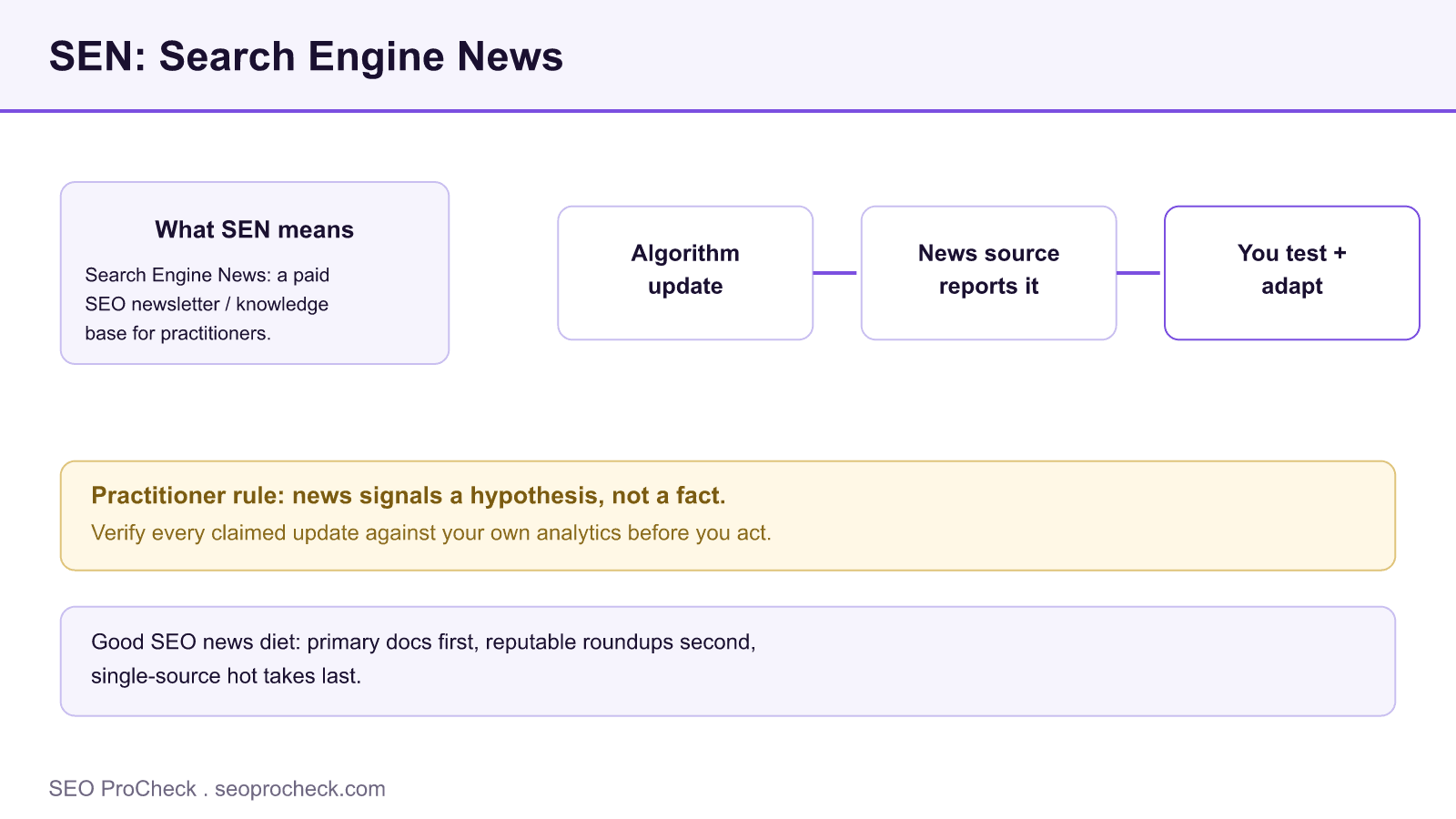
SEN stands for Search Engine News, a long-running subscription publication that tracks algorithm changes and SEO tactics for practitioners. As a lexicon entry it is a reminder that SEO news is an input to test, not a fact to obey.
- SEN = Search Engine News, a paid SEO knowledge base and newsletter.
- News reports a claimed change; your own analytics confirm whether it affects you.
- Build a source diet: primary documentation first, reputable roundups second, single-source hot takes last.
- Treat every reported update as a hypothesis to validate before you change anything.
SEN provides valuable insights for SEO practitioners. This resource examines approaches and considerations that can improve organic search performance.
Key Concepts
Understanding the fundamental principles behind this topic helps inform strategic decisions. Whether optimizing for traditional search or emerging AI platforms, foundational concepts remain relevant. This resource covers the essential knowledge practitioners need.
Implementation Considerations
Moving from concept to execution requires understanding practical constraints and opportunities. Different situations call for different approaches. This resource provides guidance for applying concepts in real-world contexts.
Measuring Impact
SEO efforts require measurement to demonstrate value and guide optimization. Identifying appropriate metrics, establishing baselines, and tracking progress enables data-driven improvement. This resource addresses how to evaluate success.
This resource contributes to the knowledge base SEO practitioners need for effective optimization in an evolving search landscape.
Source: https://www.searchenginenews.com/memberlogin
What SEN means
SEN is shorthand for Search Engine News, a long-running subscription publication and knowledge base aimed at working SEO practitioners. Historically it packaged algorithm-change reporting, tactics and how-to material behind a members login, which is exactly what the source link below points to. As a lexicon entry, SEN is less interesting as a single site and more useful as a lens on a bigger question every practitioner faces: how do you consume SEO news without letting it jerk your strategy around?
Why SEO news needs a filter
Search changes constantly, and a whole cottage industry exists to report, interpret and speculate about those changes. Some of it is gold: primary documentation, confirmed updates, careful case studies. Much of it is noise: single-source rumors, correlation dressed up as causation, and tactics that worked on one site in one niche presented as universal law. The skill is not reading more news; it is grading it.
| Source tier | Examples | How much to trust it |
|---|---|---|
| Primary | Official search engine docs, confirmed update announcements | High: this is the ground truth, read it first |
| Reputable secondary | Established SEO news outlets, well-documented studies | Medium to high: good synthesis, still verify against your data |
| Community and roundups | Forums, newsletters aggregating chatter | Medium: useful for early signals, heavy on speculation |
| Single-source hot takes | One person, one screenshot, big claim | Low: a hypothesis at best, never a basis for action alone |
A practitioner workflow for SEO news
- Read the primary source. When an update is reported, go to the official announcement or documentation before any commentary.
- Check your own analytics. Did anything actually move for your site in that window? A reported update that does not touch your traffic is not your update.
- Wait for the dust. Early volatility during a rollout often reverses. Give a major change a couple of weeks before drawing conclusions.
- Test small. If a tactic looks promising, trial it on a slice of the site and measure, rather than rolling it out everywhere on faith.
- Write down what you learned. A short log of what you tried and what happened is worth more than a hundred saved articles.
Where this fits in the modern search landscape
SEO news used to be almost entirely about Google's ranking algorithm. Today the beat has widened to include generative engine optimization and the way AI answer engines select and cite sources. The discipline is the same: treat each reported shift as a hypothesis, verify it against your own numbers, and adapt deliberately. Browse our own definitions in the SEO checks library for the underlying concepts these news cycles keep circling back to.
Common mistakes
- Acting on a single report. One tweet is a rumor, not a roadmap. Wait for corroboration and your own data.
- Chasing every update. Most core updates reward the same fundamentals. Panic edits often do more harm than the update did.
- Confusing correlation with causation. Traffic moved and an update happened does not prove the update caused it. Rule out seasonality and your own changes first.
- Hoarding without testing. A folder of saved tactics you never trial is not knowledge. Apply, measure, keep or discard.
FAQ
What does SEN stand for?
SEN stands for Search Engine News, a subscription SEO publication and knowledge base for practitioners. In a broader sense it refers to the ongoing stream of reporting about search algorithm changes and optimization tactics.
Is SEO news reliable?
It varies enormously by source. Official documentation and confirmed announcements are reliable; single-source rumors are not. The practical rule is to grade every source by tier and to confirm any claimed change against your own analytics before acting.
How should I follow SEO news without overreacting?
Build a source diet: primary documentation first, reputable outlets second, community chatter last. When an update is reported, check whether your own traffic actually moved, wait for the rollout to settle, and test changes on a small scale before committing.
Do algorithm updates require me to change my site?
Usually not dramatically. Most broad updates reward the same fundamentals of useful, well-structured, trustworthy content. If your traffic is stable through an update, the safest move is often to keep improving quality rather than to react.
Where can I find primary SEO information?
Official search engine developer documentation and their public announcement channels are the primary sources. For AI answer engines, the providers' own documentation about their crawlers and citation behavior is the equivalent starting point.
Does SEO news still matter in the age of AI search?
Yes, but the beat has widened. Alongside classic ranking updates, practitioners now track how AI Overviews and chatbots retrieve and cite content. The discipline of verifying claims against your own data matters more than ever as the pace of change increases.
Take this with you
The assistant links open with a question about this page already written. Nothing is sent until you press enter.
Claude Vincent is a technical SEO consultant focused on crawlability, rendering, and AI-search visibility. He writes the field guides and case studies at SEO ProCheck, with a bias toward the durable, unglamorous work that decides whether search engines and AI answer engines can actually read and cite a site.
About SEO ProCheck
Technical SEO consulting and GEO strategy with 20 years of enterprise experience. Case studies, resources, and tools for search and AI visibility.
Work With Me
Technical SEO audits, GEO strategy, site migrations, and international SEO. Hourly consulting for teams who need hands-on support, not just reports.
Subscribe to our newsletter!








Recent Posts
- Most Top Sites Never Say Who They Are in Structured Data October 14, 2026
- Homepage Titles Are Mostly Too Short, Not Too Long October 8, 2026
- Who Actually Serves an llms.txt? 184 Top Sites Measured September 29, 2026