The Google API Leak Should Change How Marketers and Publishers Do SEO - SparkToro
- June 3, 2024
- General

AI Summary
The 2024 Google Content Warehouse API leak exposed thousands of documented ranking attributes and reframed how marketers should talk about SEO. It does not reveal the weights or the live algorithm, but it confirms that clicks, a site level quality signal, freshness and explicit demotions are real, named features.
- The leaked documentation lists attributes, not weights, so treat it as direction rather than a formula.
- Click and engagement signals (often discussed as NavBoost) and a site level authority attribute both appear.
- Freshness, author and entity fields, and explicit demotion factors are documented.
- The practical takeaway: build genuine brand demand, satisfy clicks, and avoid patterns that trigger demotions.
The Google API Leak Should Change How Marketers and Publishers Do SEO, SparkToro provides valuable insights for SEO practitioners. This resource examines approaches and considerations that can improve organic search performance.
Key Concepts
Understanding the fundamental principles behind this topic helps inform strategic decisions. Whether optimizing for traditional search or emerging AI platforms, foundational concepts remain relevant. This resource covers the essential knowledge practitioners need.
Implementation Considerations
Moving from concept to execution requires understanding practical constraints and opportunities. Different situations call for different approaches. This resource provides guidance for applying concepts in real-world contexts.
Measuring Impact
SEO efforts require measurement to demonstrate value and guide optimization. Identifying appropriate metrics, establishing baselines, and tracking progress enables data-driven improvement. This resource addresses how to evaluate success.
This resource contributes to the knowledge base SEO practitioners need for effective optimization in an evolving search landscape.
What the leak actually is
In 2024 a large set of internal Google documentation describing the Content Warehouse API became public. It lists thousands of feature names and short descriptions used across Google systems. It is a data schema, a catalogue of attributes that can exist, not a copy of the ranking algorithm and not a table of weights. That distinction matters: the leak tells you which signals Google can store and reference, but not how heavily any one of them counts in a given query.
The signals that changed the conversation
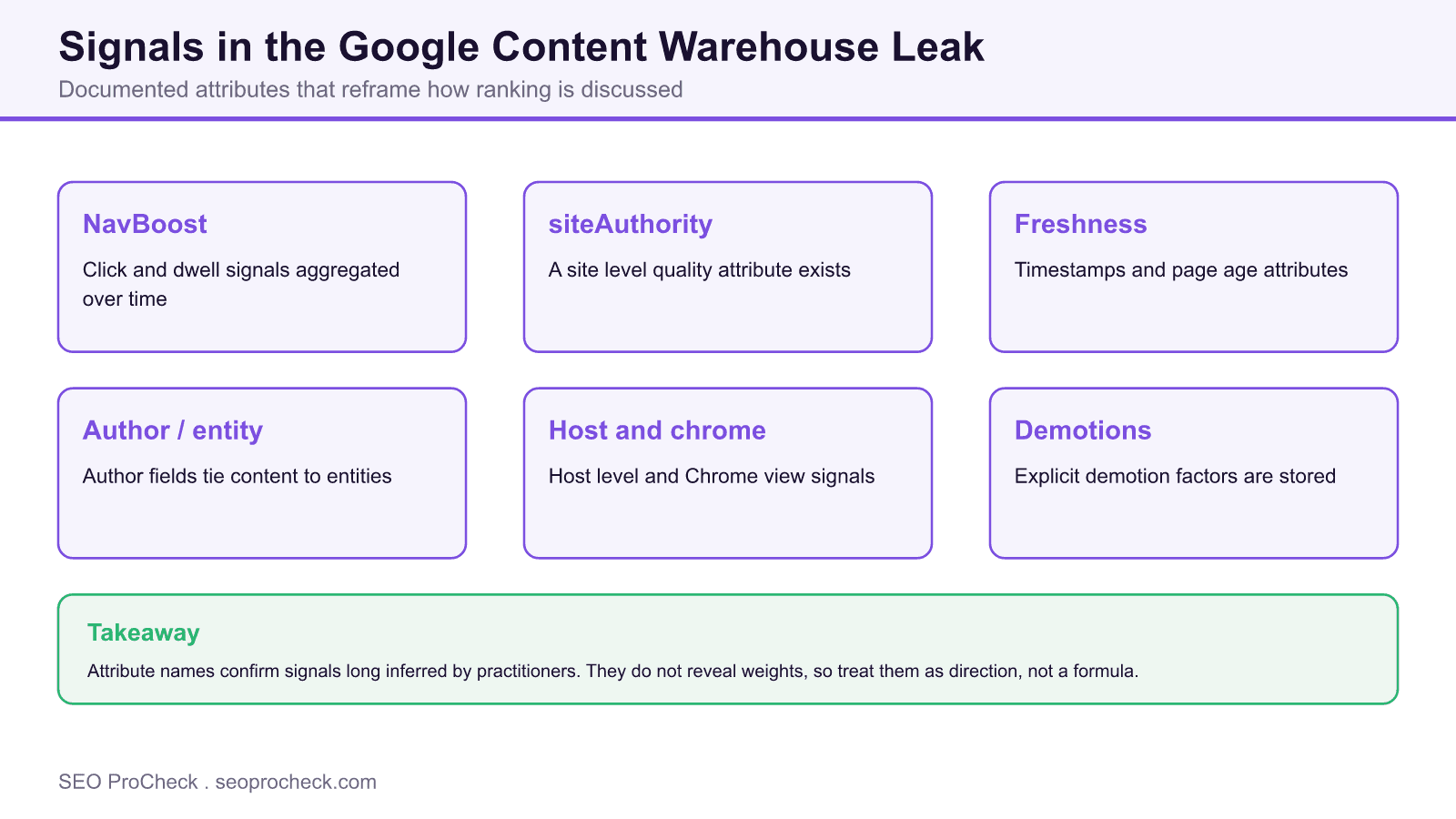
Several named attributes lined up with things practitioners had long inferred but that Google representatives had publicly downplayed:
- Click and engagement signals. Attributes consistent with a system widely discussed as NavBoost suggest that aggregated click and dwell behavior informs ranking, which supports the long held view that satisfying searchers matters.
- A site level authority attribute. The presence of a site wide quality signal undercuts the idea that authority is purely per page, and reinforces investing in overall brand and site trust.
- Freshness fields. Timestamps and page age attributes confirm that recency is tracked and can matter for time sensitive topics.
- Author and entity fields. Author related attributes tie content to identifiable entities, aligning with the emphasis on expertise and reputation.
- Host and Chrome related signals. Host level features and references to Chrome view data appear in the documentation.
- Explicit demotions. Named demotion factors show that Google actively suppresses certain patterns rather than only rewarding good ones.
How to read it responsibly
The biggest risk with a leak like this is over reading it. A feature existing in a schema does not mean it is used in production, weighted heavily, or applied the way its name implies. Names can be legacy, experimental or deprecated. The disciplined approach is to treat the leak as confirmation of direction: it validates that engagement, site level trust, freshness and demotions are real forces, and it argues against chasing narrow on page tricks. It does not hand you a checklist of exact optimizations.
What to do differently
- Earn real clicks and satisfy them. Compelling titles paired with content that fulfils the promise supports the engagement signals the leak points to.
- Build brand and site wide quality. A site level authority attribute rewards consistency across the whole domain, not just a few strong pages.
- Keep important pages fresh. Update time sensitive content and show meaningful revision, not cosmetic date changes.
- Audit for demotion triggers. Thin content, aggressive interstitials, and low quality patterns are the kind of thing explicit demotions target.
Whats changed since this analysis
Since the leak, the debate has matured from is NavBoost real toward how do we build durable demand and trust. Combine that with the rise of AI answer engines and the through line is clear: brands that people actively seek and click, and content that genuinely satisfies, are best positioned for both classic search and AI citations. For structured next steps, review our SEO checks library and the technical and GEO checks, and read more in our SEO articles.
Leaked signal categories at a glance
| Signal category | What the attributes suggest | Practical response |
|---|---|---|
| Click and engagement | Aggregated click and dwell behavior is used | Win and satisfy the click, not just the impression |
| Site level authority | A domain wide quality attribute exists | Raise quality across the whole site |
| Freshness | Page age and timestamps are tracked | Genuinely update time sensitive pages |
| Author and entity | Content is tied to identifiable authors | Establish clear, credible authorship |
| Demotions | Explicit suppression factors are stored | Remove thin and manipulative patterns |
Frequently asked questions
Is the Google API leak the ranking algorithm?
No. It is documentation of a data schema, a list of attribute names and descriptions. It shows which features can exist, not how they are weighted or combined in the live ranking system.
Does the leak prove clicks are a ranking factor?
It shows attributes consistent with click and engagement based systems, often discussed as NavBoost. That strongly supports the view that user behavior informs ranking, though it does not quantify the effect.
Should I change my SEO strategy because of the leak?
You should feel more confident investing in brand demand, genuine engagement, site wide quality and freshness. It is a reason to double down on fundamentals, not to chase newly named attributes as if they were switches.
What are demotions in the context of the leak?
The documentation includes explicit demotion factors, meaning Google actively suppresses certain pages or patterns. Thin content and manipulative tactics are the kind of thing such factors are designed to catch.
Can I optimize directly for a named attribute like siteAuthority?
No, and you should be cautious. A name in a schema can be legacy, experimental or measured differently than it sounds. Optimize for the underlying quality the name implies, not the label.
Is a site level quality signal new information?
The concept was long suspected, but seeing a documented site level attribute reinforces that domain wide trust matters, not just individual page optimization.
Claude Vincent is a technical SEO consultant focused on crawlability, rendering, and AI-search visibility. He writes the field guides and case studies at SEO ProCheck, with a bias toward the durable, unglamorous work that decides whether search engines and AI answer engines can actually read and cite a site.
About SEO ProCheck
Technical SEO consulting and GEO strategy with 20 years of enterprise experience. Case studies, resources, and tools for search and AI visibility.
Work With Me
Technical SEO audits, GEO strategy, site migrations, and international SEO. Hourly consulting for teams who need hands-on support, not just reports.
Subscribe to our newsletter!