

Experimentation & Measurement for Search Engine Optimization from Airbnb
- September 18, 2022
- Growth
AI Summary
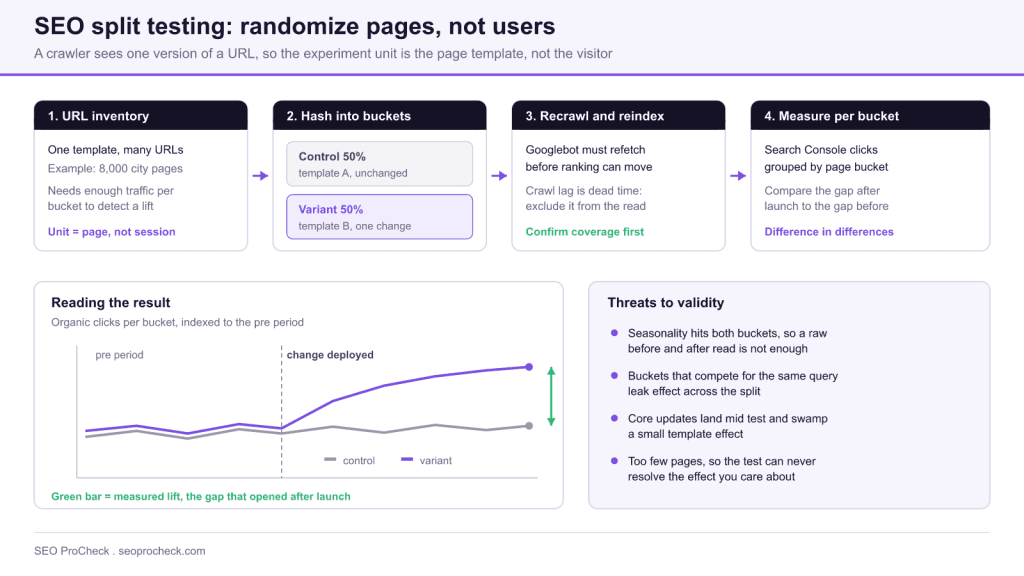
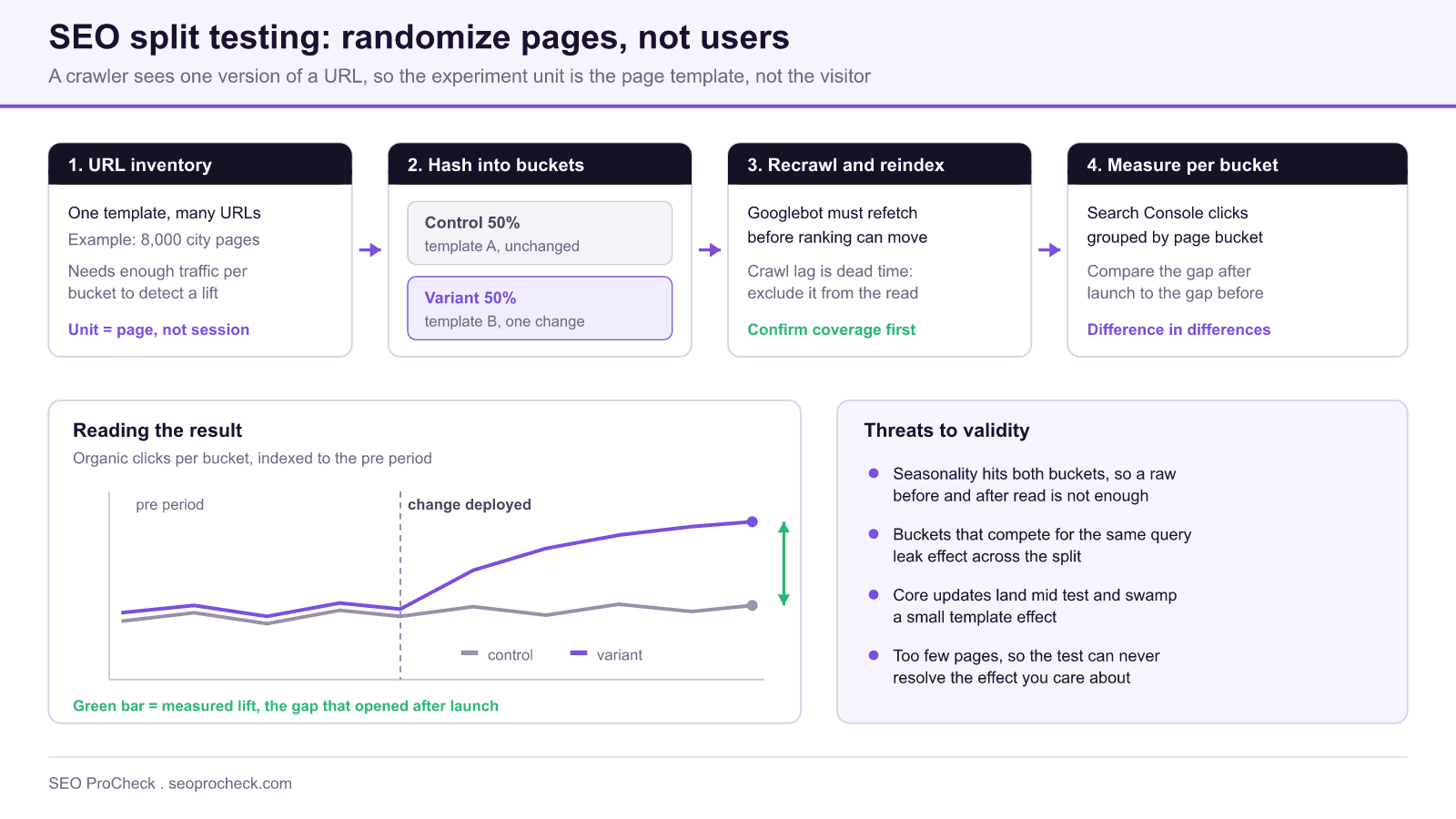
SEO experiments cannot randomize visitors, because a crawler only ever sees one version of a URL. The workable design randomizes pages: split a large set of near identical URLs into control and variant buckets, ship the change to the variant template only, then compare the gap in organic clicks after launch to the gap before launch.
- The unit of randomization is the URL, not the session, so you need hundreds or thousands of pages on one template.
- Nothing can move until Googlebot recrawls the variant bucket, so crawl lag is dead time you must exclude from the read.
- Read results with difference in differences, never a raw before and after, because seasonality and core updates hit both buckets.
- Measure at bucket level with the Search Console API or the BigQuery bulk export, not the 1,000 row UI export.
This case study documents a successful organic growth strategy, demonstrating how strategic SEO implementation drives measurable business results. The approach provides actionable insights for practitioners facing similar challenges.
Challenge and Context
Every successful SEO initiative begins with understanding the starting position and objectives. This case study reveals the initial challenges, competitive landscape, and business goals that shaped the strategy. Understanding context helps practitioners assess applicability to their own situations.
Strategic Approach
The methodology employed combined technical optimization, content strategy, and authority building in a coordinated approach. Key decisions around prioritization, resource allocation, and tactical execution provide a template for similar initiatives. The strategy balanced quick wins with sustainable long-term growth.
Implementation Details
Moving from strategy to execution required specific technical implementations, content creation processes, and measurement frameworks. This case study documents the practical steps taken, tools used, and workflows developed. These implementation details help practitioners translate strategy into action.
Results and Analysis
The outcomes demonstrate the effectiveness of the approach through measurable metrics: traffic growth, ranking improvements, and business impact. Analysis of what worked best and what could have been done differently provides learning value beyond the raw results.
This case study contributes to the evidence base for effective SEO strategy, helping practitioners learn from documented successes.
Why SEO cannot use a conventional A/B test
The Airbnb Engineering post linked at the foot of this page sits in a small genre: engineering teams explaining how they proved an SEO change worked. That question is harder than it sounds, and the reason is structural rather than statistical.
A conventional A/B test randomizes people. Half your visitors get variant A, half get variant B, and because assignment is random the two groups are otherwise identical. That design collapses the moment your subject is a search engine. Googlebot is a single client. It fetches a URL, gets one response, and indexes what it got. There is no population of crawlers to split, and deliberately serving Googlebot different HTML from the version users receive is exactly the pattern search engines classify as cloaking.
There is a second, subtler problem. Rankings are a relative outcome. Your page does not have a score in isolation; it has a position against competitors for a query. Even if you could split crawler traffic, the two variants would be competing in the same result set, so the treatment would contaminate the control. Any credible SEO experiment has to work around both constraints.
Choosing the unit of randomization
The workable answer is to move the randomization one level up: randomize URLs instead of users. If you have a few thousand pages built from one template, you can hash each URL into a control or variant bucket, deploy the template change to the variant bucket only, and treat the two groups as your samples. Every page still serves one consistent version to everybody, so there is no cloaking exposure, and the buckets are statistically comparable because assignment was random.
That design is only available to sites with template scale. Below is how the realistic options compare.
| Design | Randomization unit | What it can measure | Main threat to validity | Minimum inventory |
|---|---|---|---|---|
| User split A/B test | Visitor session | Conversion and on page behaviour only | Cannot measure ranking at all; varying HTML by client risks cloaking | Not applicable to SEO |
| Page split test | URL, hashed into buckets | Template level ranking, impression and click effects | Buckets that compete for the same queries leak effect across the split | Hundreds to thousands of pages on one template |
| Pre and post time series | Time | Site wide changes: migrations, speed work, sitewide nav | Seasonality and algorithm updates are indistinguishable from your change | Any size, but it is the weakest evidence |
| Market or locale split | Country or language folder | Changes that must ship to a whole market at once | Markets rarely share a baseline trend, so parallel trends often fails | Several comparable markets |
| Switchback (on, off, on) | Time slices on the same pages | Fast, fully reversible serving changes | Crawl and index lag smears each slice into the next | Rarely workable for SEO |
Building the buckets
Assignment should be deterministic and reproducible, not a one time random draw you cannot recover later. The standard approach is to hash a stable page identifier and take the modulus:
bucket = int(hashlib.md5(page_id.encode()).hexdigest(), 16) % 2
# 0 = control, 1 = variant. Store the assignment in the CMS,
# export it as a two column CSV (url, bucket), and keep that file.
Three rules make or break the split. First, stratify before you hash if your pages vary wildly in traffic: a handful of head pages landing in one bucket will dominate that bucket's totals and drown the effect. Bucket within traffic deciles instead. Second, freeze the assignment for the life of the test; pages that flip buckets mid test are unusable. Third, keep the assignment file, because your entire analysis is a join between that file and your Search Console export.
The measurement stack and the exact paths
Most failed SEO experiments fail at measurement, not at design. The Search Console interface is not built for this job: its export caps at 1,000 rows per table, which is useless when your variant bucket alone contains several thousand URLs. Go to the API or the BigQuery export instead.
| Source | Exact path | Granularity | Row limit | Use it for |
|---|---|---|---|---|
| Search Console UI | Performance > Search results > filter Page contains | Clicks, impressions, CTR, average position | 1,000 rows per export | Eyeball checks only |
| Search Console API | searchAnalytics.query with dimensions: ["page","date"] | Per URL, per day | 25,000 rows per request, paginate with startRow | The daily bucket series you actually analyse |
| Bulk data export | Settings > Bulk data export, then table searchdata_url_impression | Per URL, per query, per day | No practical cap | Query level diagnosis of why a bucket moved |
| Page indexing report | Indexing > Pages | Indexed vs not indexed, by reason | Sampled example URLs | Proving the variant is genuinely in the index |
| Crawl stats | Settings > Crawl stats | Requests by response code and file type | Aggregated, 90 days | Confirming the recrawl actually happened |
| Analytics platform | Landing page, filtered to the organic search channel | Sessions, conversions, revenue | Platform dependent | Translating a click lift into a business number |
Two Search Console quirks matter for experiments. Performance data is retained for 16 months, so a long baseline is available but not unlimited. And a large share of long tail queries are anonymized, which means query level totals will not reconcile with page level totals. Analyse buckets at page level and you sidestep that entirely. If you are new to the reporting surface, our Google Search Console FAQ covers the data model, and the Page indexing report guide explains the coverage states you need before an experiment is readable.
Sizing the test before you run it
Decide the minimum detectable effect first, then check whether your inventory can resolve it. A test that can only detect a 40% swing is worthless for a title tag tweak, because real template changes usually move clicks by single digit percentages. Practical guidance:
- Page count. A few hundred pages per bucket is a floor, and thousands is comfortable. Fewer than a hundred and per page variance will swamp the signal.
- Traffic floor. Each bucket needs enough daily clicks for day to day noise to average out. Buckets built mostly from zero click pages contribute variance and no signal.
- Baseline length. Collect at least four to six weeks of pre period data so you can demonstrate that the two buckets tracked each other before you changed anything. This is the parallel trends check, and it is the evidence that makes the result credible.
- Run length. Budget for crawl lag plus a readable post period. On a frequently crawled template that can be two to three weeks; on a slow crawled long tail it can be months. Check how crawl budget is allocated before you promise a timeline.
Worked example: a title template change on 8,000 city pages
Suppose you want to know whether adding the country to city page titles helps. The current template is {City} holiday rentals | Brand and the variant is {City}, {Country} holiday rentals | Brand.
- Export all 8,000 city page URLs with their trailing 8 week click totals. Sort by clicks, cut into deciles.
- Within each decile, hash to control or variant so both buckets carry a similar traffic mix. Save
bucket_assignment.csv. - Pull daily clicks and impressions per URL for the 6 weeks before launch via
searchAnalytics.query, join on the assignment file, and plot the two bucket totals. If they do not track each other, stop and rebuild the buckets. - Ship the title change to the variant bucket only. Record the deploy date.
- Watch Crawl stats and spot check variant URLs until the new titles are being fetched. Treat the days before that as dead time.
- After the readable post period, compute the change in variant clicks minus the change in control clicks. That difference, not the variant's own growth, is your result.
One warning specific to titles: Google rewrites title links when it judges the page title a poor match for the query, so a title experiment is partly a test of whether your new title survives at all. Sample the actual titles appearing in the SERP for variant pages before you interpret a flat result as "no effect".
Failure modes that quietly invalidate an SEO test
- Reading before the recrawl. The most common error. Nothing can have happened until the variant pages were refetched and reprocessed.
- Cannibalization across buckets. If control and variant pages compete for the same queries, a win in one bucket is partly a loss in the other, which understates the true effect. Bucket by query cluster, not just by URL, when the page set overlaps.
- Contaminated deploys. Someone ships an unrelated template change during the window. Freeze the template, and log every release against the test calendar.
- A core update mid test. Updates affect both buckets, which is exactly why difference in differences is the right estimator. But a large update can change the competitive set enough to break comparability. Note the dates and be prepared to rerun.
- Peeking and stopping early. Checking daily and calling the result the first day it looks significant inflates false positives. Fix the end date up front.
- Testing something invisible to the crawler. Changes rendered client side after a delayed fetch may never reach the index. Verify with the rendered HTML, not the source.
FAQ
Not for ranking outcomes. Standard A/B tools randomize visitors, and a search crawler is a single client that receives one version of the page. Splitting by client also means serving Googlebot something different from users, which is the definition of cloaking. Randomize pages instead.
Enough that per page noise averages out, which in practice means several hundred pages per bucket as a floor and low thousands to be comfortable. Just as important is that the pages share one template and carry meaningful traffic. A thousand pages with almost no clicks will not resolve anything.
Long enough for Googlebot to recrawl the variant bucket, plus a post period long enough to read. On a heavily crawled template that can total two to four weeks; on slowly crawled pages it can run for months. Set the end date before you start so you are not tempted to stop on a good day.
No. Every URL serves the same HTML to every visitor and to every crawler. The variation is between different URLs, which is no different from having two page designs on a site. Cloaking means varying the response for the same URL based on who is asking.
Because a raw before and after read attributes every external factor to your change: seasonality, a competitor's relaunch, an algorithm update, a demand spike. The control bucket absorbs all of those, so subtracting its change from the variant's change isolates the effect of the change you shipped.
Record the date and keep going, but inspect the pre period parallel trend on both sides of the update. If the two buckets still track each other after it, the difference in differences estimate remains usable. If the update visibly changed the relationship between the buckets, treat the result as inconclusive and rerun.
Take this with you
The assistant links open with a question about this page already written. Nothing is sent until you press enter.
Claude Vincent is a technical SEO consultant focused on crawlability, rendering, and AI-search visibility. He writes the field guides and case studies at SEO ProCheck, with a bias toward the durable, unglamorous work that decides whether search engines and AI answer engines can actually read and cite a site.
About SEO ProCheck
Technical SEO consulting and GEO strategy with 20 years of enterprise experience. Case studies, resources, and tools for search and AI visibility.
Work With Me
Technical SEO audits, GEO strategy, site migrations, and international SEO. Hourly consulting for teams who need hands-on support, not just reports.
Subscribe to our newsletter!








Recent Posts
- Most Top Sites Never Say Who They Are in Structured Data October 14, 2026
- Homepage Titles Are Mostly Too Short, Not Too Long October 8, 2026
- Who Actually Serves an llms.txt? 184 Top Sites Measured September 29, 2026