


AI Summary
SEO is often a language problem before it is a technical one: rankings suffer when the words your audience uses, the words on your pages, and the way search engines name entities all drift apart. A shared, ubiquitous vocabulary across content, product, and engineering keeps those layers aligned so both people and machines can match your pages to real demand.
- Users, content, queries, and entities each carry their own vocabulary, and SEO is the work of aligning them.
- Internal jargon that customers never search for quietly caps how much organic reach a page can earn.
- A shared naming convention feeds cleaner taxonomies, URLs, anchor text, and schema.
- Language and entity alignment also helps AI systems match your pages to natural language prompts.
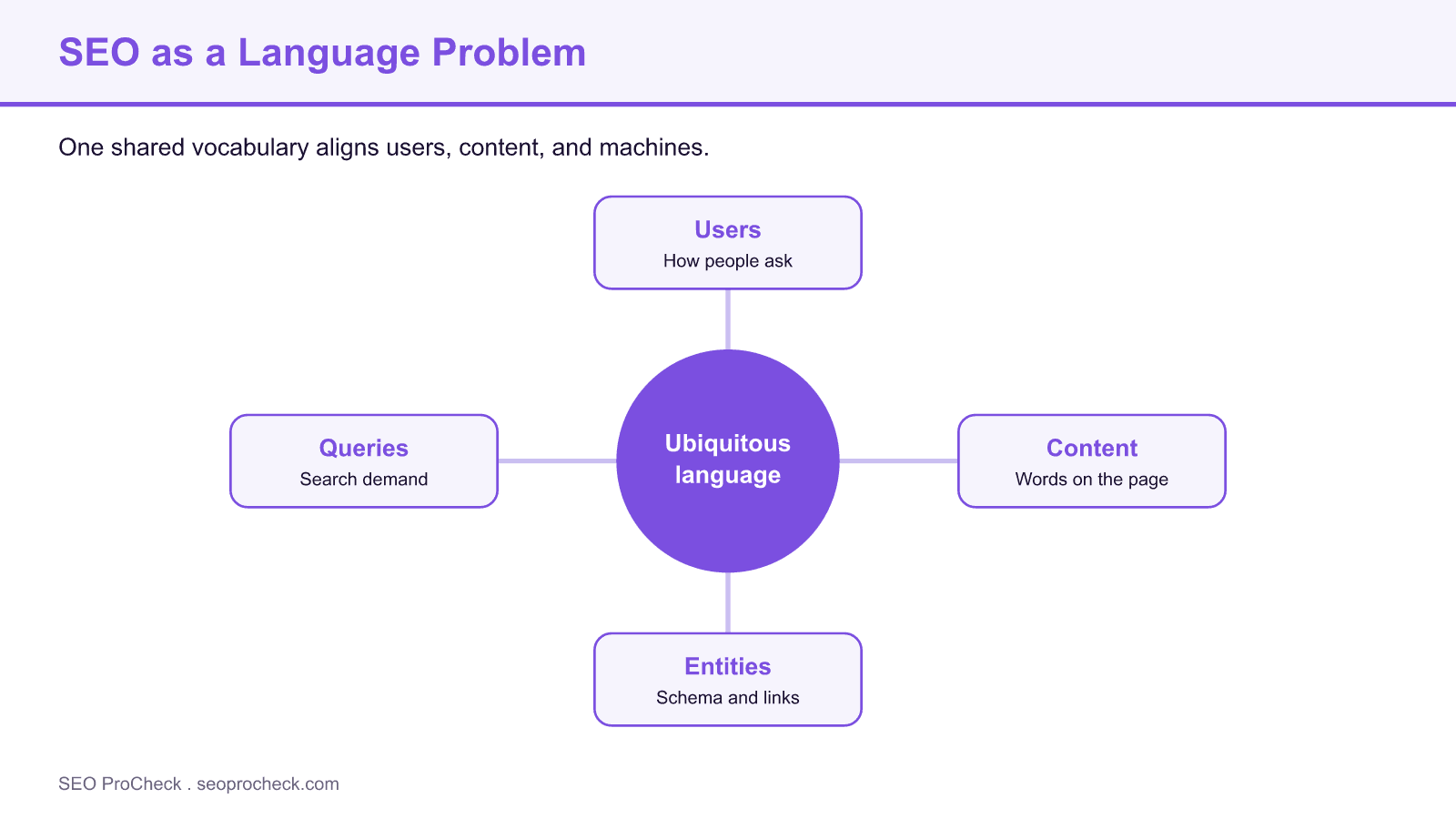
The idea behind ubiquitous language
The source for this post borrows a concept from software design called ubiquitous language: the practice of getting everyone, engineers, product managers, and stakeholders, to use one shared, precise vocabulary for the same things. Applied to SEO, the insight is that a site fails to rank not only because of technical faults but because its language is fractured. The team calls a product one thing, the marketing page calls it another, and the customer searches for a third. Search engines are left to reconcile three vocabularies that never agreed.
The hub and spoke diagram above shows the four layers that have to speak the same language: how users ask, what the queries reveal about demand, the words actually on the page, and the entities that schema and links declare. When one layer drifts, relevance leaks out of the gaps.
Where language breaks in practice
The most common failure is internal jargon. A company invents a clever product name or an industry insider term and builds its entire site around it, while the audience searches in plain language. The page can be technically perfect and still miss, because it answers a question nobody phrases that way. The reverse problem is inconsistency: the same concept is named five different ways across the site, so no single term accumulates topical weight and internal links point in scattered directions.
Entities add a third dimension. Search engines increasingly understand the world as things, people, places, products, concepts, rather than raw strings. If your content never connects your terms to the recognized entity, through consistent naming, structured data, and links, you are asking the machine to guess. Aligning your vocabulary with how demand is actually expressed is exactly what the natural language query coverage check measures.
Building a shared vocabulary
Start by listening. Pull the real language from search demand, on site search, support tickets, and sales calls, then reconcile it with the terms your team uses internally. Where the audience wins, adopt their words in visible content, headings, and anchors, even if you keep an internal codename for the product. Document the agreed terms so new pages inherit them, and map each core concept to its entity with consistent naming and structured data.
Two checks make this concrete. Use the keyword universe view to see the full spread of terms your topic should cover, and review voice query optimization to make sure your language matches how people speak their questions aloud, which is where the gap between jargon and plain language shows up most.
Four language layers and how to align them
| Layer | The vocabulary it carries | How to align it |
|---|---|---|
| Users | How real people phrase the need | Harvest from support, sales, and on site search |
| Queries | The demand search reveals | Map terms to intent, not just volume |
| Content | The words on your pages | Adopt audience language in headings and body |
| Entities | Schema and link declarations | Name things consistently and mark them up |
What has changed since
Language alignment used to be mostly about keyword matching. With entity based retrieval and AI search, it matters even more, and in a subtler way. Answer engines match on meaning, comparing the intent behind a prompt to the meaning of your content, so consistent terminology, clear definitions, and well marked entities help a machine confidently connect your page to a question. Fractured or jargon heavy language that a keyword matcher might have tolerated now makes it harder for an AI system to decide your page is the right answer. The fix is the same shared vocabulary, applied a little more rigorously.
Frequently asked questions
What does it mean that SEO is a language problem?
It means many ranking failures come from a mismatch between the words your audience uses, the words on your pages, and how search engines name concepts. Fixing the language often matters as much as fixing the technical setup.
What is ubiquitous language in SEO?
Borrowed from software design, it is the practice of agreeing on one shared, precise vocabulary across teams and content so that users, pages, and search engines all refer to the same things the same way.
How does internal jargon hurt SEO?
When you build content around insider terms or invented product names that customers never search for, your pages can be technically flawless yet still miss the demand, because they answer a question in words nobody uses.
How do I align my content vocabulary with search demand?
Gather real language from search data, on site search, support tickets, and sales calls, then adopt the audience terms in your visible content while documenting them so future pages stay consistent.
Does language alignment matter for AI search?
Yes, more than before. AI systems match on meaning, so consistent terminology, clear definitions, and marked up entities make it easier for them to connect your page to a natural language prompt.
Where do entities fit into the language of SEO?
Entities are the recognized things behind your words. Connecting your terms to the right entity through consistent naming, structured data, and links helps search engines understand your content instead of guessing.
Original summary and source
Why SEO is a Language Problem provides valuable insights for SEO practitioners. This resource examines approaches and considerations that can improve organic search performance.
Key Concepts
Understanding the fundamental principles behind this topic helps inform strategic decisions. Whether optimizing for traditional search or emerging AI platforms, foundational concepts remain relevant. This resource covers the essential knowledge practitioners need.
Implementation Considerations
Moving from concept to execution requires understanding practical constraints and opportunities. Different situations call for different approaches. This resource provides guidance for applying concepts in real-world contexts.
Measuring Impact
SEO efforts require measurement to demonstrate value and guide optimization. Identifying appropriate metrics, establishing baselines, and tracking progress enables data-driven improvement. This resource addresses how to evaluate success.
This resource contributes to the knowledge base SEO practitioners need for effective optimization in an evolving search landscape.
Source: https://www.theseosprint.com/p/ubiquitous-language?utm_source=email
Take this with you
The assistant links open with a question about this page already written. Nothing is sent until you press enter.
Claude Vincent is a technical SEO consultant focused on crawlability, rendering, and AI-search visibility. He writes the field guides and case studies at SEO ProCheck, with a bias toward the durable, unglamorous work that decides whether search engines and AI answer engines can actually read and cite a site.
About SEO ProCheck
Technical SEO consulting and GEO strategy with 20 years of enterprise experience. Case studies, resources, and tools for search and AI visibility.
Work With Me
Technical SEO audits, GEO strategy, site migrations, and international SEO. Hourly consulting for teams who need hands-on support, not just reports.
Subscribe to our newsletter!








Recent Posts
- Most Top Sites Never Say Who They Are in Structured Data October 14, 2026
- Homepage Titles Are Mostly Too Short, Not Too Long October 8, 2026
- Who Actually Serves an llms.txt? 184 Top Sites Measured September 29, 2026