

Does upgrading a listings website’s “cards” with more information improve organic traffic?
- January 26, 2023
- Content

AI Summary
Upgrading listing cards with more information, such as ratings, key attributes and a short unique description, can improve organic traffic because it adds crawlable, differentiating content to category and listing pages that would otherwise be thin. The effect should be confirmed with an A/B split test, because richer cards also add page weight and can shift how users interact with the results.
- Richer cards add unique on-page text that helps category and listing pages rank.
- Ratings, attributes and short descriptions match how users actually compare options.
- The trade-off is added markup and page weight, so measure engagement as well as traffic.
- Confirm the change with a controlled split test on the listing template.
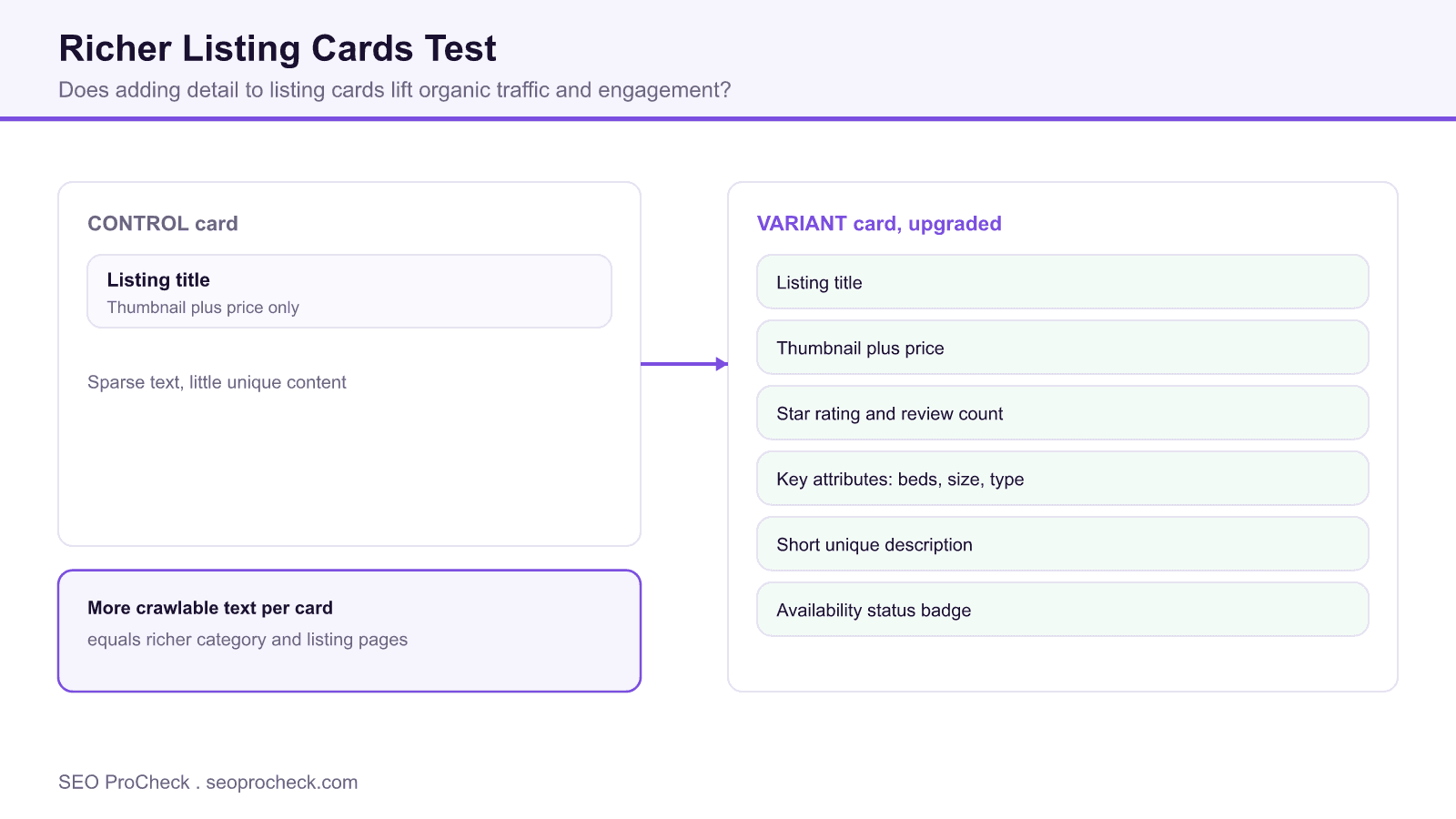
Listing and category pages are the workhorses of directories, ecommerce catalogs, real estate portals and job boards. Each one shows a grid or list of cards, and the design of that card quietly controls how much unique content the page carries. This case study asks whether upgrading those cards, giving each one more useful information, lifts organic traffic to the pages that contain them.
Why the card design is an SEO decision
A sparse card that shows only a title, thumbnail and price gives the page almost nothing unique to rank with. Multiply that across dozens of cards and the category page is mostly boilerplate chrome. A richer card, by contrast, contributes real text: a star rating and review count, key attributes such as bedrooms, size or type, a one line description and a status badge. Aggregated across the page, these details become substantive, query relevant content that helps the listing page compete for the searches that bring qualified visitors.
The change that was tested
The variant replaces the minimal control card with an upgraded card carrying additional structured information. In the diagram above, the control shows only a title and price, while the variant adds a rating and review count, key attributes, a short unique description and an availability badge. The hypothesis is that the extra crawlable content and stronger match to searcher needs lifts organic entrances to the pages built from these cards.
Keep the extra content genuinely unique
The benefit comes from information that actually differs between listings. A templated sentence repeated on every card adds bytes, not value, and can look like padding. Pull real attributes from your product or listing data and, where you generate description text, make sure it reflects the specific item. The short description is the highest leverage element: even one or two sentences of genuinely item specific copy per card meaningfully raises the unique content ratio of the page while helping users decide which result to click.
Mind the trade-offs
Richer cards are not free. More markup per card means a heavier page, so lazy load images, keep the HTML lean and watch Core Web Vitals, particularly on long category pages. Consider adding relevant structured data, for example Product or aggregateRating markup where it genuinely applies, but never mark up ratings that are not shown to users. Finally, watch engagement metrics alongside traffic: a busier card can improve click through to detail pages, or it can add noise, and only a controlled test on your own template will tell you which.
Where richer cards pay off most
Not every listing template benefits equally. The upside is largest where the category or search results page is the main organic entry point and where listings have genuinely comparable attributes, such as property portals, job boards, hotel and rental inventory, and large ecommerce catalogs. On these templates a single card design change propagates across thousands of URLs at once, so a modest per card improvement compounds into a meaningful sitewide gain. It matters less where detail pages, rather than listing pages, capture most of the organic demand. Before investing, check Search Console to confirm your listing and category URLs actually receive impressions and clicks, then prioritize the templates that already have visibility to build on.
What has changed since this test
The pressure to avoid thin, templated pages has intensified through successive helpful content and core updates, which makes the unique content that richer cards provide more valuable. At the same time, Core Web Vitals remain a real consideration, so the modern version of this tactic is to add meaningful information per card while keeping the page fast. Structured, item specific detail also feeds answer engines that assemble comparisons, so a well built listing card can earn visibility beyond the classic blue link.
Control card versus upgraded card
| Card element | Control card | Upgraded card |
|---|---|---|
| Title and image | Yes | Yes |
| Price | Yes | Yes |
| Rating and reviews | No | Yes, where genuine |
| Key attributes | No | Yes, from listing data |
| Unique description | No | One or two item specific lines |
| Unique content ratio | Low | Higher |
Related reading on SEO ProCheck: on-page SEO techniques, content SEO strategy, content case studies.
Frequently asked questions
Do richer listing cards improve organic traffic?
They often do, because they add unique, query relevant content to pages that were mostly boilerplate. The gain depends on whether the added content is genuinely unique per listing, so validate it with a split test.
What information should an upgraded card include?
Ratings and review counts where they are real, key attributes pulled from your listing data, a short item specific description and a status or availability badge. The description usually adds the most SEO value.
Will more content on each card slow the page down?
It can, especially on long category pages. Lazy load images, keep the HTML lean and monitor Core Web Vitals so the extra information does not cost you speed.
Should I add structured data to listing cards?
Only for attributes that are genuinely shown, such as Product details or an aggregateRating that matches the visible rating. Never mark up ratings or data that users cannot see on the page.
How do I keep card descriptions from looking like padding?
Generate them from real, item specific data rather than repeating a template. Even a single sentence that reflects the actual listing raises unique content without looking like filler.
How should I measure the impact?
Run a controlled A/B split test on the listing template and compare organic entrances between the control and variant groups. Watch click through to detail pages and Core Web Vitals alongside traffic.
Source: https://www.searchpilot.com/resources/case-studies/adding-details-to-listings-pages-on-website/
Take this with you
The assistant links open with a question about this page already written. Nothing is sent until you press enter.
Claude Vincent is a technical SEO consultant focused on crawlability, rendering, and AI-search visibility. He writes the field guides and case studies at SEO ProCheck, with a bias toward the durable, unglamorous work that decides whether search engines and AI answer engines can actually read and cite a site.
About SEO ProCheck
Technical SEO consulting and GEO strategy with 20 years of enterprise experience. Case studies, resources, and tools for search and AI visibility.
Work With Me
Technical SEO audits, GEO strategy, site migrations, and international SEO. Hourly consulting for teams who need hands-on support, not just reports.
Subscribe to our newsletter!








Recent Posts
- Most Top Sites Never Say Who They Are in Structured Data October 14, 2026
- Homepage Titles Are Mostly Too Short, Not Too Long October 8, 2026
- Who Actually Serves an llms.txt? 184 Top Sites Measured September 29, 2026