

Content Hubs: How To Improve The Way You’re Currently Producing Hub And Spoke Content
- January 26, 2023
- Content
AI Summary
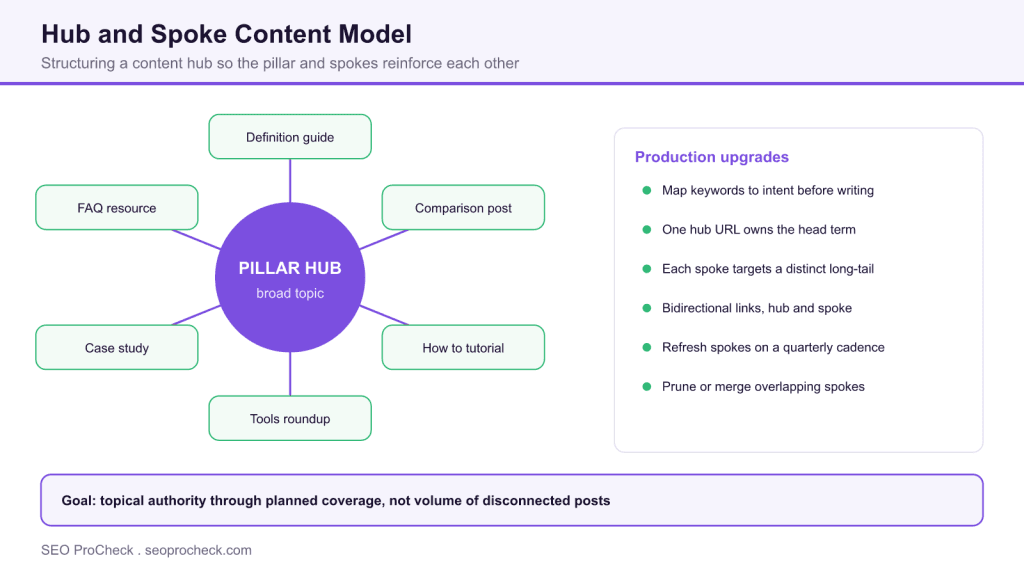
A hub and spoke model improves content production by giving one pillar hub page ownership of a broad topic while focused spoke articles each target a distinct long-tail query and link back to the hub. You improve an existing setup by mapping keywords to intent before writing, enforcing bidirectional internal links, refreshing spokes on a schedule and merging overlapping posts.
- The hub owns the head term; each spoke owns one specific sub-question or long-tail query.
- Bidirectional internal links between hub and spokes are what create measurable topical authority.
- Most content teams already have hubs, the gains come from tightening intent mapping and linking.
- Prune or merge overlapping spokes so two pages never compete for the same query.
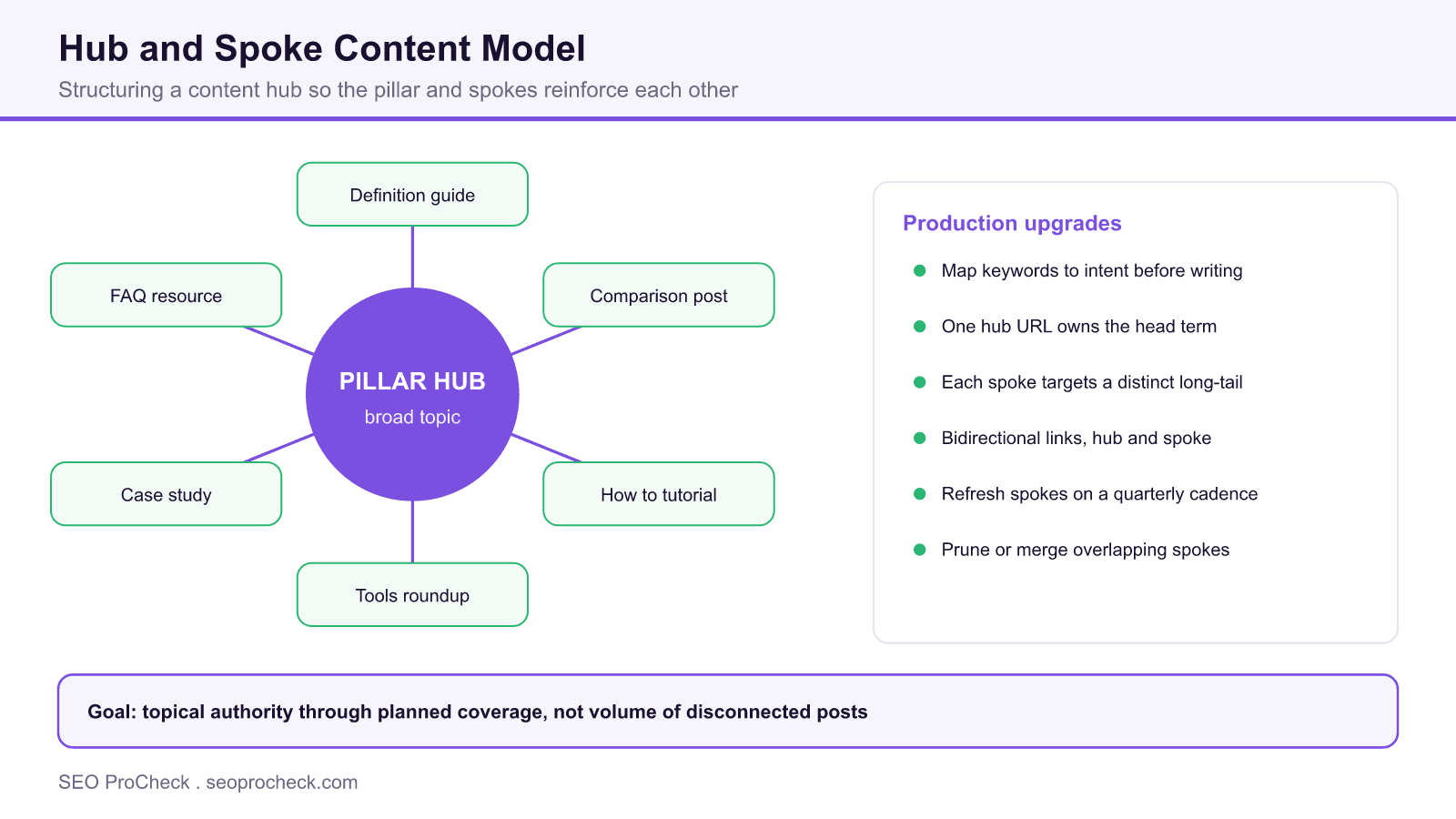
Hub and spoke content, sometimes called a topic cluster or pillar and cluster model, is one of the most durable structures in content SEO. A pillar hub covers a broad topic at a high level, and a set of spoke articles each dive deep on one sub-topic, all interlinked. Most teams producing serious volumes of content already use some version of this. The practical question this piece addresses is how to improve a model you are already running, not how to discover it for the first time.
Get intent mapping right before you write
The most common failure is producing spokes by keyword volume instead of by intent. Two keywords with high volume can share the same underlying intent, which means one page should serve both, while a single lower volume keyword can hide a distinct question that deserves its own spoke. Before commissioning any article, group your keywords by the job the searcher is trying to do, then assign one URL per distinct intent. The hub takes the head term and the widest informational intent; each spoke takes exactly one long-tail intent. This mapping step prevents the two most expensive problems later: cannibalization and thin overlap.
Make the internal linking bidirectional and deliberate
The structure only pays off if the links are real. Every spoke should link up to the hub with descriptive anchor text, and the hub should link down to every spoke it covers. Spokes that are genuinely related should also link to each other, but only where it helps the reader. Treat the hub as the canonical entry point for the topic and concentrate your strongest internal links and, where appropriate, external links to it. Weak or missing internal linking is the single biggest reason a nominal hub and spoke setup fails to build authority, because search engines infer topical relationships largely from how you link.
Build a repeatable production workflow
Improving production means making the pipeline boringly repeatable. A workable flow: research and cluster keywords, map each cluster to a hub or spoke URL, write a brief that states the single target intent and the required internal links, draft, edit against a quality bar, publish with the hub and spoke links wired in both directions, then schedule the next refresh. Document the target query, the parent hub and the sibling spokes in a simple content map or spreadsheet so no writer has to guess where a piece fits. This is where most teams find their real gains: not in writing more, but in wiring what they write into a coherent structure.
Refresh, prune and merge on a cadence
Hub and spoke content decays. Set a quarterly review to update spokes with new information, refresh the hub so it still summarizes the current set, and audit for overlap. When two spokes have drifted into competing for the same query, merge them into the stronger URL and redirect the weaker one, then update the hub link. Pruning is not failure; it keeps the cluster tight and stops your own pages from splitting their signals.
What has changed since this playbook
Topical authority and clear intent coverage matter more in an era of AI overviews and answer engines, which tend to draw from well structured, comprehensively covered topics. A clean hub and spoke architecture makes your site easier to parse and easier to cite, because the relationships between pages are explicit. The mechanics in this piece, intent mapping, bidirectional linking and disciplined refreshing, are exactly what makes a cluster legible to both classic search and AI driven surfaces.
Hub versus spoke: roles at a glance
| Attribute | Pillar hub | Spoke article |
|---|---|---|
| Target query | Broad head term | One specific long-tail intent |
| Depth | Overview that frames the topic | Deep answer to one question |
| Internal links | Links down to every spoke | Links up to the hub, plus siblings |
| Update cadence | Refresh when the set changes | Quarterly review and refresh |
| Failure mode | Too shallow to rank the head term | Overlaps and cannibalizes a sibling |
Related reading on SEO ProCheck: content SEO strategy, internal linking best practices, keyword research, content case studies.
Frequently asked questions
What is the difference between a hub and a spoke?
The hub is a pillar page that covers a broad topic and frames the whole cluster, while a spoke is a focused article that answers one specific sub-question. The hub owns the head term and the spokes own the long-tail queries around it.
How many spokes should a hub have?
As many as there are distinct intents worth serving, and no more. Add a spoke when a real sub-question has no home, and merge spokes when two of them compete for the same query rather than padding the count.
Why is internal linking so important in this model?
Search engines infer topical relationships largely from how pages link to each other. Bidirectional links between the hub and its spokes are what turn a pile of related posts into a cluster that builds authority.
How do I fix an existing hub and spoke setup that is not working?
Start by mapping every page to a single intent, then audit and repair the internal links so every spoke links up and the hub links down. Merge overlapping spokes and prune thin ones before producing anything new.
How often should I refresh spokes?
A quarterly cadence works for most topics: update facts, re-check the internal links, and confirm the hub still summarizes the current set. Fast moving topics may need more frequent updates.
Does hub and spoke still help with AI search?
Yes. Answer engines favor well structured, comprehensively covered topics, and a clean cluster with explicit links is easier to parse and cite than scattered posts with no clear relationships.
Take this with you
The assistant links open with a question about this page already written. Nothing is sent until you press enter.
Claude Vincent is a technical SEO consultant focused on crawlability, rendering, and AI-search visibility. He writes the field guides and case studies at SEO ProCheck, with a bias toward the durable, unglamorous work that decides whether search engines and AI answer engines can actually read and cite a site.
About SEO ProCheck
Technical SEO consulting and GEO strategy with 20 years of enterprise experience. Case studies, resources, and tools for search and AI visibility.
Work With Me
Technical SEO audits, GEO strategy, site migrations, and international SEO. Hourly consulting for teams who need hands-on support, not just reports.
Subscribe to our newsletter!








Recent Posts
- Most Top Sites Never Say Who They Are in Structured Data October 14, 2026
- Homepage Titles Are Mostly Too Short, Not Too Long October 8, 2026
- Who Actually Serves an llms.txt? 184 Top Sites Measured September 29, 2026