

AI Summary
Placing FAQ content inside a collapsible accordion does not harm indexing or rankings, as long as the answer text is present in the initial HTML that Googlebot receives. The real risk is not the visual collapse; it is FAQ answers that only load after a click through JavaScript, because that content may never reach the index.
- Google indexes content hidden behind accordions and tabs when it sits in the rendered DOM.
- Mobile-first indexing treats collapsed content with full weight, since accordions are standard mobile UX.
- The pattern that hurts you is answers fetched on click by AJAX, which can leave the text out of the crawled HTML.
- FAQ rich results are now limited by Google to government and health sites, but collapsed FAQs still help users and topical depth.
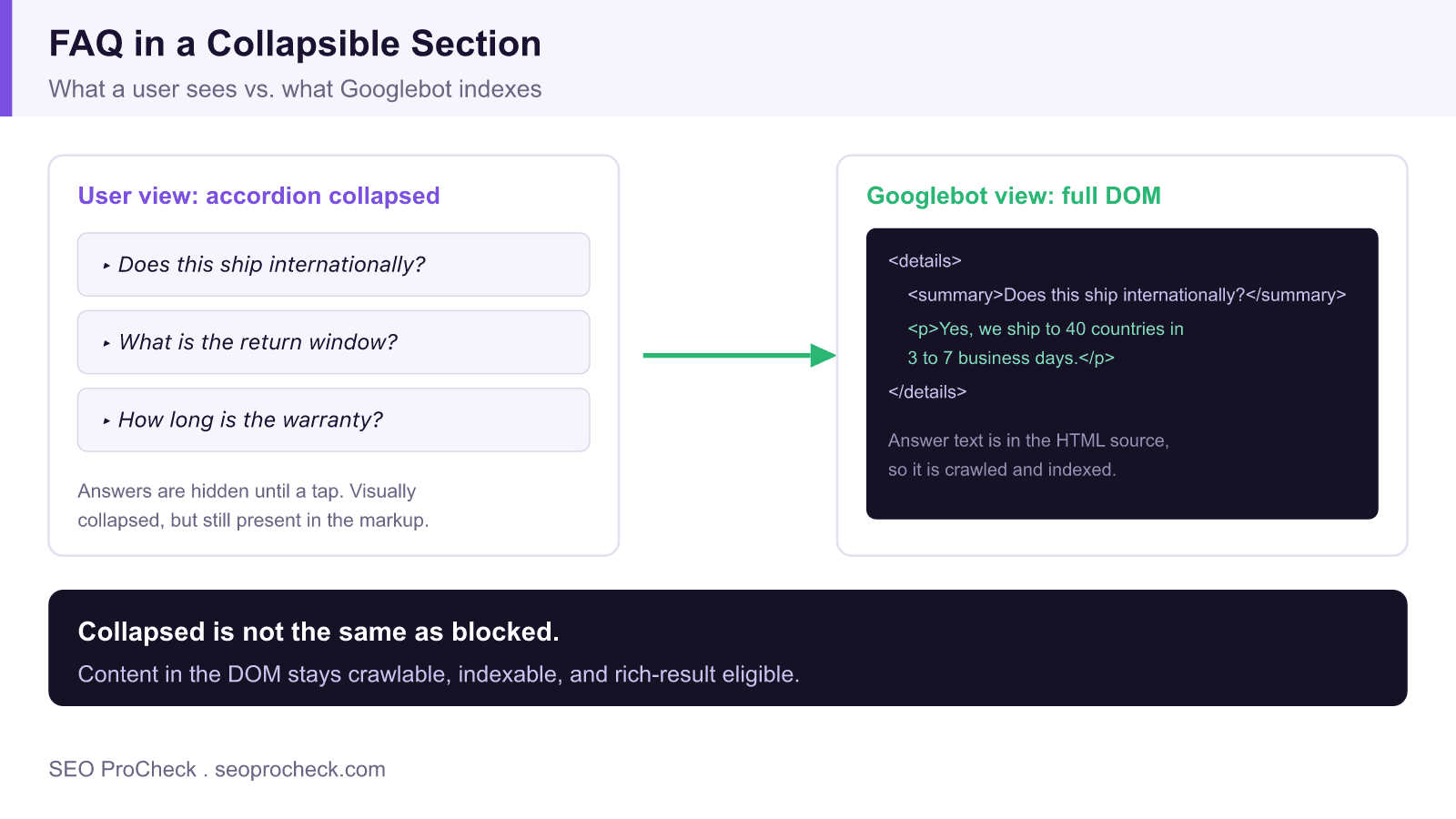
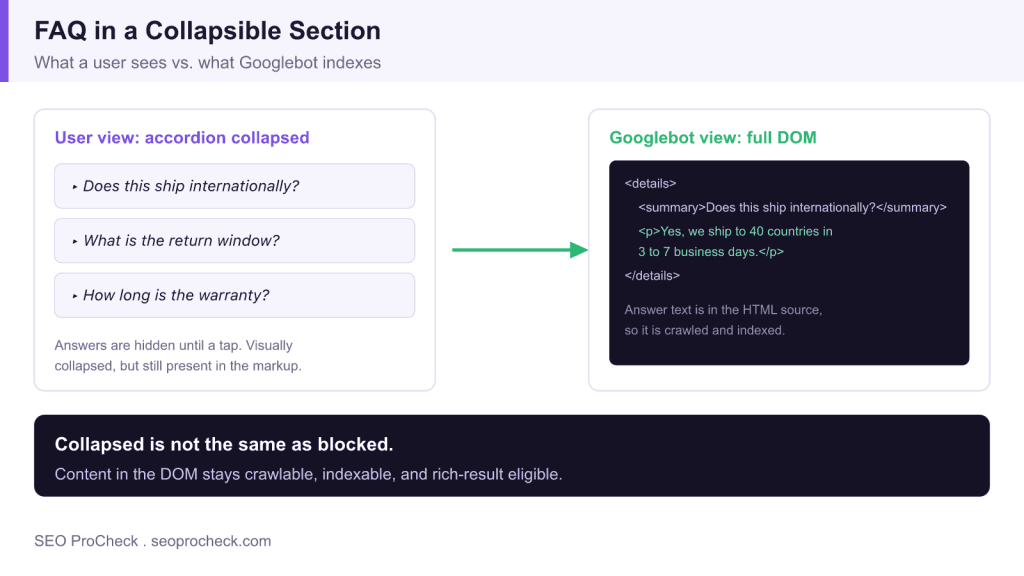
Moving a long FAQ block into a collapsible accordion is one of the most common design requests a content team ever gets. The layout is cleaner, the page feels shorter, and mobile users can scan headings instead of scrolling through walls of text. The recurring worry is whether tucking those answers behind a tap quietly strips them out of Google. The short answer, backed by controlled testing and by Google's own guidance, is that a collapsible section is safe as long as the answer text ships inside the initial HTML.
Rendered layout is not the same as the crawled document
Search engines work from two different views of a page. The first is the raw HTML that the server returns. The second is the rendered DOM after CSS and JavaScript run. An accordion built with CSS (a class that sets display:none or max-height:0 on the answer, or a native <details> element) keeps the full answer text inside both views. The text is in the source, it is in the DOM, and Googlebot reads it the same way it reads a visible paragraph. Collapsing it changes only the pixels a human sees, not the bytes a crawler parses.
You can confirm this yourself in seconds. Open the page, choose View Source, and search for a sentence that only appears inside a closed accordion panel. If the sentence is in the raw source, it is crawlable. If it is missing from the source and only appears after you click, the answer is being injected by script, and that is where indexing problems begin.
The pattern that actually hurts you
The dangerous version of a collapsible FAQ is the one that loads answers on demand. A widget renders only the questions, then fires an XMLHttpRequest or fetch() call to pull each answer from an API the moment a user expands it. Nothing is wrong with that for people, but Googlebot does not click. If the answer never exists in the HTML and is never rendered without interaction, it can be absent from the index entirely. The content looks present to your analytics and to your eyes, yet it contributes nothing to rankings because search engines never received it.
The fix is to render the answers server side and let CSS or a native disclosure element hide them. Progressive enhancement is the rule: ship the complete answer in the markup first, then layer interactivity on top. If you must lazy load, make sure a crawlable copy still exists in the initial response.
Why mobile-first indexing settled the old debate
Years ago there was a real argument that content hidden behind tabs on desktop carried slightly less weight. That caveat belonged to a desktop-indexing world. Since Google moved every site to mobile-first indexing, the mobile version is the version that gets indexed and ranked, and accordions are the normal, expected way to present dense information on a small screen. Google has repeatedly confirmed that content hidden behind a tap on mobile is given full weight. Collapsing your FAQ now matches the exact experience Google evaluates.
What has changed since: FAQ rich results
One thing genuinely changed, and it is worth separating from the indexing question. In August 2023 Google restricted FAQ rich results so that the expandable question and answer snippets show only for well known, authoritative government and health websites. For nearly every commercial site, valid FAQPage structured data no longer produces those extra rows in the search result. This is a change to how FAQs are displayed in search, not to whether the underlying text is indexed. A collapsed FAQ still helps users, still builds topical depth on the page, and its answers still count as indexable content. You simply should not expect the rich result decoration anymore.
Implementation checklist that keeps a collapsible FAQ safe
Use these steps as a repeatable review before shipping any accordion:
- Render every question and answer in the server response, not on click.
- Prefer the native
<details>and<summary>elements or a simple CSS toggle over a script that fetches content. - Confirm the answer text appears in View Source and in the URL Inspection tool's rendered HTML.
- Keep one clear heading structure so the questions read as real headings, not as buttons only.
- If you still add FAQPage schema, keep it accurate and matching the visible text, even though rich results are limited.
Collapsible FAQ patterns and indexing safety
| Pattern | Answer in initial HTML? | Indexed? | Notes |
|---|---|---|---|
| CSS accordion (display:none) | Yes | Yes | Safe. Text is in the DOM. |
| Native <details> and <summary> | Yes | Yes | Safe and accessible by default. |
| CSS tabs | Yes | Yes | Full weight under mobile-first indexing. |
| JavaScript rendered on load | In rendered DOM | Usually | Depends on successful rendering. Verify. |
| AJAX fetch on click | No | Risky | Answer may never reach the index. |
Related reading
- Server rendering vs client rendering for crawlers explains why on-load JavaScript matters for what gets indexed.
- Why raw HTML still decides what search engines read covers the source versus rendered gap in depth.
- SEO vs AEO vs GEO puts FAQ content in the context of answer engines and AI overviews.
Case study summary and source
Content-driven SEO success requires strategic approaches to creation, optimization, and management. This case study demonstrates how content strategy directly drives organic growth when aligned with user needs and search behavior.
Content Strategy Framework
Effective content strategy begins with understanding target audiences, their questions, and the competitive content landscape. This case study outlines the strategic framework that guided content decisions, from topic selection to format choices.
Content Development Process
Moving from strategy to published content requires efficient processes for research, creation, and optimization. This case study documents workflows, quality standards, and production approaches that enabled consistent, high-quality output.
Optimization and Distribution
Published content requires ongoing optimization based on performance data. This case study covers how content was refined post-publication, how internal linking supported content performance, and how distribution amplified content reach.
Results and Attribution
Measuring content ROI requires connecting content efforts to business outcomes. This case study demonstrates the traffic, engagement, and business results achieved through strategic content investment. Attribution methodology helps validate content strategy effectiveness.
Content SEO case studies help practitioners build cases for content investment with documented results.
Frequently asked questions
Does hiding FAQ answers in an accordion stop Google from indexing them?
No. If the answer text is in the page's HTML, Google indexes it whether the panel is open or closed. The collapse only affects what a human sees, not what a crawler parses. Problems appear only when the answer is loaded by script after a click.
Is content behind a click to expand control ranked lower than visible content?
Not under mobile-first indexing. Google evaluates the mobile page, where accordions are standard, and gives that content full weight. The old idea that tabbed content counts less belonged to the desktop indexing era.
Do I still get FAQ rich results if my FAQ is collapsed?
Probably not, but that is unrelated to the collapse. In August 2023 Google limited FAQ rich results to authoritative government and health sites. Most commercial pages no longer show the expandable snippets even with valid FAQPage markup, whether the FAQ is collapsed or open.
What is the one FAQ pattern that actually hurts indexing?
Answers fetched on demand. If a widget shows only questions and pulls each answer from an API when a user expands it, the text is missing from the crawled HTML and can be left out of the index entirely. Render answers server side instead.
How do I check that Google can see my collapsed FAQ answers?
Open View Source and search for a sentence that appears only in a closed panel. If it is in the source, it is crawlable. You can also use the URL Inspection tool and read the rendered HTML to confirm the answer is present.
Should I use the details element or a JavaScript accordion?
Prefer the native details and summary elements. They are accessible, need no script, and keep the answer in the DOM by default. A JavaScript accordion is fine too, as long as the answer is in the initial HTML rather than fetched on click.
Claude Vincent is a technical SEO consultant focused on crawlability, rendering, and AI-search visibility. He writes the field guides and case studies at SEO ProCheck, with a bias toward the durable, unglamorous work that decides whether search engines and AI answer engines can actually read and cite a site.
About SEO ProCheck
Technical SEO consulting and GEO strategy with 20 years of enterprise experience. Case studies, resources, and tools for search and AI visibility.
Work With Me
Technical SEO audits, GEO strategy, site migrations, and international SEO. Hourly consulting for teams who need hands-on support, not just reports.
Subscribe to our newsletter!







Recent Posts
- Can AI Crawlers Actually Read Your Site? I Measured 400 of the Biggest September 5, 2026
- The Pre-Publish Quality Gate for AI-Assisted Content August 6, 2026
- AGENTS.md vs llms.txt vs llms-full.txt: Which Agent File Does What July 18, 2026