

Adding User-Centric Content to Target Featured Snippets: SEO Split Testing Lessons
- April 20, 2021
- Content
AI Summary
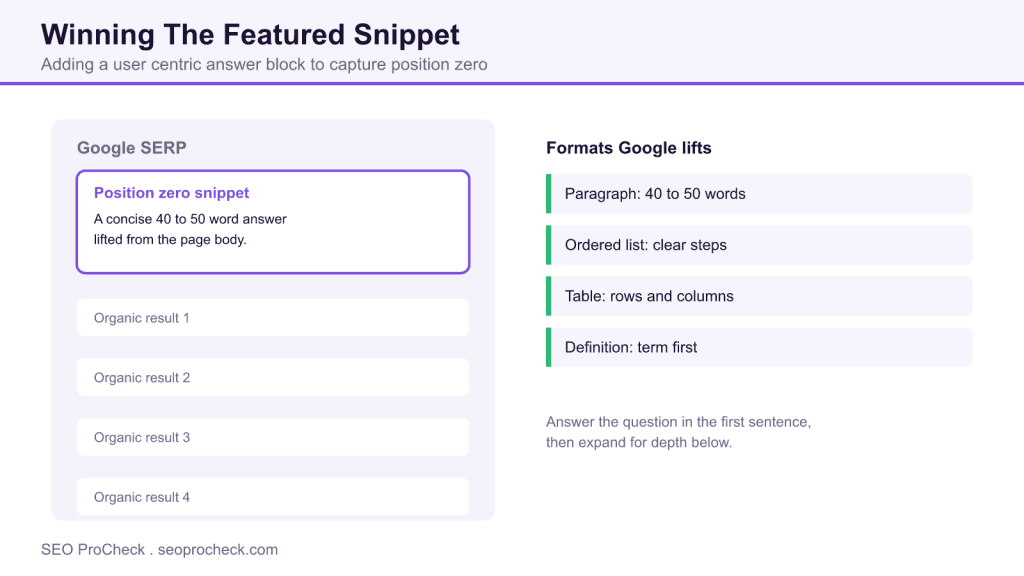
Adding a concise, user-centric answer block that directly answers the searcher question can win the featured snippet, and controlled SEO split testing is how you confirm the change actually helped rather than guessing. Format the answer in the shape Google prefers, a short paragraph, an ordered list, or a table, and place it high on the page.
- Featured snippets are lifted from on-page content that answers the query cleanly and early.
- A 40 to 50 word paragraph, a numbered list, or a compact table are the formats Google most often lifts.
- SEO split testing measures the real effect of a snippet-targeting change against a control forecast.
- Winning position zero increasingly feeds AI answers as well as classic search.
Why user-centric answer blocks win snippets
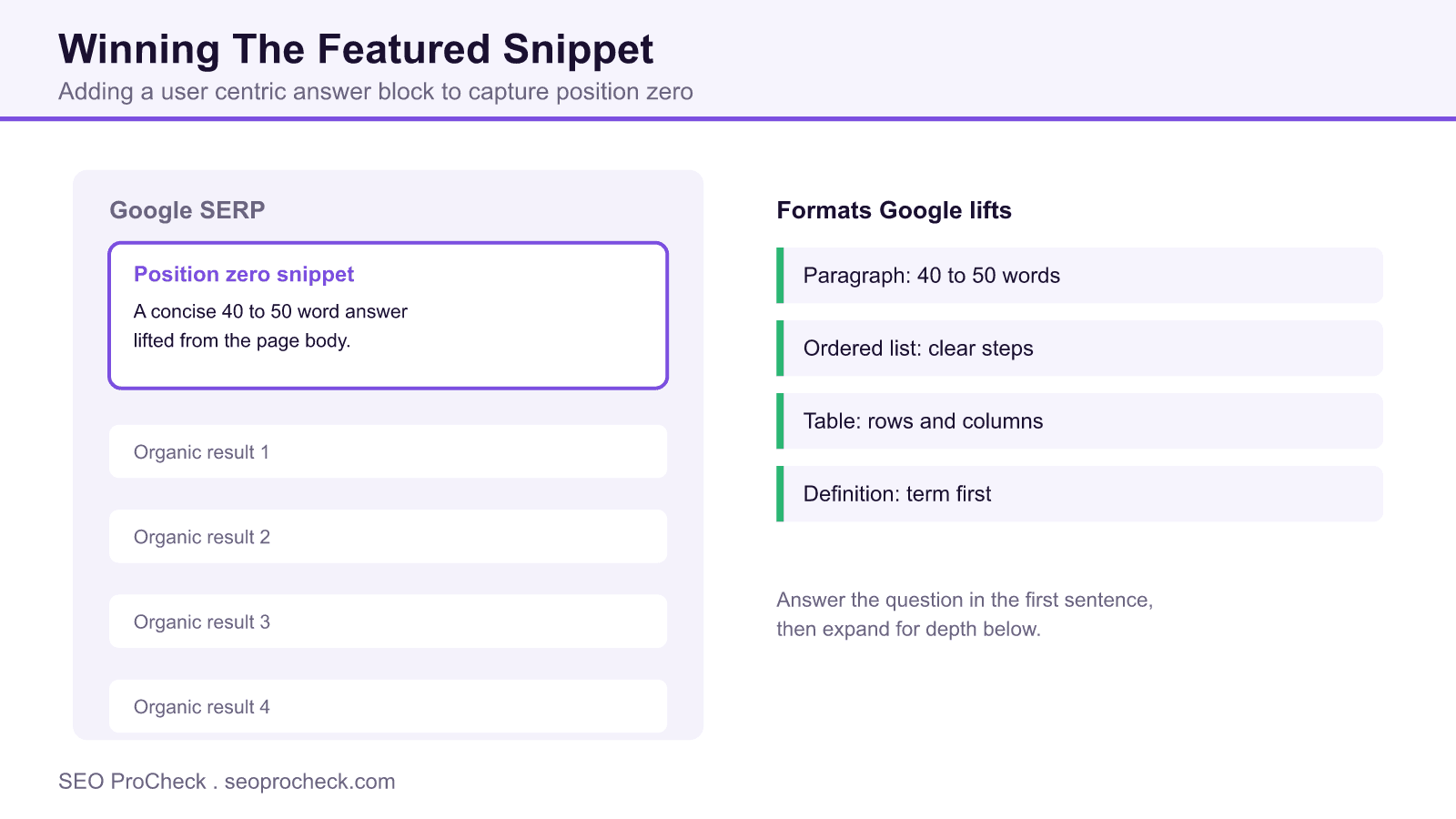
A featured snippet is Google lifting a passage from a page because it answers the query more directly than the surrounding results. The case study behind this page, linked below, comes from the split-testing discipline, where a hypothesis is deployed to a group of similar pages and measured against a control. The recurring lesson is that pages framed around the user question, rather than around the brand or the product, are the ones Google chooses to feature.
If you are optimizing for position zero, start with our practical playbook on featured snippet optimization and the evidence in what content wins position zero.
The formats Google lifts
Snippets come in predictable shapes. Paragraph snippets answer a question in roughly 40 to 50 words, so a tight definition or direct answer near the top of the page is ideal. List snippets pull ordered or unordered lists, which suits how-to steps and rankings. Table snippets lift rows and columns, so comparison data formatted as a real HTML table can be featured wholesale. Matching your content structure to the snippet type the query already triggers is half the battle: inspect the current snippet, then build a better version of that exact format.
Designing the answer block
Place a clear, self-contained answer high on the page, ideally right after the introduction and under a heading that mirrors the question. Answer in the first sentence, then expand for depth below so the page still satisfies readers who want more. Keep the liftable passage free of unresolved pronouns and internal references so it makes sense out of context. Add supporting structure, a list of steps or a comparison table, when the query invites it. This user-first framing is the same principle that underpins durable featured snippet strategy, which now feeds AI Overviews and assistant answers too.
Proving it with a split test
The reason case studies like this one matter is method. Rather than change one page and credit any subsequent movement to the edit, SEO split testing applies the change to a bucket of similar pages, holds a comparable bucket as control, and models the difference. That isolates the effect of the answer block from seasonality and algorithm noise. If you cannot run a formal test, the disciplined alternative is a clean before and after on a single template with annotations, so you at least know when the change shipped and can watch the snippet and the clicks together.
Snippet formats and how to earn them
| Snippet type | Best for | On-page format | Target length |
|---|---|---|---|
| Paragraph | definitions, direct answers | short paragraph under a question heading | 40 to 50 words |
| Ordered list | steps, processes, rankings | numbered list | 4 to 8 items |
| Unordered list | features, examples | bulleted list | 4 to 8 items |
| Table | comparisons, specs, pricing | real HTML table | compact rows and columns |
What has changed since
Since this test, featured snippets have become a feeder for AI Overviews and assistant answers, so the same clear answer blocks now earn visibility in AI search as well as classic results. Google has also trimmed some snippet displays over time, which makes concise, well-structured answers more valuable, not less.
Case summary and source
The original third-party summary and attribution for this page are preserved below.
Content-driven SEO success requires strategic approaches to creation, optimization, and management. This case study demonstrates how content strategy directly drives organic growth when aligned with user needs and search behavior.
Content Strategy Framework
Effective content strategy begins with understanding target audiences, their questions, and the competitive content landscape. This case study outlines the strategic framework that guided content decisions, from topic selection to format choices.
Content Development Process
Moving from strategy to published content requires efficient processes for research, creation, and optimization. This case study documents workflows, quality standards, and production approaches that enabled consistent, high-quality output.
Optimization and Distribution
Published content requires ongoing optimization based on performance data. This case study covers how content was refined post-publication, how internal linking supported content performance, and how distribution amplified content reach.
Results and Attribution
Measuring content ROI requires connecting content efforts to business outcomes. This case study demonstrates the traffic, engagement, and business results achieved through strategic content investment. Attribution methodology helps validate content strategy effectiveness.
Content SEO case studies help practitioners build cases for content investment with documented results.
Source: https://www.searchpilot.com/resources/case-studies/seo-split-test-lessons-featured-snippets/
Frequently asked questions
What is a user-centric answer block?
It is a short, self-contained passage written to answer the searcher question directly, placed high on the page under a heading that mirrors the query. It is framed around what the user asked rather than around the brand or product.
How long should a paragraph snippet answer be?
Paragraph snippets are typically around 40 to 50 words. Answer the question in the first sentence, then expand below so the passage works both as a lifted snippet and as the opening of a fuller section.
How do I know which snippet format to target?
Search the query and inspect the current featured snippet. Google usually keeps the same format, so if it shows a list, build a better list; if it shows a table, format your data as a real HTML table.
What is an SEO split test?
It is a controlled experiment that applies a change to a group of similar pages while holding a comparable group as a control, then models the difference. It isolates the effect of your change from seasonality and algorithm updates.
Do featured snippets still matter with AI Overviews?
Yes. The same clear, well-structured answers that win featured snippets are frequently used to build AI Overviews and assistant responses, so the optimization work carries over to AI search.
Can targeting a snippet lose me clicks?
Occasionally a snippet answers the query so completely that users do not click, but for most informational queries the visibility and authority of position zero outweigh that risk. Testing tells you which case applies.
Take this with you
The assistant links open with a question about this page already written. Nothing is sent until you press enter.
Claude Vincent is a technical SEO consultant focused on crawlability, rendering, and AI-search visibility. He writes the field guides and case studies at SEO ProCheck, with a bias toward the durable, unglamorous work that decides whether search engines and AI answer engines can actually read and cite a site.
About SEO ProCheck
Technical SEO consulting and GEO strategy with 20 years of enterprise experience. Case studies, resources, and tools for search and AI visibility.
Work With Me
Technical SEO audits, GEO strategy, site migrations, and international SEO. Hourly consulting for teams who need hands-on support, not just reports.
Subscribe to our newsletter!








Recent Posts
- Most Top Sites Never Say Who They Are in Structured Data October 14, 2026
- Homepage Titles Are Mostly Too Short, Not Too Long October 8, 2026
- Who Actually Serves an llms.txt? 184 Top Sites Measured September 29, 2026