Content Strategy for Publishers w/ Former New York Times SEOs - Siege Media
- June 18, 2018
- Content
AI Summary
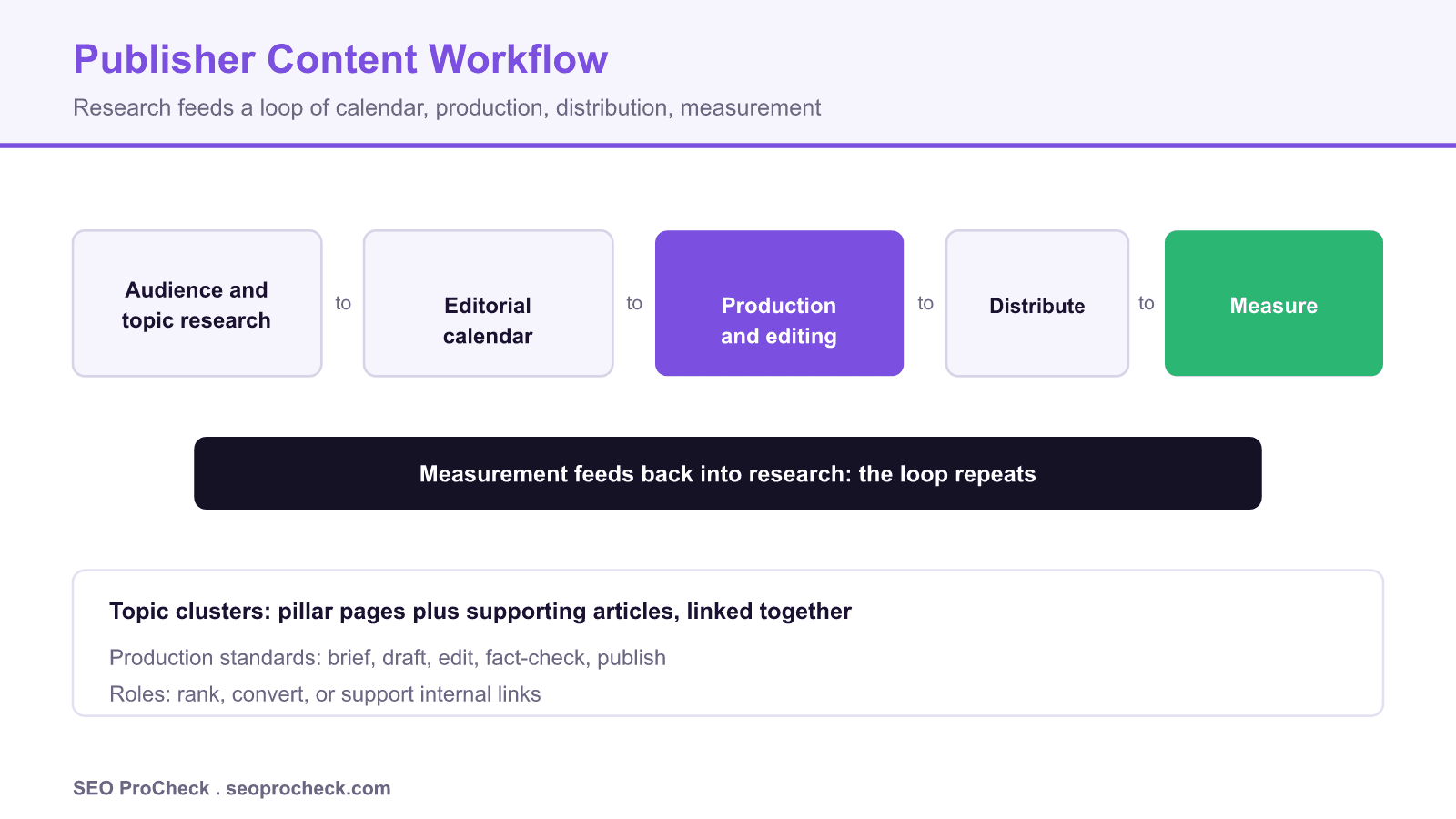
Content strategy for publishers is the repeatable system that turns audience research into a steady stream of pages that rank and retain readers. The teams that scale it treat the editorial calendar, production standards, and measurement as one connected loop rather than a pile of one-off articles.
- Start from audience questions and topical authority, not from a keyword dump.
- An editorial calendar plus clear production standards is what makes quality repeatable at volume.
- Internal linking into topic clusters is how publishers turn many articles into ranking power.
- Measure by topic and by page role, then reinvest in what proves out.
Publishers live and die by throughput, so their content strategy has to solve a harder problem than most brands face: produce a lot, keep quality high, and make every article compound the value of the ones already published. The teams that get this right, including editors who came out of newsrooms like the New York Times, run content as a connected system rather than a list of assignments. This piece walks through that system and the practitioner decisions inside each stage.
Start from audience questions and topical authority
Strategy begins before the calendar. You map the topics your audience cares about, the questions they ask at each stage, and the areas where you can plausibly become an authority. Topical authority is earned by covering a subject completely, not by publishing one strong article and moving on. That means planning in clusters: a broad pillar that frames a subject and a set of supporting articles that answer the narrower questions underneath it. Modern relevance is semantic, built on entities and relationships rather than exact-match phrases, which is why we recommend pairing this planning with the ideas in our guide to semantic SEO for content strategy.
The editorial calendar is the operating system
For a publisher, the calendar is where strategy becomes real. It sequences clusters so that supporting articles and their pillar ship close together, it balances evergreen pieces against timely ones, and it assigns each article a clear job before anyone writes a word. A shared calendar also prevents the classic publisher failure mode, which is two writers unknowingly covering the same query and creating internal competition. Being early to a topic still matters, and a disciplined calendar is how you capture that advantage, an idea we expand on in our note on first mover content strategy.
Production standards make quality repeatable
Volume without standards produces thin content at scale, which is the exact pattern search engines have learned to suppress. The fix is a documented production path that every article follows: a brief that states the target question and the angle, a draft, a substantive edit, a fact-check with sourcing, and a final SEO pass for headings, internal links, and metadata. Former newsroom editors bring a useful habit here, which is that the edit is not optional polish but a core step that catches weak arguments and unsupported claims before they publish. When each article passes the same gate, quality stops depending on which writer drew the assignment.
| Stage | Owner | Key output | Failure mode if skipped |
|---|---|---|---|
| Brief | Editor or strategist | Target question, angle, sources | Writers guess, drafts wander |
| Draft | Writer | First full version | Blank-page delays |
| Edit | Editor | Tightened argument, verified claims | Thin or inaccurate content ships |
| SEO pass | SEO lead | Headings, links, metadata | Good content nobody can find |
| Measure | Analyst | Topic and page performance | Reinvestment is guesswork |
Distribution and internal linking
Publishing is the middle of the process, not the end. Distribution across newsletters, social, and syndication earns the early attention that helps a new article gather signals. Internally, the most durable growth lever is linking supporting articles up to their pillar and across to their siblings, so authority concentrates where you want to rank. Our internal linking strategy for topic clusters lays out the exact linking patterns that turn a pile of articles into a structure search engines reward.
Measure by topic, then reinvest
Publishers should judge performance at the level of the cluster and the individual page role, not just sitewide sessions. Some pages exist to rank and pull traffic, some to convert, and some mainly to pass internal links. Reading them all against the same session metric hides what is working. Track which clusters gain authority, which supporting pages feed their pillar, and where a gap in coverage is capping a topic, then feed those findings straight back into the next planning cycle. That feedback loop, research to calendar to production to distribution to measurement and back to research, is the whole strategy in one sentence.
Common pitfalls that stall publisher SEO
Three failure modes recur across publisher teams. The first is publishing on a fixed cadence regardless of coverage, so the calendar fills with whatever is easy rather than what a cluster actually needs, and topical authority never consolidates. The second is orphaned articles: strong pieces that ship with no internal links pointing to them, which leaves them isolated and slow to rank. The third is treating older content as finished. Evergreen pages decay as facts change and competitors improve, so a publisher needs a scheduled refresh cycle that revisits top pages, updates them, and re-links them into their cluster. Building these three checks into the workflow, coverage-driven planning, deliberate internal linking on publish, and a refresh cadence, is usually the difference between a content operation that compounds and one that simply produces.
Source: https://www.siegemedia.com/conversation/content-strategy-for-publishers
Frequently asked questions
What is content strategy for a publisher?
It is the repeatable system a publisher uses to turn audience research into a steady stream of articles that rank and retain readers, connecting the editorial calendar, production standards, and measurement into one loop.
Why do former newsroom editors matter for SEO content?
They bring a strong editing culture and a fact-checking habit. That discipline prevents thin, unsupported content at scale, which is exactly the pattern search engines suppress.
What is topical authority and how do I build it?
Topical authority is the trust a site earns by covering a subject completely. You build it by planning in clusters, a broad pillar plus supporting articles that answer the narrower questions, and linking them together.
How many articles should a publisher plan at once?
Plan in clusters rather than counts. Sequence a pillar and its supporting articles so they ship close together, then move to the next cluster once coverage is solid.
How should publishers measure content performance?
Measure by topic cluster and by the role of each page, whether it exists to rank, to convert, or to support internal links, rather than judging every page by the same sitewide session metric.
Does volume hurt SEO?
Volume without standards does. A documented production path that every article follows keeps quality consistent, so scale becomes an advantage instead of a source of thin content.
Claude Vincent is a technical SEO consultant focused on crawlability, rendering, and AI-search visibility. He writes the field guides and case studies at SEO ProCheck, with a bias toward the durable, unglamorous work that decides whether search engines and AI answer engines can actually read and cite a site.
About SEO ProCheck
Technical SEO consulting and GEO strategy with 20 years of enterprise experience. Case studies, resources, and tools for search and AI visibility.
Work With Me
Technical SEO audits, GEO strategy, site migrations, and international SEO. Hourly consulting for teams who need hands-on support, not just reports.
Subscribe to our newsletter!