

International SEO Site Structure: ccTLDs, Subdomains, and Subdirectories
- September 15, 2024
- International SEO and Hreflang, Technical SEO
AI Summary
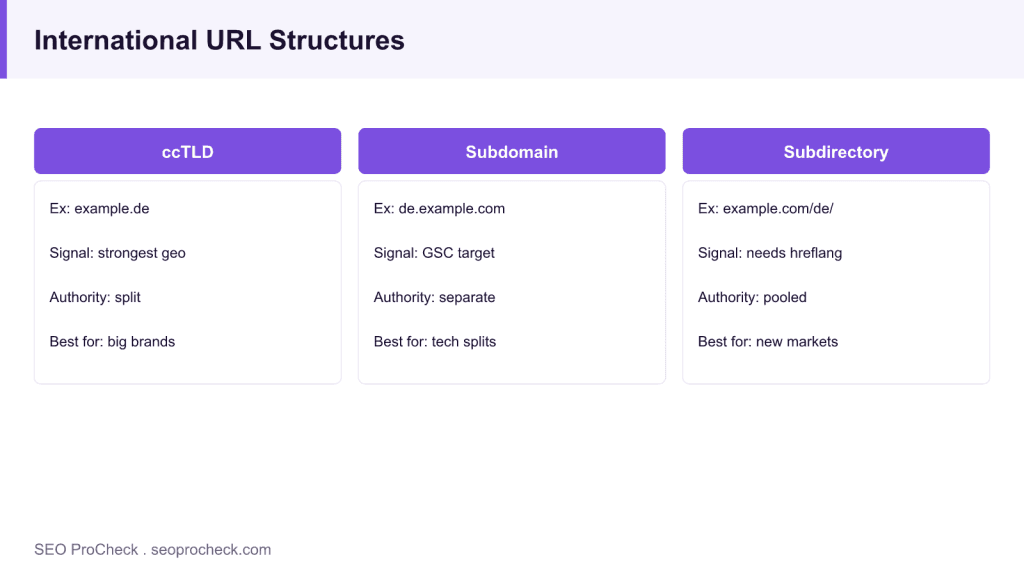
International site structure is the choice between ccTLDs, subdomains, and subdirectories, and it decides how your authority consolidates, how strong your geographic targeting is, and how complex the site is to run. Subdirectories suit most sites, while ccTLDs fit established brands with the resources to build authority per market.
- ccTLDs give the strongest geo signal but split authority across separate domains.
- Subdomains keep brand consistency but their authority stays somewhat separate.
- Subdirectories consolidate authority under one domain and suit most new markets.
- Implement reciprocal hreflang with an x-default for every set of equivalent pages.
Choosing With a Clear Comparison
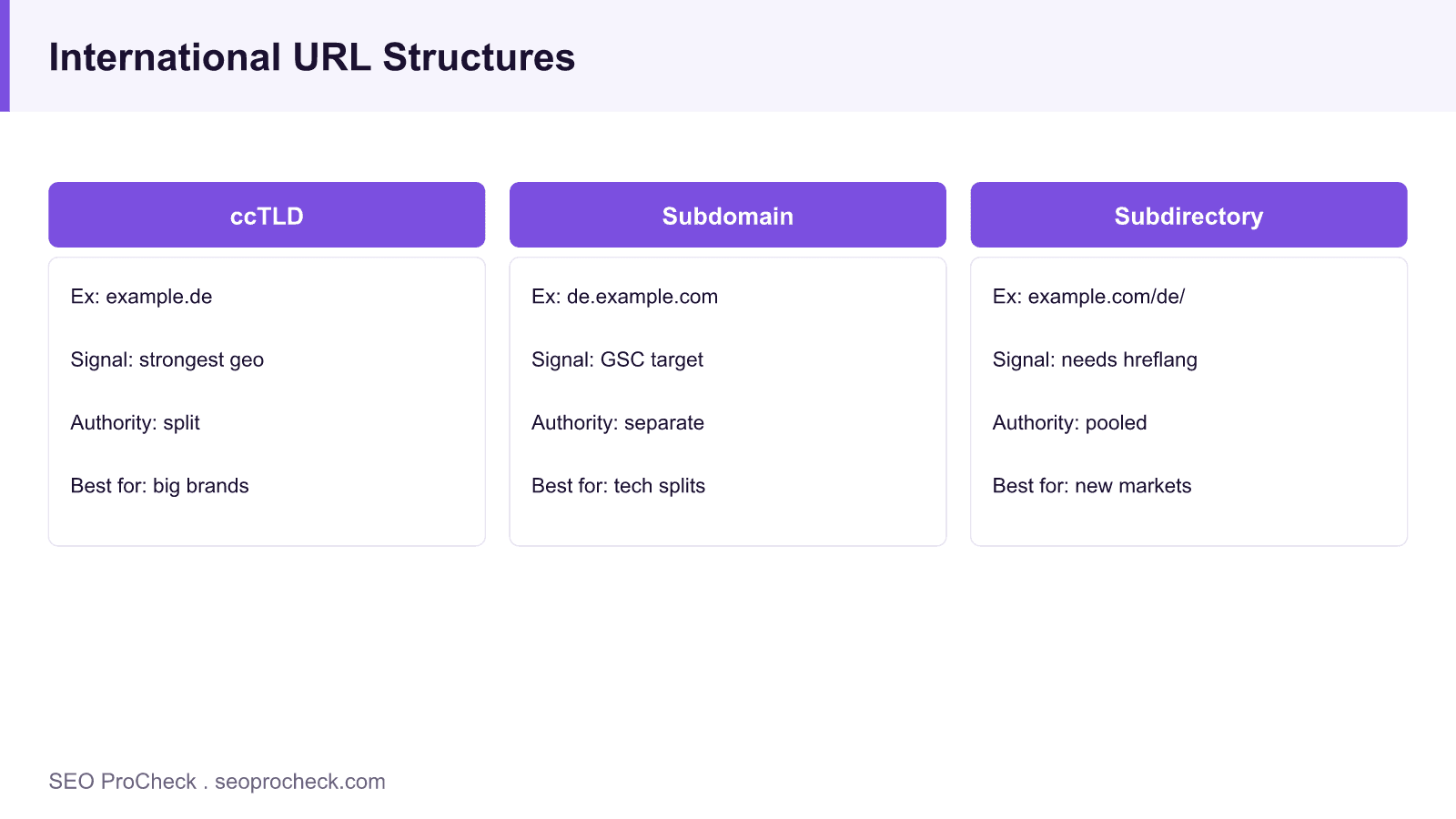
The three structures trade the same variables in different proportions: strength of the geographic signal, how authority accumulates, and how much management overhead you accept. The table below sets them side by side so you can match a structure to your resources and goals before committing, because migrating between them later is costly.
Structure Comparison at a Glance
| Structure | Example | Geo signal | Authority | Best fit |
|---|---|---|---|---|
| ccTLD | example.de | Strongest, built in | Split across domains | Established brands, legal needs |
| Subdomain | de.example.com | Set via hreflang and localization | Somewhat separate | Distinct technical setups |
| Subdirectory | example.com/de/ | Needs hreflang and localization | Consolidated under one domain | Most new markets |
Hreflang Ties It Together
Whatever structure you pick, hreflang is what tells Google which language or regional version to serve. Implement it for every set of equivalent pages, keep the annotations bidirectional so each version points back at the others, and include a self referencing tag on each URL. A subdirectory setup for German and French might use annotations such as hreflang="de" pointing at example.com/de/ and hreflang="fr" pointing at example.com/fr/, plus an x-default for users who match no listed locale. Consistent language, currency, and on-page localization reinforce the same signal.
Common Mistakes to Watch
Three errors undo good structure decisions. The first is splitting authority across ccTLDs without the resources to build links for each domain, which leaves every market weak. The second is inconsistent or non-reciprocal hreflang, which causes Google to ignore the annotations and serve the wrong version. The third is thin or machine-translated localization that duplicates content without adapting it, which fails both users and search engines. Decide the structure deliberately, then keep technical implementation consistent across every regional version.
Related reading: keep each regional version focused with deciding when to consolidate versus create new content, match every market page to searcher intent with user intent mapping for content planning, and find more infrastructure guides in the technical SEO library.
Choosing the right site structure for international SEO affects authority consolidation, management complexity, and regional targeting effectiveness. The three main approaches, ccTLDs, subdomains, and subdirectories, each have distinct advantages and challenges.
Country Code Top-Level Domains (ccTLDs)
ccTLDs like .de, .fr, and .co.uk provide the strongest geographic targeting signal. Google inherently associates these domains with their respective countries. Users in those countries may trust local ccTLDs more, potentially improving click-through rates.
However, ccTLDs split authority across separate domains. Each ccTLD builds its own backlink profile and domain authority independently. This makes ccTLDs most appropriate for established brands willing to invest in building authority for each market separately, or for markets requiring strong local presence.
Subdomains for International Targeting
Subdomains like de.example.com or fr.example.com keep all sites under one gTLD while allowing geographic targeting through hreflang and locale-specific content, since Google no longer supports the Search Console country setting. Subdomains provide some separation for technical management while maintaining brand URL consistency.
Authority sharing between subdomains and root domains is debated. Google claims understanding of relationships, but practical evidence suggests subdomain authority remains somewhat separate. Subdomains work well for significantly different content or technical requirements between markets.
Subdirectories for International Content
Subdirectories like example.com/de/ or example.com/fr/ consolidate all authority under one domain. Links to any country version benefit the entire domain. This approach maximizes authority building efficiency and simplifies site management.
Subdirectories require proper hreflang implementation since the URL structure doesn't inherently signal geography. Geographic targeting comes from hreflang and localized content, since Google no longer supports the Search Console country setting. For most sites, subdirectories provide the best balance of authority consolidation and targeting capability.
Decision Framework
Choose ccTLDs when local market presence is paramount, you have resources to build authority for each domain independently, and legal or regulatory requirements favor local domains. Major brands often use ccTLDs for primary markets while using subdirectories for secondary markets.
Choose subdirectories when consolidating authority matters, you're entering new international markets with limited resources, or content across markets is similar. Most sites benefit from subdirectory approaches unless specific requirements indicate otherwise.
Implementation Considerations
Regardless of structure, implement hreflang properly to signal language and regional targeting. Ensure consistent technical implementation across all regional versions. Consider content management workflow when choosing structures; centralized management often favors subdirectories while distributed teams may prefer separate properties.
Frequently Asked Questions
Which international structure is best for most sites?
Subdirectories such as example.com/de/ suit most sites because they consolidate authority under one domain and simplify management. Reserve ccTLDs for markets where a strong local presence or legal requirement justifies building authority separately.
Do subdomains share authority with the main domain?
The sharing is debated. Google says it understands the relationship, but practical evidence suggests subdomain authority stays somewhat separate. Subdomains fit cases where markets need distinct technical setups more than maximum authority consolidation.
Do I still need hreflang with ccTLDs?
Yes, whenever you have equivalent pages in different languages or regions. Hreflang tells Google which version to serve to which audience and prevents duplicate content issues, regardless of whether you use ccTLDs, subdomains, or subdirectories.
How do I set geographic targeting for a subdirectory?
Because a subdirectory URL does not signal a country on its own, set targeting through hreflang annotations and keep localized content, currency, and language consistent. Legacy country targeting controls have been retired, so hreflang and clear localization now carry that signal.
Can I mix structures across markets?
Yes. Many large brands run ccTLDs for their most important markets while using subdirectories for secondary ones. The trade-off is added complexity, so mix structures only when specific markets genuinely justify separate domains.
Take this with you
The assistant links open with a question about this page already written. Nothing is sent until you press enter.
Claude Vincent is a technical SEO consultant focused on crawlability, rendering, and AI-search visibility. He writes the field guides and case studies at SEO ProCheck, with a bias toward the durable, unglamorous work that decides whether search engines and AI answer engines can actually read and cite a site.
About SEO ProCheck
Technical SEO consulting and GEO strategy with 20 years of enterprise experience. Case studies, resources, and tools for search and AI visibility.
Work With Me
Technical SEO audits, GEO strategy, site migrations, and international SEO. Hourly consulting for teams who need hands-on support, not just reports.
Subscribe to our newsletter!








Recent Posts
- Most Top Sites Never Say Who They Are in Structured Data October 14, 2026
- Homepage Titles Are Mostly Too Short, Not Too Long October 8, 2026
- Who Actually Serves an llms.txt? 184 Top Sites Measured September 29, 2026