

When to Consolidate vs Create New Content
- August 11, 2021
- Content Architecture, Content SEO

AI Summary
Consolidate when several pages compete for the same intent and dilute each other, and create new when a query carries a distinct intent that no existing page satisfies. The deciding principle is one dominant search intent per URL, confirmed in your own Search Console data before you redirect anything.
- The core test is whether the query has a distinct intent no current page serves.
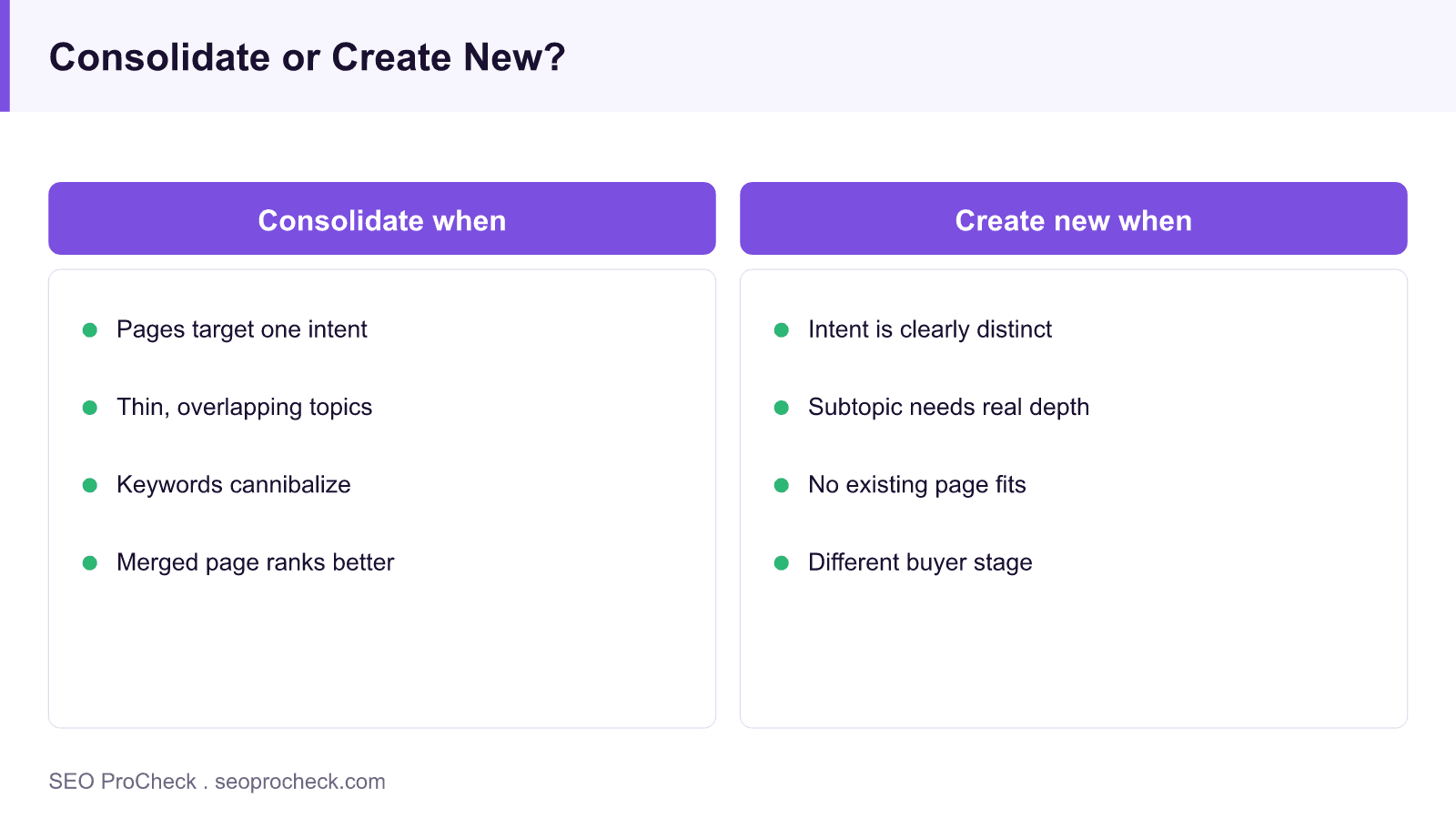
- Consolidate cannibalizing or thin overlapping pages into one stronger URL.
- Create new only when intent is distinct and you have real unique depth.
- Merge safely with a single 301 to the strongest URL and updated internal links.
The Core Test: One Intent per URL
Every consolidate or create decision comes back to a single principle: each URL should own one dominant search intent. When two pages chase the same intent, they split link equity, confuse Google about which to rank, and often leave both stuck below where a single strong page would sit. When a query carries an intent that none of your pages serves, no amount of editing existing content will fill the gap and a new page is warranted.
Decision Guide
| Scenario | Decision | Action |
|---|---|---|
| Two URLs swap for one query | Consolidate | Merge into the stronger URL, 301 the other |
| Several thin pages on one subtopic | Consolidate | Combine into one in-depth page |
| Query has distinct intent, no page fits | Create new | Build a dedicated page for that intent |
| Subtopic deep enough to stand alone | Create new | Publish and link from the parent page |
| Pages serve different intents | Keep separate | Differentiate and interlink |
Signals You Should Consolidate
Look for cannibalization in Search Console: filter by a query, add the page dimension, and watch for two or more URLs trading positions for the same term. Add to that any cluster of thin, overlapping pages that each cover a slice of one subtopic, and any group whose combined traffic is declining while a single authoritative page on the topic would likely rank better. These are the classic consolidation cases where merging concentrates authority.
Signals You Should Create New
Create a new page when the query intent is clearly distinct from anything you publish, when you have enough unique, non-repetitive depth to sustain a standalone page, and when no existing page is a natural home. A genuinely new subtopic deserves its own URL so it can build focused relevance, rather than being wedged into a loosely related article where it dilutes the host.
How to Consolidate Safely
When the data says merge, do it carefully. Choose the URL with the strongest backlinks and rankings as the survivor. Move the unique, valuable content from the other pages into it and keep the better of the competing titles. Apply a single 301 redirect from each retired URL to the survivor so authority transfers. Update internal links across the site to point at the survivor, then resubmit it through URL Inspection in Search Console so the change is recrawled quickly. Watch the merged page for thirty to ninety days to confirm the combined authority lifts it.
Related reading: strengthen the survivor with optimizing existing content for better rankings, define the intent of each cluster first with user intent mapping for content planning, and find more planning guides in the keyword research library.
Understanding Content Pruning
Content Pruning represents a critical component of modern SEO strategy. As search engines continue to evolve and user expectations shift, understanding the nuances of content pruning becomes essential for maintaining and improving organic visibility. This guide covers the key concepts, implementation approaches, and strategic considerations that SEO practitioners need to master.
Key Considerations for When to Consolidate vs Create New Content
When approaching content pruning, several factors require careful attention. Technical implementation must align with broader SEO objectives while maintaining site performance and user experience. The balance between optimization and over-optimization requires ongoing monitoring and adjustment based on performance data and algorithm changes. Industry benchmarks and competitor analysis provide context for evaluating your own implementation.
Implementation Best Practices
Successful implementation begins with thorough auditing of current state and clear goal definition. Document baseline metrics before making changes to enable accurate impact measurement. Prioritize changes based on potential impact and implementation effort, focusing on high-impact items first. Test changes in staging environments when possible, and monitor closely after deployment to production. Maintain documentation of changes for future reference and troubleshooting.
Common Mistakes to Avoid
Several patterns consistently cause problems in content pruning implementations. Rushing implementation without proper planning leads to errors that can be costly to fix. Ignoring the interplay between different SEO factors creates conflicts that undermine results. Failing to monitor and iterate based on performance data means missing optimization opportunities. Over-optimization signals can trigger algorithmic penalties that take months to recover from.
Measuring Success
Effective measurement requires defining appropriate KPIs aligned with business objectives. Track both leading indicators (rankings, impressions, technical metrics) and lagging indicators (traffic, conversions, revenue) to build a complete picture. Establish reasonable timeframes for evaluation, as SEO changes often take weeks or months to fully manifest in results. Compare performance against historical baselines and competitor benchmarks to contextualize results.
Strategic Recommendations
Approach content pruning as an ongoing program rather than a one-time project. Build processes for regular auditing, monitoring, and optimization. Stay current with industry developments and algorithm changes that may affect your strategy. Invest in education for team members to build internal capabilities. Consider how content pruning fits within your broader digital marketing and business strategy for maximum impact.
Frequently Asked Questions
What is the core test for consolidating versus creating?
Ask whether the query has a distinct intent that no current page satisfies. If yes, create a new page. If several existing pages already chase the same intent and dilute each other, consolidate them into one stronger page.
How do I know my pages are cannibalizing each other?
In Search Console, filter by a query and watch the page column. If two or more URLs keep swapping positions for the same query, or neither ranks as well as you would expect, they are competing and are candidates to merge.
How do I consolidate pages without losing rankings?
Pick the strongest URL as the survivor, merge the unique value from the others into it, then 301 redirect the retired URLs to the survivor. Update internal links to point at the survivor and resubmit it in Search Console.
When is a new page clearly the right call?
Create new when the query has genuinely distinct intent, when you have enough unique depth to justify a standalone page, and when no existing page is a natural home for the topic. Forcing a new subtopic into an unrelated page serves neither well.
Does consolidating always help?
Not always. Consolidate only when pages overlap in intent and dilute each other. Merging pages that serve different intents can weaken both, so confirm the overlap in the data before you redirect anything.
Claude Vincent is a technical SEO consultant focused on crawlability, rendering, and AI-search visibility. He writes the field guides and case studies at SEO ProCheck, with a bias toward the durable, unglamorous work that decides whether search engines and AI answer engines can actually read and cite a site.
About SEO ProCheck
Technical SEO consulting and GEO strategy with 20 years of enterprise experience. Case studies, resources, and tools for search and AI visibility.
Work With Me
Technical SEO audits, GEO strategy, site migrations, and international SEO. Hourly consulting for teams who need hands-on support, not just reports.
Subscribe to our newsletter!







Recent Posts
- Can AI Crawlers Actually Read Your Site? I Measured 400 of the Biggest September 5, 2026
- The Pre-Publish Quality Gate for AI-Assisted Content August 6, 2026
- AGENTS.md vs llms.txt vs llms-full.txt: Which Agent File Does What July 18, 2026