

AI Summary
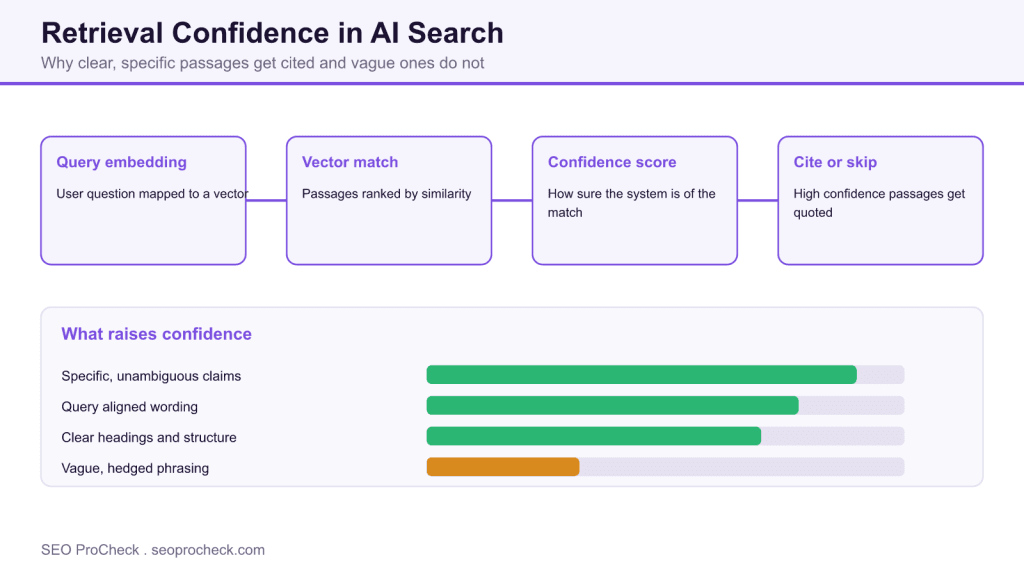
A retrieval confidence score is how sure an AI system is that a passage answers the query it retrieved it for, and higher confidence means a higher chance of citation. You raise it by writing specific, unambiguous, well structured passages whose wording aligns with how people actually ask.
- AI answer engines embed a query, match passages by similarity, and score how confident the match is.
- Specific, self contained sentences retrieve with higher confidence than vague or hedged ones.
- Matching real query language and using clear headings both improve confidence.
- Element code TE-006. Test it by checking whether AI systems retrieve and cite your content.
Quick Reference
Element Code: TE-006
Issue: Content may not be retrieved with high confidence by AI systems
Impact: Lower likelihood of citation in AI responses
Fix: Improve content clarity and specificity for retrieval
Detection: AI response testing
What Is This Issue?
AI systems have confidence scores for retrieved content. Higher confidence means more likely citation. Clear, specific content retrieves with higher confidence.
Why This Matters for Your Website
Confident retrieval leads to confident citation. Ambiguous content retrieves with lower confidence.
How to Fix This Issue
- Be specific: Clear, unambiguous statements
- Match queries: Content language aligns with searches
- Structure well: Clear organization aids retrieval
Tools for Detection
- AI testing: Test retrieval quality
AI Search and GEO Considerations
Retrieval confidence directly influences AI citation likelihood.
TL;DR (The Simple Version)
Make your content clear and specific so AI systems can retrieve it with high confidence for relevant queries.
What a retrieval confidence score is
Generative answer engines such as Google AI Overviews, ChatGPT, Perplexity and Gemini do not read your whole site when they answer. They embed the user query as a vector, search a large index of passages for the closest matches, and assign each candidate a similarity or confidence value. The system then decides which passages are trustworthy enough to include and cite. Retrieval confidence is that internal certainty: it reflects how well a passage matches the query and how clearly it stands on its own. Low confidence passages get filtered out, so they never make it into the answer, no matter how good the surrounding page is.
Why some passages retrieve with more confidence
Confidence rises when a passage is unambiguous and self contained. A sentence like the recommended image alt text length is 125 characters or fewer carries its own subject and answer, so a model can lift it without the surrounding context. A hedged sentence like it depends on various factors and best practices vary offers nothing concrete to match against, so it scores low. Confidence also rises when the passage uses the same vocabulary the searcher uses, because vector similarity is higher when the wording overlaps in meaning. Clear headings and short paragraphs help too, since they give the retriever clean units to score.
How to raise retrieval confidence on your pages
- Lead with the answer. Put the direct, specific statement first, then explain. Front loaded answers are the easiest to retrieve and quote.
- Write self contained sentences. Each key sentence should make sense on its own, without relying on the previous paragraph for its subject.
- Use concrete numbers and names. Specifics like exact figures, versions and entity names give the retriever something firm to match.
- Mirror real queries. Phrase headings and answers the way people search, so the semantic distance between query and passage is small.
- Structure clearly. One idea per paragraph and descriptive headings give the system clean passages to score.
How to test it
There is no public API that prints a confidence number, so you test behaviorally. Ask the answer engines the questions your page should win, and see whether they retrieve and cite your passage or a competitor. If a rival with weaker overall content is cited, look at how their winning passage is written: it is usually more specific and self contained than yours. Rewrite your passage to be equally direct and retest. This links closely to the way you present data and structure, so review our notes on data visualization markup and structured data, and browse the full technical and GEO checks.
Passage traits and retrieval confidence
| Passage trait | Effect on confidence | Fix |
|---|---|---|
| Specific, concrete claim | Raises confidence | Keep and lead with it |
| Query aligned wording | Raises confidence | Mirror how people ask |
| Vague, hedged phrasing | Lowers confidence | Replace with a definite statement |
| Context dependent sentence | Lowers confidence | Make each key sentence self contained |
| Buried answer | Lowers confidence | Move the answer to the top |
Frequently asked questions
What is a retrieval confidence score?
It is how sure an AI system is that a retrieved passage answers the query it was pulled for. Higher confidence means the passage is more likely to be included and cited in the generated answer.
How do I improve retrieval confidence?
Write specific, self contained sentences, lead with the direct answer, use concrete numbers and entity names, and mirror the wording people use when they search. Clear headings and one idea per paragraph also help.
Can I see the actual confidence number?
No. There is no public metric that exposes it. You assess it behaviorally by testing whether answer engines retrieve and cite your passages for the queries you target.
Why does specificity matter so much?
Vector matching rewards passages that clearly and unambiguously answer a query. A definite statement with concrete detail matches a question far more strongly than a vague or hedged sentence.
Is this the same as ranking in Google?
It is related but distinct. Classic ranking orders whole documents, while retrieval confidence scores individual passages for use in an AI answer. A page can rank yet still lose the citation to a more quotable passage.
Does structure affect retrieval?
Yes. Clear headings and short, focused paragraphs give the retriever clean passages to score, which raises the odds that your best sentence is pulled with high confidence.
Claude Vincent is a technical SEO consultant focused on crawlability, rendering, and AI-search visibility. He writes the field guides and case studies at SEO ProCheck, with a bias toward the durable, unglamorous work that decides whether search engines and AI answer engines can actually read and cite a site.
About SEO ProCheck
Technical SEO consulting and GEO strategy with 20 years of enterprise experience. Case studies, resources, and tools for search and AI visibility.
Work With Me
Technical SEO audits, GEO strategy, site migrations, and international SEO. Hourly consulting for teams who need hands-on support, not just reports.
Subscribe to our newsletter!



Recent Posts
- Can AI Crawlers Actually Read Your Site? I Measured 400 of the Biggest September 5, 2026
- The Pre-Publish Quality Gate for AI-Assisted Content August 6, 2026
- AGENTS.md vs llms.txt vs llms-full.txt: Which Agent File Does What July 18, 2026