


AI Summary
Optimizing existing content means refreshing pages that have decayed or stalled just below page one, which is usually a higher return than writing new articles. The URL already carries history, backlinks, and index coverage, so targeted updates compound faster than a fresh start.
- Find candidates in Search Console: falling clicks with steady impressions signal decay.
- Keep the same URL so you retain backlinks, history, and rankings.
- Add depth, current facts, better titles, internal links, and schema rather than gutting what ranks.
- Measure the specific target queries over thirty to ninety days, not just sitewide traffic.
How to Spot Pages Worth Refreshing
Start in the Google Search Console Search Results report. Set a date comparison of the last three months against the same period a year earlier and sort by clicks lost. The most valuable refresh candidates share one pattern: impressions hold steady or rise while clicks fall, which means the page still surfaces but is losing the click to fresher or deeper competitors. A second candidate group is pages with strong impressions and a weak click rate, where the fix is the title and meta rather than the body. A third group is anything ranking in positions five to fifteen, close enough that added depth can push it onto page one.
Diagnose Before You Edit
| Symptom in Search Console | Likely diagnosis | Primary fix |
|---|---|---|
| Clicks falling, impressions steady | Content decay, fresher competitors | Update facts, add depth, refresh date |
| High impressions, low click rate | Weak title or meta description | Rewrite title and meta to match intent |
| Stuck in positions 5 to 15 | Striking distance, thin coverage | Expand sections, add internal links |
| Ranking for the wrong query | Intent mismatch | Refocus the page on one dominant intent |
The Refresh Workflow
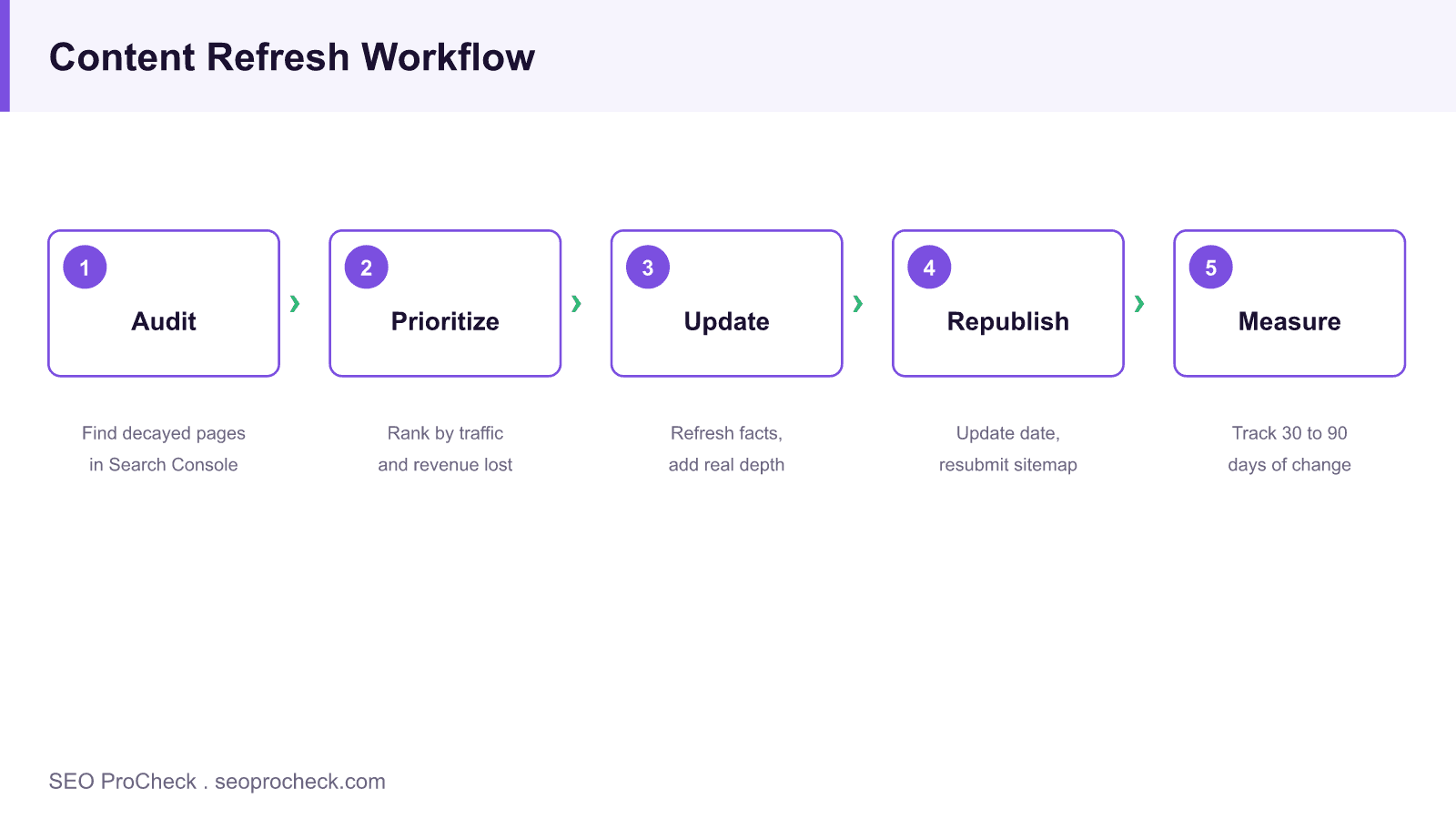
Work the same repeatable loop every time. Audit the candidate against the live SERP and the top ranking pages. Prioritize by traffic and revenue at stake, not by how easy the edit feels. Update the page by correcting outdated facts, adding worked examples, refreshing statistics with a visible source and date, improving internal links, rewriting the title and meta to match intent, and adding a FAQ, a table, or schema where they are missing. Republish without touching the URL, update the modified date, and resubmit the page through URL Inspection in Search Console so Google recrawls it promptly. Then measure over thirty to ninety days against the specific queries you set out to win.
Preserve What Already Works
The point of a refresh is to build on existing equity, so protect it. Keep the URL, keep the sections that already rank, and add rather than gut. If analytics show a heading or block is pulling featured snippets or steady clicks, leave its core intact and enrich around it. Only remove a page when you are deliberately merging it into a stronger one, and in that case use a single 301 redirect to the surviving URL so the authority follows.
Related reading: decide the merge question with our guide to when to consolidate versus create new content, align each page to a single searcher goal with user intent mapping for content planning, and browse more tactics in the keyword research library.
Understanding Content Updates
Content Updates represents a critical component of modern SEO strategy. As search engines continue to evolve and user expectations shift, understanding the nuances of content updates becomes essential for maintaining and improving organic visibility. This guide covers the key concepts, implementation approaches, and strategic considerations that SEO practitioners need to master.
Key Considerations for Optimizing Existing Content for Better Rankings
When approaching content updates, several factors require careful attention. Technical implementation must align with broader SEO objectives while maintaining site performance and user experience. The balance between optimization and over-optimization requires ongoing monitoring and adjustment based on performance data and algorithm changes. Industry benchmarks and competitor analysis provide context for evaluating your own implementation.
Implementation Best Practices
Successful implementation begins with thorough auditing of current state and clear goal definition. Document baseline metrics before making changes to enable accurate impact measurement. Prioritize changes based on potential impact and implementation effort, focusing on high-impact items first. Test changes in staging environments when possible, and monitor closely after deployment to production. Maintain documentation of changes for future reference and troubleshooting.
Common Mistakes to Avoid
Several patterns consistently cause problems in content updates implementations. Rushing implementation without proper planning leads to errors that can be costly to fix. Ignoring the interplay between different SEO factors creates conflicts that undermine results. Failing to monitor and iterate based on performance data means missing optimization opportunities. Over-optimization signals can trigger algorithmic penalties that take months to recover from.
Measuring Success
Effective measurement requires defining appropriate KPIs aligned with business objectives. Track both leading indicators (rankings, impressions, technical metrics) and lagging indicators (traffic, conversions, revenue) to build a complete picture. Establish reasonable timeframes for evaluation, as SEO changes often take weeks or months to fully manifest in results. Compare performance against historical baselines and competitor benchmarks to contextualize results.
Strategic Recommendations
Approach content updates as an ongoing program rather than a one-time project. Build processes for regular auditing, monitoring, and optimization. Stay current with industry developments and algorithm changes that may affect your strategy. Invest in education for team members to build internal capabilities. Consider how content updates fits within your broader digital marketing and business strategy for maximum impact.
Frequently Asked Questions
How do I find pages that are worth refreshing?
In Google Search Console, compare the last three months against the prior year in the Search Results report. Pages with falling clicks but steady impressions are decaying, pages with high impressions and low click rate need a better title, and pages sitting in positions five to fifteen are within striking distance of page one.
Should I change the URL when I refresh a page?
No. Keep the existing URL so you retain its history, backlinks, and index coverage. Changing the slug forces a redirect and resets some of the signals that make refreshing worthwhile in the first place.
How long before a refresh shows results?
Allow thirty to ninety days. Google has to recrawl, reprocess, and re-rank the page, and click behavior takes time to accumulate. Track the specific queries you targeted rather than sitewide traffic so you can see the real effect.
What should I actually change during a refresh?
Update outdated facts and dates, add depth where the page is thin, improve the title and meta description, strengthen internal links, refresh or add images, and add a FAQ or schema if they are missing. Add value rather than rewriting sections that already rank.
Is refreshing better than writing new content?
For pages that already rank on page two or that have decayed from a stronger position, refreshing is usually the higher return because the URL already has authority. New content is the right call only when no existing page fits the intent.
Take this with you
The assistant links open with a question about this page already written. Nothing is sent until you press enter.
Claude Vincent is a technical SEO consultant focused on crawlability, rendering, and AI-search visibility. He writes the field guides and case studies at SEO ProCheck, with a bias toward the durable, unglamorous work that decides whether search engines and AI answer engines can actually read and cite a site.
About SEO ProCheck
Technical SEO consulting and GEO strategy with 20 years of enterprise experience. Case studies, resources, and tools for search and AI visibility.
Work With Me
Technical SEO audits, GEO strategy, site migrations, and international SEO. Hourly consulting for teams who need hands-on support, not just reports.
Subscribe to our newsletter!








Recent Posts
- Most Top Sites Never Say Who They Are in Structured Data October 14, 2026
- Homepage Titles Are Mostly Too Short, Not Too Long October 8, 2026
- Who Actually Serves an llms.txt? 184 Top Sites Measured September 29, 2026