

Content Localization Best Practices
- February 9, 2024
- International SEO and Hreflang, Technical SEO
AI Summary
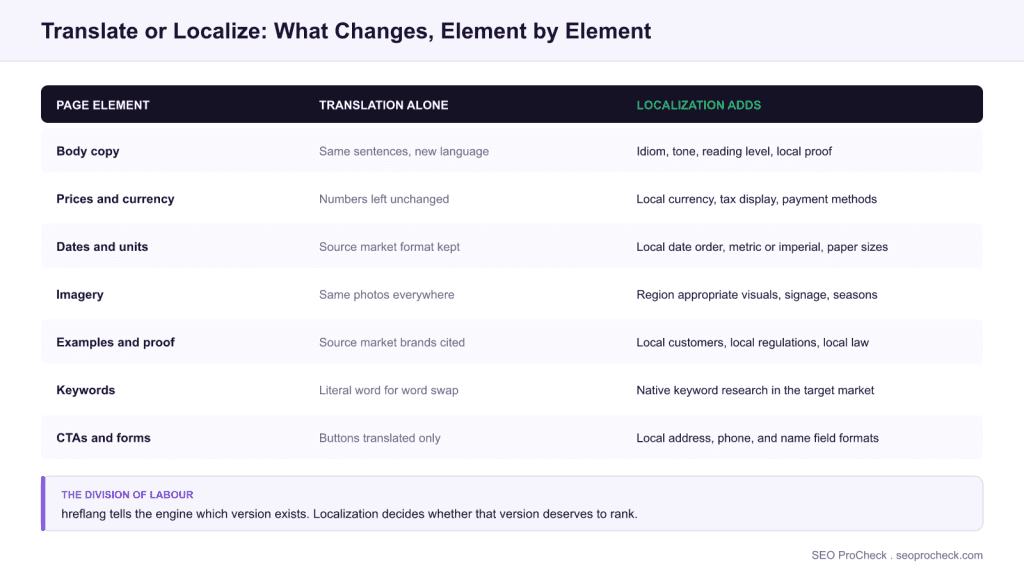
Translation converts the words on a page. Localization adapts everything a buyer in that market actually judges you on: the keywords they really search, currency, units, date formats, examples, imagery, and legal content. Hreflang then routes each variant to the right audience, but it is only the routing layer, and it cannot rescue a page that was merely translated.
- Run keyword research per market, never port a keyword list across languages.
- Give every language and region combination its own indexable URL, never swap content on one URL by IP or cookie.
- Hreflang must be reciprocal, self-referencing, and complete, or Google can ignore the whole set.
- A region code never stands alone:
ukis Ukrainian, the United Kingdom isen-GB.

Content localization is the process of adapting a page's language, terminology, currency, units, examples, and cultural references for a specific market, as opposed to translation, which only converts the words. In SEO terms, localization is what makes a French page rank in France instead of merely existing in French, and it pairs with hreflang annotations that tell Google which language/region variant to serve to which user.
Understanding International SEO
International SEO represents a critical component of modern SEO strategy. As search engines continue to evolve and user expectations shift, understanding the nuances of international seo becomes essential for maintaining and improving organic visibility. This guide covers the key concepts, implementation approaches, and strategic considerations that SEO practitioners need to master.
The core distinction to internalize: Google does not rank "a site" internationally: it ranks individual URL variants for individual query-locale combinations. A page that performs well for "sneakers" in the US will not automatically perform for "baskets" in France or "trainers" in the UK, even with perfect hreflang. Localization is the content-side work; hreflang is only the routing layer on top of it.
Localize vs. Translate: The Element-by-Element Breakdown
Most localization failures come from treating every page element the same way. Some elements need true market adaptation, some need straight translation, and some must never be translated at all. Use this as a working checklist:
| Element | Localize or translate? | Common mistake |
|---|---|---|
| Title tag & meta description | Localize: rewrite around the keyword natives actually search, not a translation of the English keyword | Machine-translating "car insurance" to "assurance automobile" when French users search "assurance auto" |
| Body copy | Localize: adapt examples, idioms, tone, and formality (tu/vous, du/Sie) | Word-for-word translation that reads unmistakably machine-generated, which drags down quality signals market-wide |
| Currency, units, dates | Localize: EUR/GBP, metric/imperial, DD/MM vs MM/DD | Showing USD prices on a UK page; this also kills conversion, not just rankings |
| URL slugs | Translate (once, then freeze): localized slugs help CTR and relevance | Changing slugs after launch without 301s, orphaning the indexed URLs |
| Structured data | Localize: priceCurrency, inLanguage, localized name/description values | Leaving English JSON-LD on translated pages, creating a language mismatch signal |
| Brand names, product names | Do not translate | Over-eager translators localizing trademarked product names, breaking brand-query rankings |
| Internal anchor text | Localize: anchors should use the target-language keyword | Translated body copy with English navigation and anchors, splitting relevance signals |
| Customer reviews / UGC | Keep in original language or clearly machine-translate with disclosure | Silently auto-translating reviews, which can read as fabricated content |
| Legal, support, checkout pages | Localize fully: local regulations (GDPR notices, imprint/Impressum in DACH) differ by market | Assuming legal boilerplate transfers across markets |
Key Considerations for Content Localization Best Practices
When approaching international seo, several factors require careful attention. Technical implementation must align with broader SEO objectives while maintaining site performance and user experience. The balance between optimization and over-optimization requires ongoing monitoring and adjustment based on performance data and algorithm changes. Industry benchmarks and competitor analysis provide context for evaluating your own implementation.
In practice, three considerations dominate every localization project I've run:
1. Keyword research per market, not per language. Never port a keyword list across markets. "Mobile phone" (UK), "cell phone" (US), and "Handy" (Germany, an English word natives use that no translator would produce) illustrate why. Run fresh keyword research in each target market with a local-database tool before a single word is written, and map one primary local keyword per page.
2. One language-region combination per URL. Every localized variant needs its own indexable URL: subdirectory (/fr-fr/), subdomain, or ccTLD. Do not serve different languages on the same URL via cookies, Accept-Language headers, or IP detection: Googlebot crawls predominantly from US IPs without cookies and will only ever see one version. If you use automatic redirects for users, always leave the localized URLs directly reachable and cross-linked.
3. Hreflang must be reciprocal and complete. Each variant lists all its siblings plus itself (self-referencing), using ISO 639-1 language codes and optional ISO 3166-1 Alpha-2 region codes: fr, fr-FR, fr-CA. Add an x-default entry pointing at your language-selector or fallback page. Example head implementation:
<link rel="alternate" hreflang="en-us" href="https://example.com/us/page/" />
<link rel="alternate" hreflang="en-gb" href="https://example.com/uk/page/" />
<link rel="alternate" hreflang="fr-fr" href="https://example.com/fr/page/" />
<link rel="alternate" hreflang="x-default" href="https://example.com/" />
If tag A points to B but B doesn't point back, Google ignores the pair: "return tag" errors are the single most common hreflang failure a crawl will surface, closely followed by a missing self-reference on one variant in the set. For large sites, moving hreflang into the XML sitemap (via xhtml:link entries) keeps page weight down and makes bulk auditing easier.
Hreflang code errors and the correct form
Most rejected hreflang sets fail on the code itself rather than the logic. The value is language first, optionally followed by region, and a region can never travel alone. These are the forms a crawl surfaces most often:
| Written as | Why it fails | Correct form |
|---|---|---|
hreflang="uk" | Intended as the United Kingdom, but uk is the language code for Ukrainian, and a region cannot stand alone anyway | hreflang="en-GB" |
hreflang="en-UK" | The ISO 3166-1 Alpha-2 region code for the United Kingdom is GB, not UK | hreflang="en-GB" |
hreflang="jp" | JP is the country code for Japan; the ISO 639-1 language code for Japanese is ja | hreflang="ja" or hreflang="ja-JP" |
hreflang="en-EU" | EU is not a country in ISO 3166-1, so the annotation is discarded | Name the actual markets, or use x-default for the fallback |
| A page with no entry for itself | The set is incomplete, so the whole cluster can be ignored | Every URL in the set lists all siblings and itself |
| Annotations pointing at redirecting or canonicalised URLs | The target is not the indexable version, so the pairing breaks | Point every entry at the final, self-canonical, indexable URL |
No x-default anywhere in the set | Not an error, but users outside every declared market get no defined fallback | Add one x-default entry for the selector or global page |
Case is not significant to Google, so en-gb and en-GB are read the same way. Writing the region in caps is simply a convention that makes the language and region halves easier to scan in a review.
Implementation Best Practices
Successful implementation begins with thorough auditing of current state and clear goal definition. Document baseline metrics before making changes to enable accurate impact measurement. Prioritize changes based on potential impact and implementation effort, focusing on high-impact items first. Test changes in staging environments when possible, and monitor closely after deployment to production. Maintain documentation of changes for future reference and troubleshooting.
A workable rollout sequence for a new market: (1) market-specific keyword research and search-demand validation; (2) localize the revenue-critical templates first (product/category/service pages), not the blog; (3) implement hreflang across the cluster in one release, never piecemeal; (4) localize internal linking and navigation so the new section is crawlable from the localized homepage; (5) submit a market-specific XML sitemap in Search Console; (6) verify with a crawler (Screaming Frog's Hreflang tab flags missing return links, invalid codes, and non-canonical hreflang targets out of the box). Partial localization, meaning a translated page surrounded by English chrome, English breadcrumbs, and English related-links, consistently underperforms because the page-level language signal is diluted.
Common Mistakes to Avoid
Several patterns consistently cause problems in international seo implementations. Rushing implementation without proper planning leads to errors that can be costly to fix. Ignoring the interplay between different SEO factors creates conflicts that undermine results. Failing to monitor and iterate based on performance data means missing optimization opportunities. Over-optimization signals can trigger algorithmic penalties that take months to recover from.
The specific traps worth naming: using country flags as language switchers (a flag is a country, not a language: Spanish is not "the flag of Spain" to a Mexican user); canonicalizing all variants to the English version, which silently instructs Google to drop the localized pages from the index (each variant should self-canonicalize); publishing raw machine translation at scale, which since the scaled-content policies is a genuine suppression risk rather than just a UX problem; and duplicating en-US content to en-GB/en-AU with nothing changed but the hreflang: same-language variants are legitimate, but they need genuine local differences (currency, spelling, terminology, local proof points) to justify separate URLs.
Measuring Success
Effective measurement requires defining appropriate KPIs aligned with business objectives. Track both leading indicators (rankings, impressions, technical metrics) and lagging indicators (traffic, conversions, revenue) to build a complete picture. Establish reasonable timeframes for evaluation, as SEO changes often take weeks or months to fully manifest in results. Compare performance against historical baselines and competitor benchmarks to contextualize results.
For international work specifically: segment Search Console Performance data by country (Performance → Search results → add a Country filter) and compare each market's impressions and CTR against its localized section rather than looking at site-wide numbers. A telltale failure signature is a market where impressions exist but the wrong-language URL earns them: filter Performance by page URL containing your locale folder and cross-check the countries served. That pattern almost always traces back to broken hreflang reciprocity or canonical conflicts. Wrong-page-served problems can also be spot-checked with a site: query from a VPN exit in the target country.
Strategic Recommendations
Approach international seo as an ongoing program rather than a one-time project. Build processes for regular auditing, monitoring, and optimization. Stay current with industry developments and algorithm changes that may affect your strategy. Invest in education for team members to build internal capabilities. Consider how international seo fits within your broader digital marketing and business strategy for maximum impact.
Sequence markets by evidence, not ambition: expand where Search Console already shows meaningful impressions from a country you haven't localized for, that's latent demand you're currently serving with the wrong page. And budget for maintenance: every new page published in the primary language creates localization debt in every market, so decide up front which templates are always localized, which are localized on demand, and which markets get the primary-language version deliberately.
Frequently Asked Questions
What is the difference between localization and translation in SEO?
Translation converts words from one language to another; localization adapts the whole page, including keywords, currency, units, examples, tone, and legal content, to a specific market. A translated page can be linguistically perfect and still fail to rank because it targets keywords nobody in that market searches. For SEO, localization always starts with fresh keyword research in the target market.
Do I need hreflang if my content is only in one language?
If you have one language and one URL per page, no. Hreflang is needed when multiple variants of the same content exist for different languages or regions, including same-language regional variants like en-US vs en-GB, where it prevents the variants from competing against each other and gets the right currency and spelling in front of the right user.
Should I use subdirectories, subdomains, or ccTLDs for international sites?
Subdirectories (example.com/fr/) are the default recommendation for most sites: they consolidate authority on one domain and are cheapest to maintain. ccTLDs (example.fr) send the strongest country signal but split your link equity and multiply infrastructure cost: they make sense mainly for large brands with genuinely separate country operations. Subdomains sit awkwardly in between and are rarely the best choice for a new build.
Is machine translation bad for SEO?
Unedited machine translation published at scale is risky: Google's spam policies treat mass-produced, unreviewed automated content as scaled content abuse regardless of the tool used. Machine translation with genuine human review and market adaptation is fine and is how most localization teams actually work. The dividing line is editorial review and added local value, not the technology.
Why is Google showing the wrong language version of my page?
The usual causes, in order of frequency: hreflang tags missing the reciprocal return link, so the annotation is ignored; variants canonicalized to a single version; the localized page being much weaker than the original (thin translation, no internal links pointing to it); or region codes used without the required language code (hreflang="uk" is invalid, it must be en-GB, and note the UK's region code is GB).
How long does it take for localized pages to rank?
Expect a longer ramp than domestic content: the new section starts with no internal history, and in competitive markets you're up against native-language incumbents with local links. Indexation typically resolves within weeks if the technical setup is clean; competitive rankings are a months-scale outcome and depend heavily on earning links and engagement from within the target market, not just publishing the pages.
Take this with you
The assistant links open with a question about this page already written. Nothing is sent until you press enter.
Claude Vincent is a technical SEO consultant focused on crawlability, rendering, and AI-search visibility. He writes the field guides and case studies at SEO ProCheck, with a bias toward the durable, unglamorous work that decides whether search engines and AI answer engines can actually read and cite a site.
About SEO ProCheck
Technical SEO consulting and GEO strategy with 20 years of enterprise experience. Case studies, resources, and tools for search and AI visibility.
Work With Me
Technical SEO audits, GEO strategy, site migrations, and international SEO. Hourly consulting for teams who need hands-on support, not just reports.
Subscribe to our newsletter!








Recent Posts
- Most Top Sites Never Say Who They Are in Structured Data October 14, 2026
- Homepage Titles Are Mostly Too Short, Not Too Long October 8, 2026
- Who Actually Serves an llms.txt? 184 Top Sites Measured September 29, 2026