

AI Summary
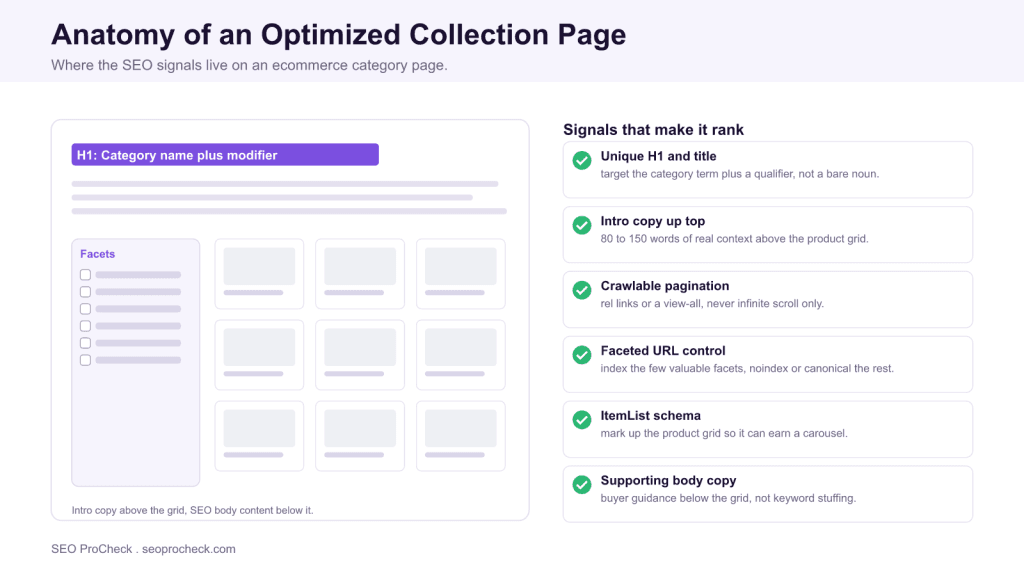
Collection pages, the category and listing pages that group products, are usually an ecommerce store's highest value ranking asset because they target broad, high intent buying queries. To rank they need a unique H1 and intro copy, disciplined control over faceted navigation URLs, crawlable pagination, and ItemList schema on the product grid.
- Write a unique H1, title, and 80 to 150 word intro that target the category term plus a qualifier.
- Control faceted navigation: index the few valuable filter combinations, canonical or noindex the rest.
- Keep pagination crawlable with real links or a view-all page, never infinite scroll alone.
- Add ItemList schema to the product grid so the page can earn carousel treatment.
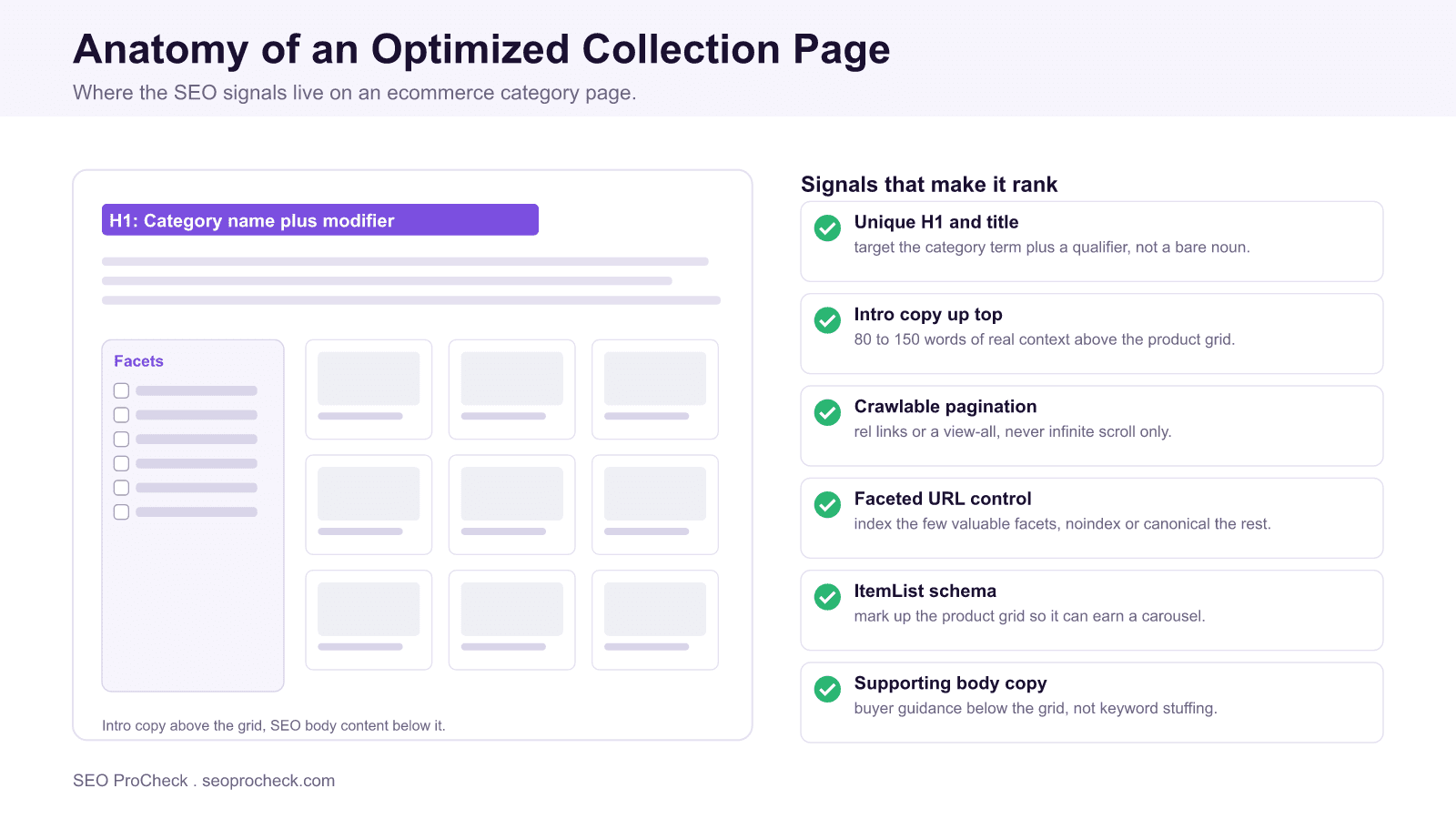
On most ecommerce sites, collection pages quietly outrank everything else. A single category page such as /mens-running-shoes/ targets a broad, high intent query that individual product pages can never win, and it funnels visitors to dozens of products at once. Yet these pages are also where the biggest technical SEO problems hide: thin or duplicated copy, faceted navigation spawning thousands of near identical URLs, and pagination that search engines cannot crawl. This guide walks through the on-page content, URL control, and structured data that turn a bare product grid into a page that ranks for the money keyword.
Collection pages sit one level above products in your site architecture, so their optimization compounds with strong product pages beneath them. If the individual items are not yet solid, pair this with our guide to ecommerce product page SEO before pushing category rankings.
Give the page content, not just a product grid
A collection page that is only a grid of thumbnails is thin by definition: its unique text is a handful of product names that also appear on hundreds of other stores. Search engines have nothing to rank. Fix this with three distinct pieces of copy:
- A unique H1: use the category name plus a qualifier that matches search intent, for example "Men's Trail Running Shoes" rather than a bare "Shoes." It should not duplicate the site name or another category.
- Intro copy above the grid: 80 to 150 words that frame the category, mention the key attributes buyers filter on, and set expectations. Keep it above the fold enough that it is clearly part of the page, not buried.
- Supporting body copy below the grid: a longer section with buyer guidance, common questions, and links to subcategories. This is where you earn long tail relevance without cluttering the shopping experience.
Write for the shopper first. Blocks of repeated keywords stuffed below the fold are a classic pattern that Google's core ranking systems demote and its keyword stuffing spam policy targets. The goal is genuinely useful context that also happens to establish topical relevance.
Control faceted navigation before it controls you
Faceted navigation, the filters for size, color, brand, and price, is the number one source of crawl and index bloat on ecommerce sites. Every filter combination can generate a unique URL with query parameters, and left unmanaged a single category can spawn thousands of thin, near duplicate pages that waste crawl budget and split ranking signals. The discipline is to decide, per facet, which combinations deserve to be indexed and which do not.
| Facet type | Example | Has real search demand? | Recommended handling |
|---|---|---|---|
| Attribute with demand | color, brand, gender | Yes, people search "blue running shoes" | Index a clean static URL, add unique intro copy |
| Sort and view order | sort=price, view=grid | No, same products reordered | Canonical to the unsorted URL |
| Multi-select combinations | size=9 and color=red and price band | Rarely | noindex, follow, or block the parameter in robots.txt |
| Session or tracking params | sessionid, utm | No | Canonical to the clean URL, strip where possible |
The pages you choose to index should have static, readable URLs and their own intro copy, so they read as deliberate landing pages rather than filter accidents. Everything else should point back to the canonical category through rel="canonical" or be kept out of the index with a noindex, follow robots directive. Never rely on robots.txt alone to fix an index bloat problem, because a URL blocked in robots.txt can still be indexed without its content.
Keep pagination crawlable
Large categories span multiple pages, and how you paginate decides whether Google can reach every product. Infinite scroll that loads products only through JavaScript on user action can leave deeper products undiscovered. Provide a crawlable path: real anchor links to numbered pages, or a view-all page that lists the full set when the count is reasonable. Each paginated URL should self canonicalize (page 2 canonicals to page 2, not page 1) so its products stay discoverable. Link the paginated series so a crawler can walk from page to page without executing scripts.
Mark up the grid with ItemList schema
Structured data helps search engines understand that the page is a curated list of products. ItemList schema describes the grid as an ordered set of items, which can qualify the page for carousel and list style rich results. Implement it so the item order matches the visible order on the page, and combine it with per product Product markup where appropriate. Our ItemList schema for product collections guide covers the exact properties and the common validation errors to avoid.
Wire the page into your architecture
A collection page needs internal prominence to rank. Link to it from the main navigation or a hub page, cross-link related categories, and link down to the products and subcategories it contains. This creates the topic cluster structure that concentrates authority on the pages you most want to rank. For the linking model, see our guide to an internal linking strategy for topic clusters. Where categories are seasonal, apply the lifecycle in our seasonal product page strategy so the collection compounds equity year over year.
Key takeaways
Collection pages win the highest value ecommerce queries when they carry real content and clean URLs. Give each one a unique H1, intro copy, and supporting body text; decide deliberately which faceted URLs to index and canonical or noindex the rest; keep pagination crawlable; add ItemList schema; and wire the page firmly into your internal link graph. Get these right and your category pages become the durable engine of ecommerce organic traffic.
A collection page, also called a category or listing page, groups related products under one URL, such as a "men's running shoes" page. It targets broad, high intent buying queries that individual product pages cannot rank for, which makes it one of the most valuable pages on an ecommerce site.
Yes. A bare product grid is thin because its only unique text is product names shared with other stores. Add a unique H1, an 80 to 150 word intro above the grid, and supporting body copy below it so search engines have real content to rank and shoppers get useful context.
Decide per facet. Index a clean static URL for filters with real search demand, such as color or brand, and give it unique copy. Canonical sort and view parameters back to the base URL, and noindex or block rare multi-select combinations so filters do not spawn thousands of thin pages.
It can be, if products load only through JavaScript on user action, because crawlers may never reach deeper items. Provide a crawlable alternative: real links to numbered pages or a view-all page, with each paginated URL canonicalizing to itself so every product stays discoverable.
Use ItemList schema to describe the product grid as an ordered list, which can qualify the page for carousel style rich results. Keep the marked up order matching the visible order, and add per product Product markup where it fits.
No. An empty category returns a poor experience and should be noindexed or return a helpful message until it has stock. When the category is a permanent part of the catalog but temporarily empty, keep the URL live and add related products or a notice rather than deleting it.
Are your category pages leaking crawl budget?
Faceted navigation and broken pagination can bury your most valuable pages under thousands of thin URLs. An audit maps the bloat and the fix.
Take this with you
The assistant links open with a question about this page already written. Nothing is sent until you press enter.
Claude Vincent is a technical SEO consultant focused on crawlability, rendering, and AI-search visibility. He writes the field guides and case studies at SEO ProCheck, with a bias toward the durable, unglamorous work that decides whether search engines and AI answer engines can actually read and cite a site.
About SEO ProCheck
Technical SEO consulting and GEO strategy with 20 years of enterprise experience. Case studies, resources, and tools for search and AI visibility.
Work With Me
Technical SEO audits, GEO strategy, site migrations, and international SEO. Hourly consulting for teams who need hands-on support, not just reports.
Subscribe to our newsletter!








Recent Posts
- Most Top Sites Never Say Who They Are in Structured Data October 14, 2026
- Homepage Titles Are Mostly Too Short, Not Too Long October 8, 2026
- Who Actually Serves an llms.txt? 184 Top Sites Measured September 29, 2026