

AI Summary
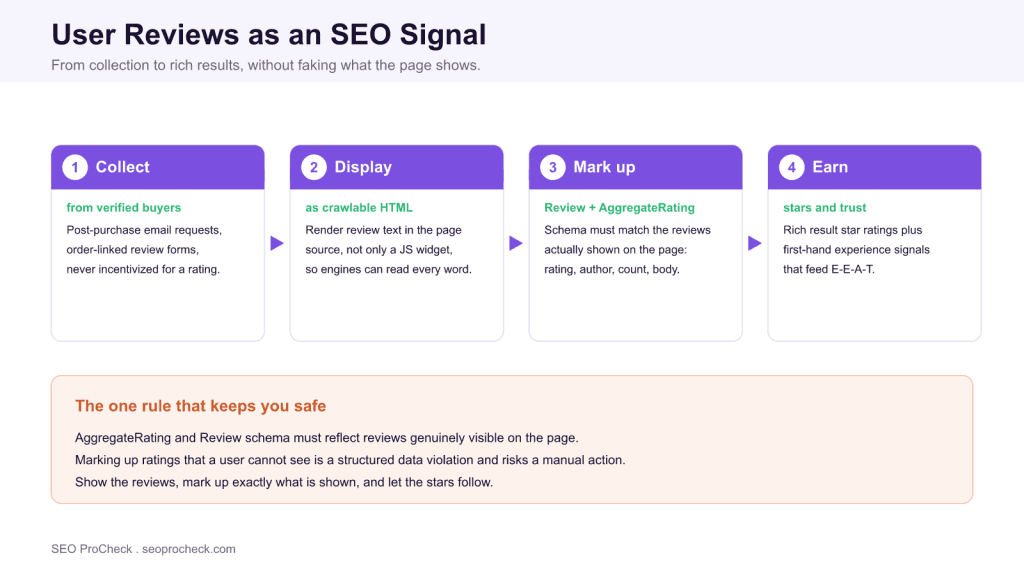
User reviews strengthen SEO in two ways: they add unique, keyword rich content and first-hand experience that feeds E-E-A-T, and when marked up correctly they can earn star rich results that lift click-through rate. The one rule that keeps you safe is that Review and AggregateRating schema must reflect reviews genuinely visible on the page, never invented ratings.
- Collect reviews from verified buyers and never pay for or incentivize a specific rating.
- Render review text as crawlable HTML, not only inside a JavaScript widget.
- Mark up Review and AggregateRating so the values match the visible reviews exactly.
- Reviews supply the Experience in E-E-A-T that thin, author-only pages lack.
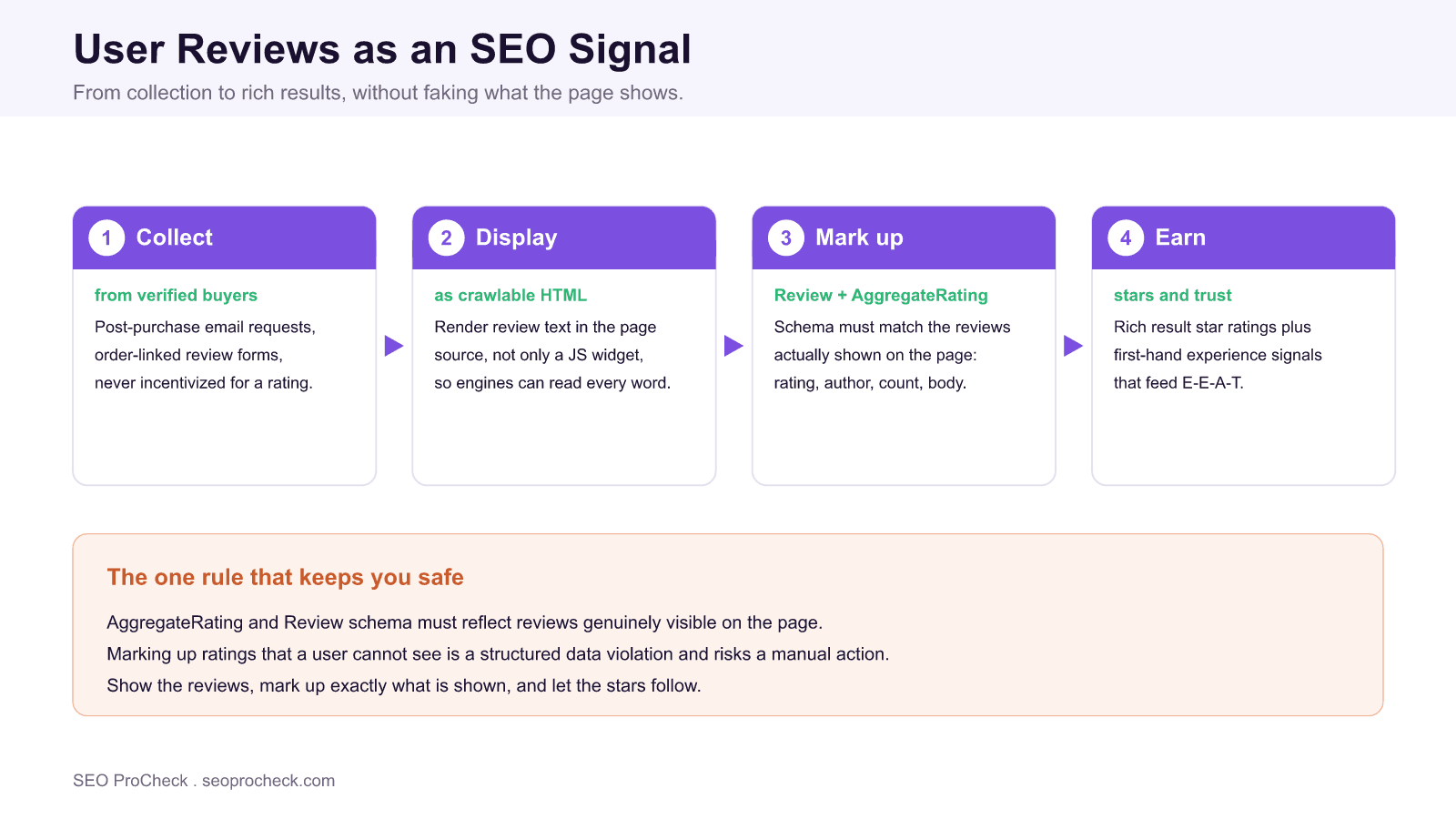
User reviews are one of the few SEO assets that grow on their own once the system is in place. Every genuine review adds unique content that no competitor can copy, supplies the first-hand experience signal that Google's E-E-A-T framework rewards, and can put star ratings directly in the search result. But reviews also carry the sharpest structured data risk on the web: mark up ratings that a user cannot see and you invite a manual action. This guide covers how to collect, display, and mark up reviews so they help rankings without crossing that line.
Reviews are the practical face of the Experience pillar in Google's E-E-A-T framework. Where an author byline signals expertise, a body of real customer reviews signals that actual people have used the product or service, which is exactly the trust signal that thin pages lack.
Why user reviews move rankings
Reviews help SEO through several distinct mechanisms, and it helps to keep them separate because each is optimized differently:
- Unique content at scale: customers describe products in the words other customers search with, adding long tail relevance and freshness that you never have to write.
- Experience and trust signals: a page backed by dozens of authentic reviews demonstrates real world use, a core input to E-E-A-T, especially on your money or your life topics.
- Rich result eligibility: valid Review and AggregateRating markup can surface star ratings in search, which typically lifts click-through rate.
- Behavioral signals: reviews reduce purchase hesitation, improving engagement and conversion, which supports the page indirectly.
Collect reviews the right way
The most reliable source is a post-purchase request to verified buyers. Trigger a review email a sensible interval after delivery, link directly to an order-connected review form, and make submission frictionless. Two hard rules protect you: never pay for a specific star rating, and never gate a discount behind a positive review. You may ask all customers for honest feedback; you may not buy the outcome. Fake or incentivized reviews violate the guidelines of Google and most platforms, and they poison the trust signal you are trying to build.
Display reviews as crawlable HTML
A review only helps SEO if a search engine can read it. Many review platforms inject content through JavaScript into an embedded widget, which can leave the actual review text invisible in the raw HTML. Confirm that the review body, author, rating, and date render in the page source, for example through server side rendering or a hybrid approach, so the content is indexable. View the rendered and raw HTML to check. If your provider only offers a client-side widget, look for an option that also writes the reviews into the page markup.
Mark up Review and AggregateRating correctly
Structured data is what turns visible reviews into star rich results. The two relevant types are Review, for an individual review, and AggregateRating, for the summary score across all reviews. The properties below are the ones that matter, and every one must correspond to something a visitor can actually see on the page.
| Schema property | What it holds | Must be visible on page? |
|---|---|---|
ratingValue | The star score, for example 4.6 | Yes |
reviewCount / ratingCount | How many reviews the score is based on | Yes |
author | The reviewer's name, a real person or org | Yes |
reviewBody | The written review text | Yes |
itemReviewed | The product, service, or business reviewed | Yes, it is the page subject |
Google's policy is explicit: the ratings you mark up must be available to users on the same page. Do not add AggregateRating for a self-serving review of your own business on its own site, and do not aggregate ratings that live only in your database. For the full property list, valid ranges, and the common validation errors, see our reference on AggregateRating schema.
Respond to reviews and manage reputation
Reviews are a two way signal. Responding to them, especially critical ones, adds more unique content, demonstrates active management, and reinforces trust with both users and search engines. Off site reviews on your Google Business Profile and reputable third party platforms feed the wider reputation signal that Google weighs for E-E-A-T. Treat on site and off site reviews as one system. Our guide to managing online reputation for E-E-A-T covers the off site half in depth, and for smaller sites the E-E-A-T signals for small sites guide shows how reviews can substitute for the authority larger brands buy.
Key takeaways
User reviews are a compounding SEO asset: unique content, experience signals, and star rich results all at once. Collect them honestly from verified buyers, render them as crawlable HTML, and mark them up with Review and AggregateRating values that match exactly what the page shows. The line you never cross is inventing or hiding ratings in schema, because that risks a manual action and destroys the trust reviews are meant to build.
Yes. Reviews add unique, keyword rich content, supply the first-hand experience signal that feeds E-E-A-T, and when marked up correctly can earn star ratings in search that lift click-through rate. They also reduce purchase hesitation, which improves engagement.
Only if the ratings are genuinely shown to users on the same page. Valid Review and AggregateRating markup can earn star rich results, but Google prohibits marking up ratings a visitor cannot see, and self-serving reviews of your own business on your own site are not eligible.
Common causes are review text that only loads through JavaScript and is missing from the crawlable HTML, schema values that do not match the visible reviews, ineligible self-serving markup, or Google simply choosing not to show the enhancement. Confirm the reviews render in the page source and that the markup validates.
Yes. Paying for a specific rating or gating discounts behind positive reviews violates the guidelines of Google and most review platforms, can trigger penalties, and destroys the trust signal reviews are meant to provide. Ask all customers for honest feedback instead.
Reviews are the clearest signal of the Experience pillar in E-E-A-T. They show that real people have used the product or service, which an author byline alone cannot. On your money or your life topics, a body of authentic reviews and active responses is a meaningful trust signal.
Yes. A measured response adds unique content, shows active reputation management, and reassures future customers. Handled well, critical reviews and your replies build more trust than a wall of unbroken five star ratings that can look manufactured.
Are your review stars eligible, or a manual action waiting to happen?
Invisible review widgets and mismatched schema are the two most common ways star ratings fail or backfire. An audit checks both.
Take this with you
The assistant links open with a question about this page already written. Nothing is sent until you press enter.
Claude Vincent is a technical SEO consultant focused on crawlability, rendering, and AI-search visibility. He writes the field guides and case studies at SEO ProCheck, with a bias toward the durable, unglamorous work that decides whether search engines and AI answer engines can actually read and cite a site.
About SEO ProCheck
Technical SEO consulting and GEO strategy with 20 years of enterprise experience. Case studies, resources, and tools for search and AI visibility.
Work With Me
Technical SEO audits, GEO strategy, site migrations, and international SEO. Hourly consulting for teams who need hands-on support, not just reports.
Subscribe to our newsletter!








Recent Posts
- Most Top Sites Never Say Who They Are in Structured Data October 14, 2026
- Homepage Titles Are Mostly Too Short, Not Too Long October 8, 2026
- Who Actually Serves an llms.txt? 184 Top Sites Measured September 29, 2026